
The mysterious charm of aquamarine: From the depths of the oceans to the most precious jewelry collections
This article was written by Demi Karanikolaou for Vimagazino / To Vima Greece - print & digital here
The waters were impossibly clear. As I sat by the sea during a recent summer escape in Greece, I found myself admiring the sort of landscape that has become almost synonymous with the country itself: sunlight dancing across the surface of the water, white buildings in the distance and the kind of effortlessness that always reminds me of the local style - where beauty is often at its most impactful because it is simple. It was then that something else caught my eye. A woman sitting nearby was wearing a striking ring that seemed to shimmer under the sunlight in much the same way as the sea itself. Its large pale-blue gemstone mesmerised me and unable to resist, I complimented her on the piece. "It is my favourite summer jewel," she replied. "I always feel like it puts me in a true summer mood. I feel like it rejuvenates me." It turned out that the gemstone in question was aquamarine. Her comment felt oddly appropriate, as there was indeed something unmistakably summery about the stone. Before long, I found myself falling into one of my usual internet rabbit holes, researching the history of aquamarine, its symbolism and the jewellers who continue to be fascinated by it centuries after it first appeared in mythology. The answer, it turns out, lies largely in the sea itself.
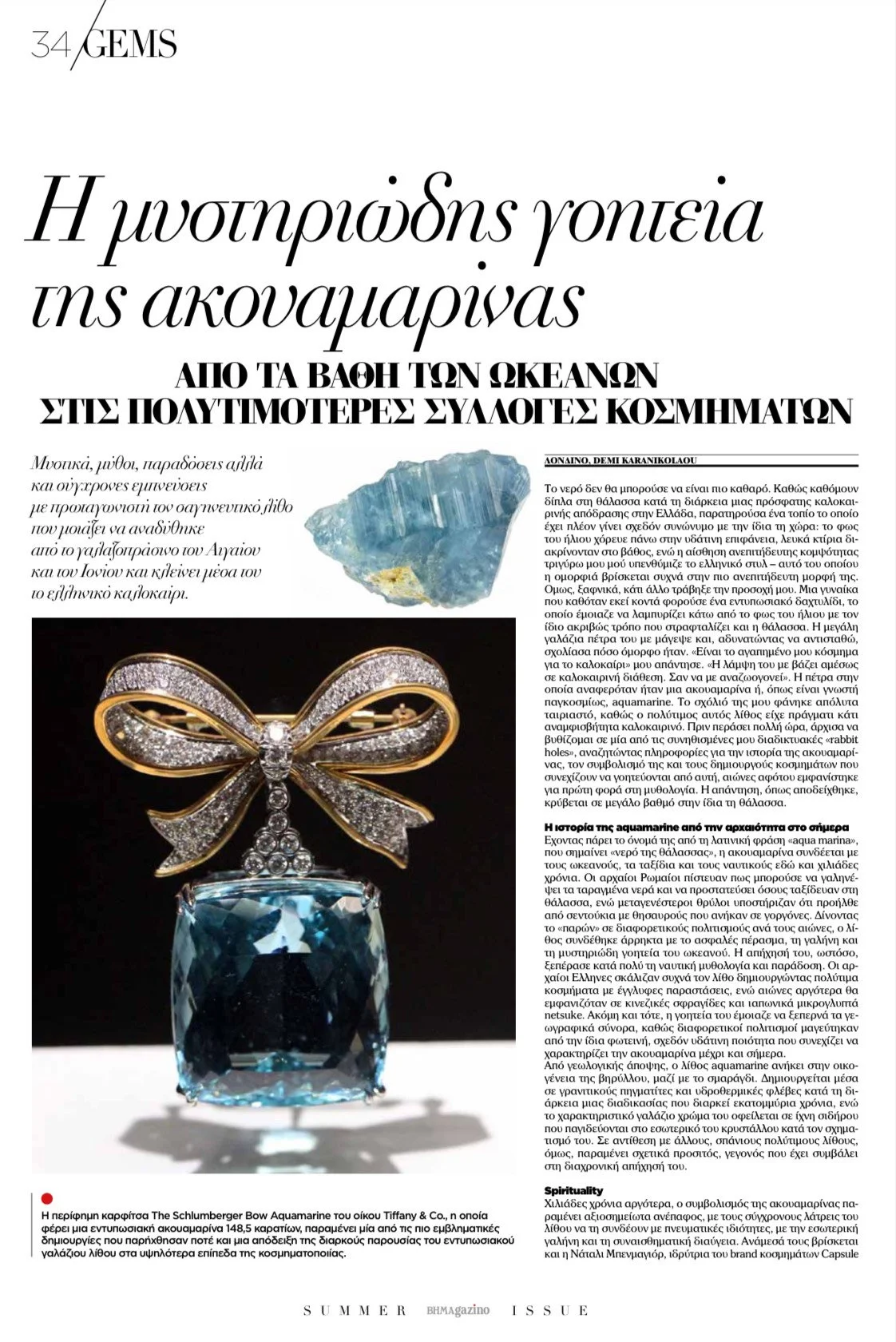
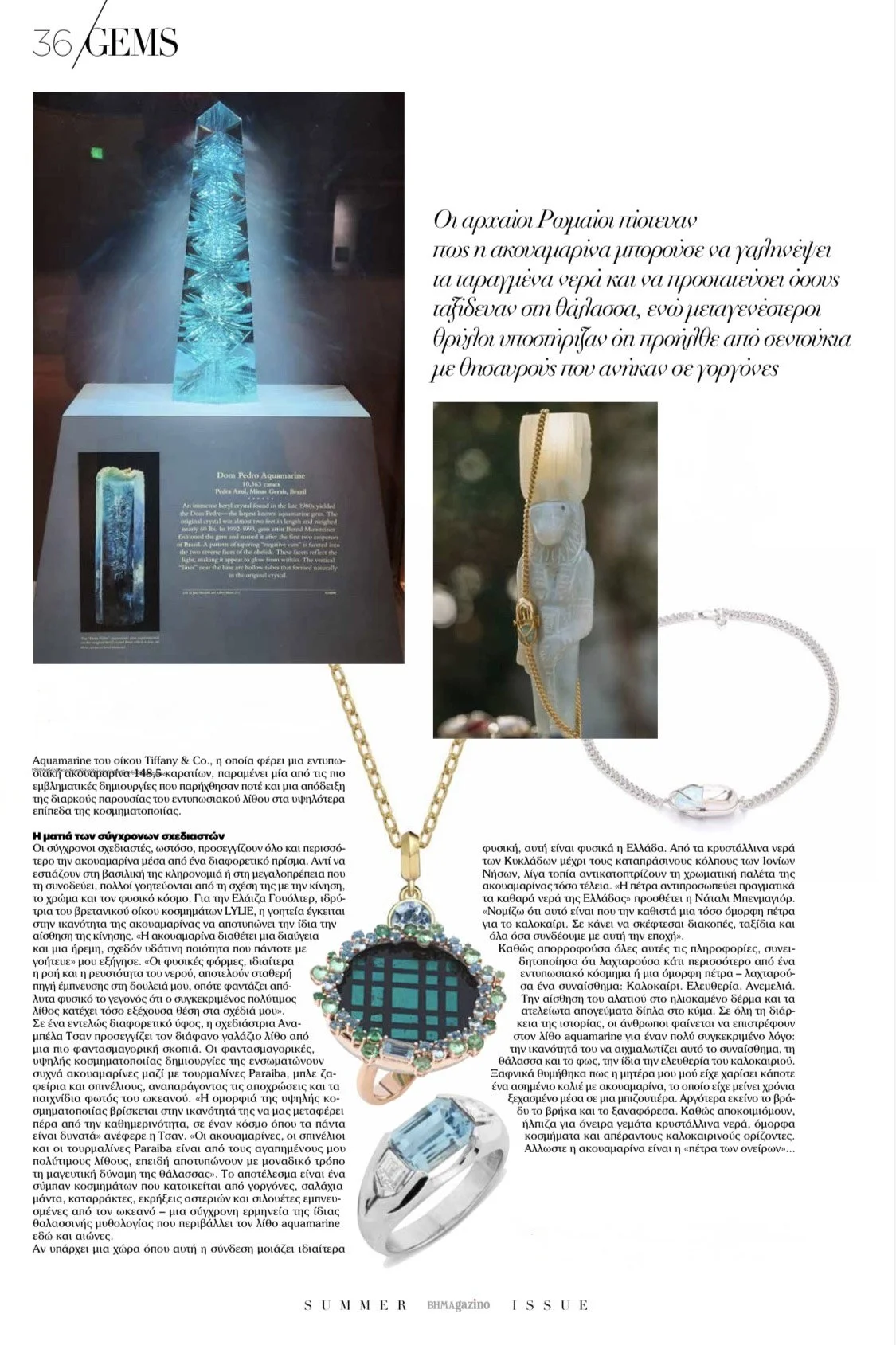
Named after the Latin phrase aqua marina, meaning "water of the sea", aquamarine has been associated with oceans, voyages and sailors for thousands of years. Ancient Romans believed the gemstone could calm rough waters and protect those travelling by sea, while later folklore suggested that aquamarines originated from the treasure chests of mermaids. Across different cultures and centuries, the stone became linked to safe passage, serenity and the mysterious allure of the ocean. Aquamarine's appeal extended far beyond maritime mythology. The Ancient Greeks frequently engraved the stone into intaglios, transforming it into miniature works of art, while centuries later it would appear in Chinese seals and Japanese netsuke carvings. Even then, its appeal seemed to transcend geography, with cultures across the world becoming captivated by the same luminous, water-like quality that continues to define the gemstone today. Geologically speaking, aquamarine belongs to the beryl family, alongside emerald and morganite. Formed over millions of years within granite pegmatites and hydrothermal veins, its characteristic pale blue colour comes from traces of iron trapped within the crystal during its formation, and unlike many rarer gemstones, aquamarine remains relatively accessible, helping sustain its popularity across generations.
Thousands of years later, the symbolism remains remarkably intact, with modern wearers associating aquamarine with spiritual qualities and ideas of calmness, renewal and emotional clarity. Natalie Benmayor, founder of jewellery brand Capsule Eleven, is among them. "Aquamarine is one of the crystals that we use in our Capsule Crystal jewellery range, where you can interchange crystals depending on the energy you seek," she explained to me when we met up on a hot London morning. "I often wear aquamarine because it's great for rejuvenating the spirit." Within crystal traditions, aquamarine is frequently associated with emotional cleansing and inner flow, often described as a stone that encourages clarity, creativity and tranquillity, earning it the nickname "the dream stone" among some practitioners. "Aquamarine reawakens the passion and creativity you have towards all areas of your life," Benmayor continued. "It helps to clear and cleanse the water element within our bodies and allows things to flow through the mind, body and spirit."
Perhaps unsurprisingly, many of these interpretations still return to the same source of inspiration: water. "I really love the colour aquamarine as well. It encourages you to go with the flow," she said. "It has that water energy that really screams summer to me."
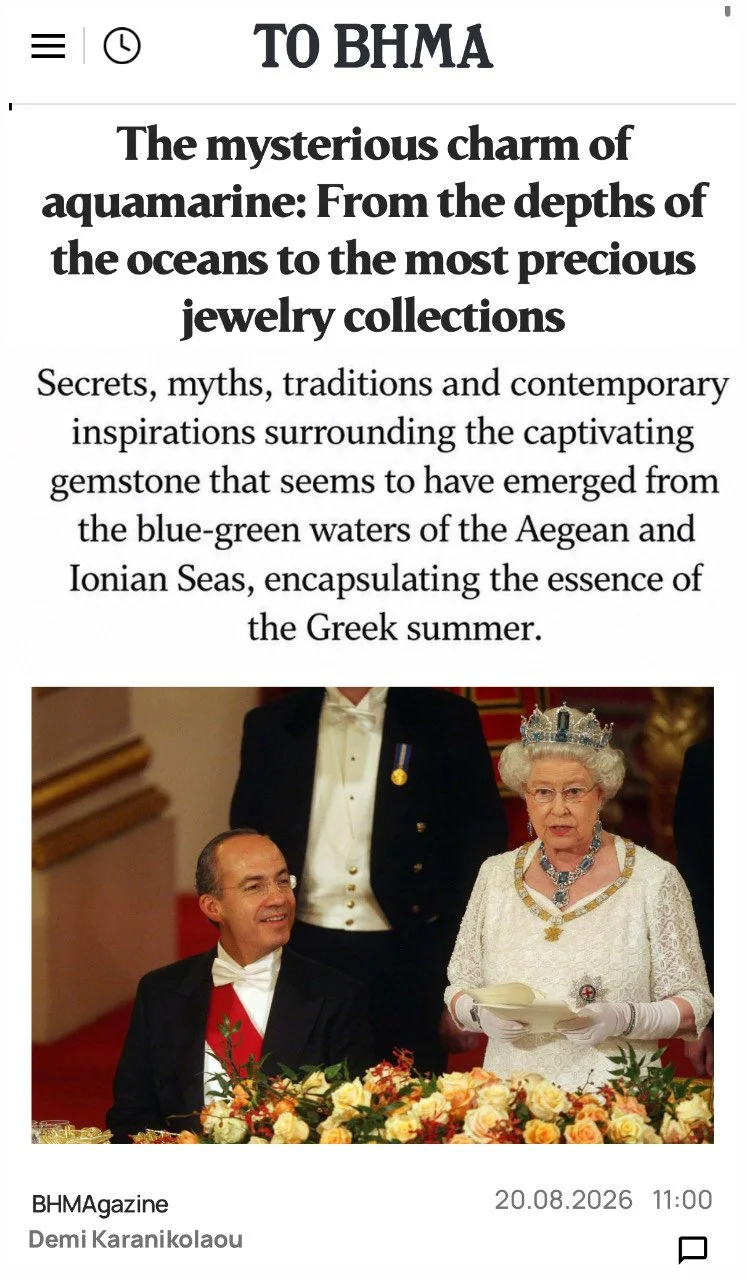
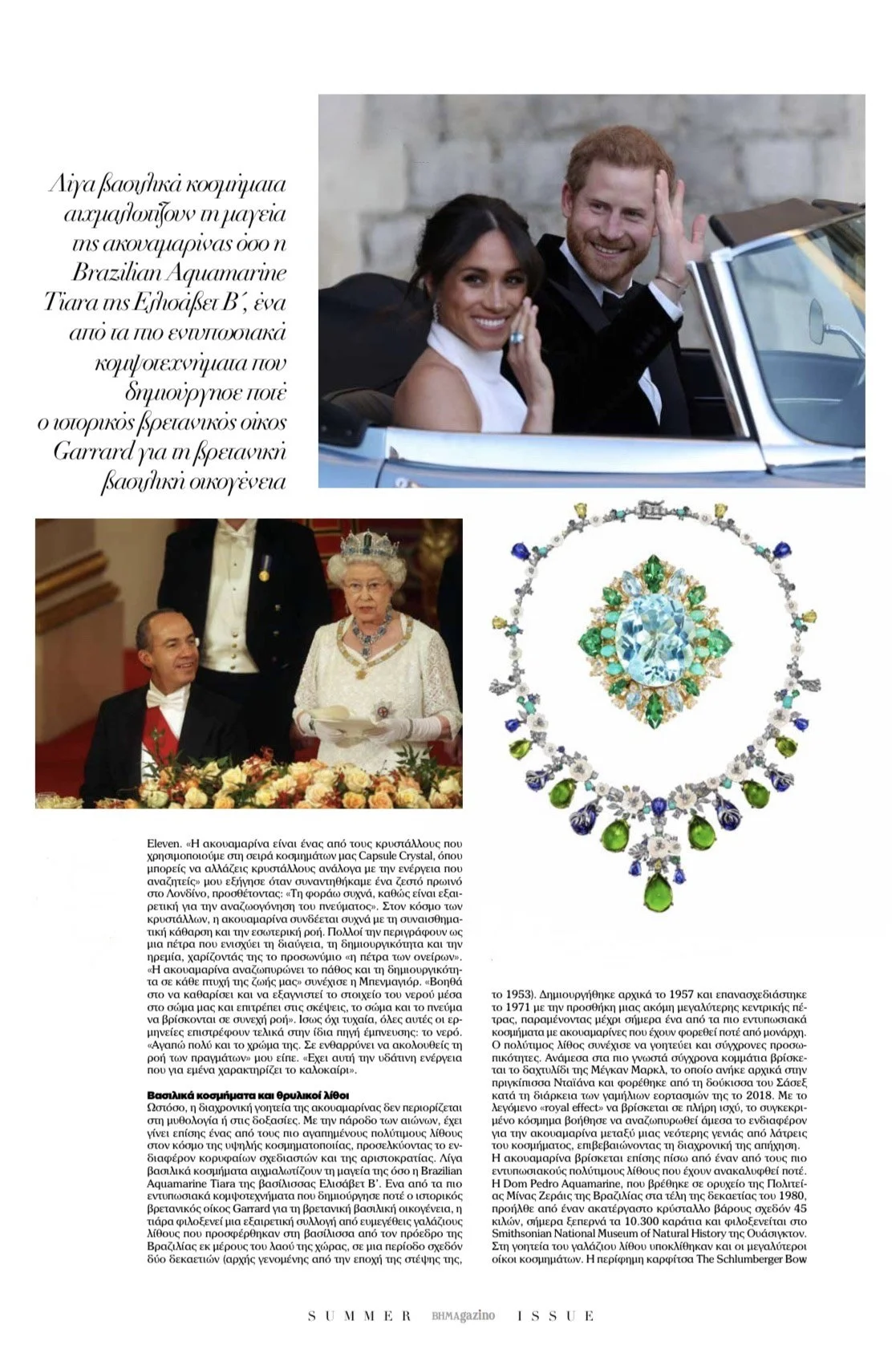
Yet aquamarine's enduring appeal is not confined to mythology or crystal traditions. Over the centuries, it has also become one of the most beloved gemstones within the world of fine jewellery, attracting everyone from master jewellers to royalty. Few royal jewels capture the magic of aquamarine quite like Queen Elizabeth II's Brazilian Aquamarine Tiara. One of the most spectacular pieces ever created by heritage British jeweller Garrard for the British Royal Family, the tiara showcases an extraordinary collection of aquamarines gifted by the President of Brazil on behalf of the Brazilian people over a period of fifteen years. First commissioned in 1957 and later enhanced in 1971 with an even larger central stone, it remains one of the most striking aquamarine jewels ever worn by a monarch. The gemstone has continued to captivate public figures in more recent years. Among its most famous contemporary appearances is Meghan Markle's aquamarine ring, originally owned by Princess Diana and worn by the Duchess of Sussex during her wedding celebrations in 2018. With the "royal effect" in full swing, the piece helped instantly reignite interest in aquamarine among a younger generation of jewellery enthusiasts, reinforcing the stone's timeless appeal. Aquamarine is also responsible for one of the most extraordinary gemstones ever discovered. The Dom Pedro Aquamarine, found in Brazil during the late 1980s, was cut from a crystal weighing nearly 100 pounds and today measures more than 10,000 carats. Named after Brazil's first emperors, it remains the largest faceted aquamarine in the world and is currently housed at the Smithsonian National Museum of Natural History in Washington. Legendary jewellery houses have long recognised the allure of the stone. Tiffany & Co.'s celebrated Schlumberger Bow, featuring a remarkable 148.5-carat aquamarine, remains one of the most iconic aquamarine creations ever produced and serves as a testament to the gemstone's enduring presence within the highest levels of jewellery craftsmanship.
Contemporary designers, however, are increasingly approaching aquamarine through a different lens. Rather than emphasising aristocratic grandeur, many are drawn to the gemstone's connection with movement, colour and the natural world. For Eliza Walter, founder of British jewellery house LYLIE, the attraction lies in aquamarine's ability to capture movement itself. "Aquamarine possesses a clarity and tranquil, water-like quality that I have always been drawn to," she explained to me. "Natural forms, particularly the movement and fluidity of water, are a constant source of inspiration in my work, so it feels only fitting that the gemstone features so prominently within my designs." Elsewhere, designer Anabela Chan approaches aquamarine from a more fantastical perspective. Her dramatic high-jewellery creations frequently incorporate aquamarines alongside Paraiba tourmalines, blue sapphires and spinels to recreate the colours of the ocean. "The beauty of high jewellery is that it is an escape from the ordinary to a realm where anything is possible," Chan explained. "Aquamarines, blue spinels and Paraiba tourmalines are some of my favourite coloured gemstones. They perfectly reflect and mimic the mesmerising magic of the sea." The result is a jewellery universe populated by mermaids, manta rays, waterfalls, starbursts and ocean-inspired silhouettes, a contemporary interpretation of the same maritime mythology that has surrounded aquamarine for centuries.
And if there is one country where that connection feels particularly natural, it is Greece. From the crystalline waters of the Cyclades to the turquoise coves of the Ionian islands, few landscapes mirror the colour palette of aquamarine quite so perfectly. "Aquamarine really represents the clear waters of Greece," Benmayor adds. "I think that's what makes it such a beautiful summer stone. It makes people think of holidays and travel, and that feels like exactly the right mood for this season." Perhaps that is why the gemstone continues to fascinate. As I absorbed everything I had learned, I found myself longing for more than a stone or a piece of jewellery - I was longing for a feeling: Summer. Freedom. Lightness. The sensation of salt on sun-kissed skin and endless afternoons by the water. Throughout history, people have returned to aquamarine for a remarkably similar reason: its ability to encapsulate a feeling. The sea. The light. The freedom of summer itself. Suddenly, I remembered that my mother had once passed down to me a silver aquamarine necklace that had spent years forgotten inside a jewellery box. Later that evening, I found it and quickly fastened it around my neck. As I went to sleep, I could not help but hope for dreams filled with crystal-clear waters, beautiful jewels and distant summer horizons. After all, if aquamarine truly is the dream stone, there are certainly worse places for the mind to wander.