
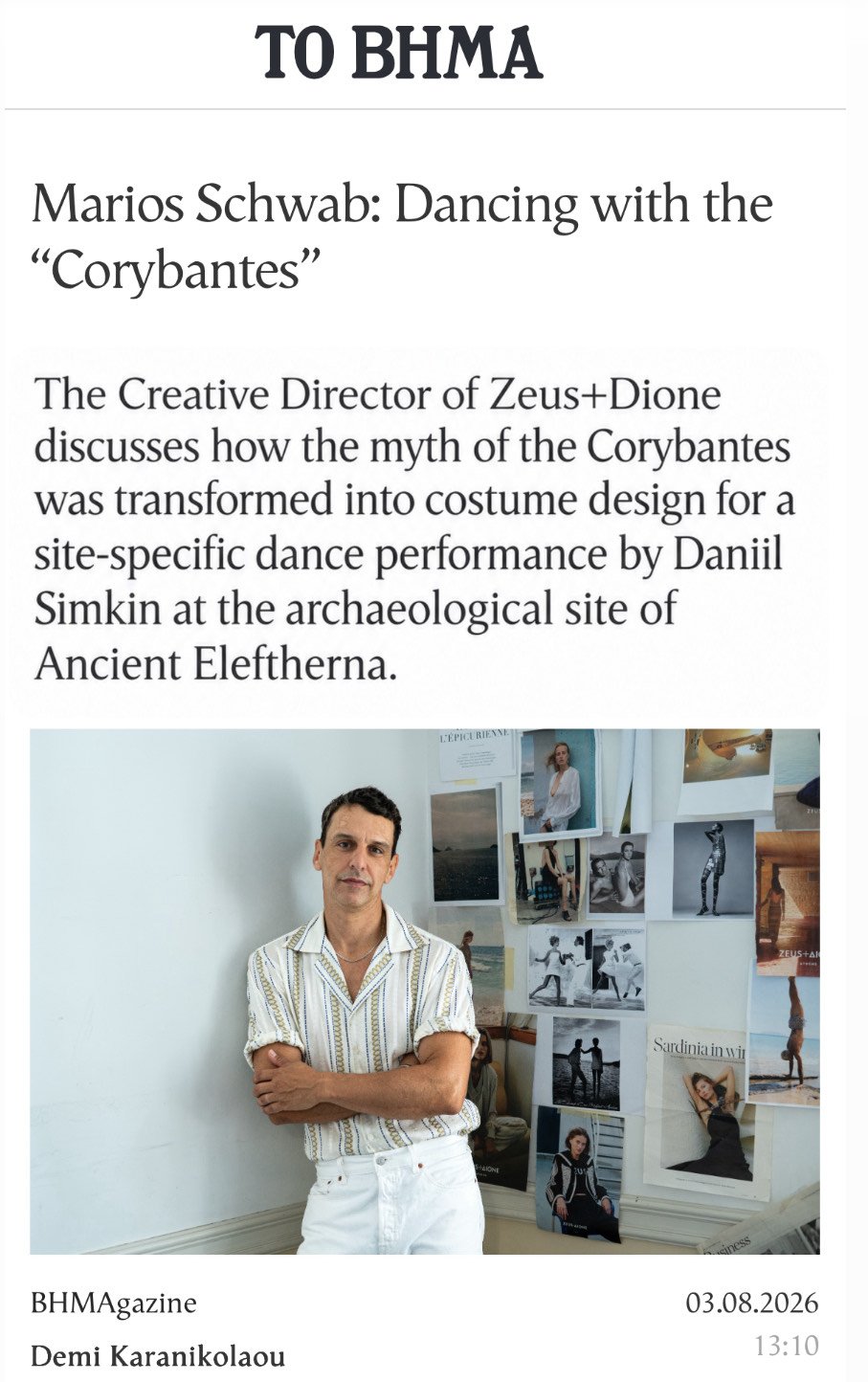
Marios Schwab: Dancing with the “Corybantes”
This article was written by Demi Karanikolaou for Vimagazino / To Vima Greece - print & digital here
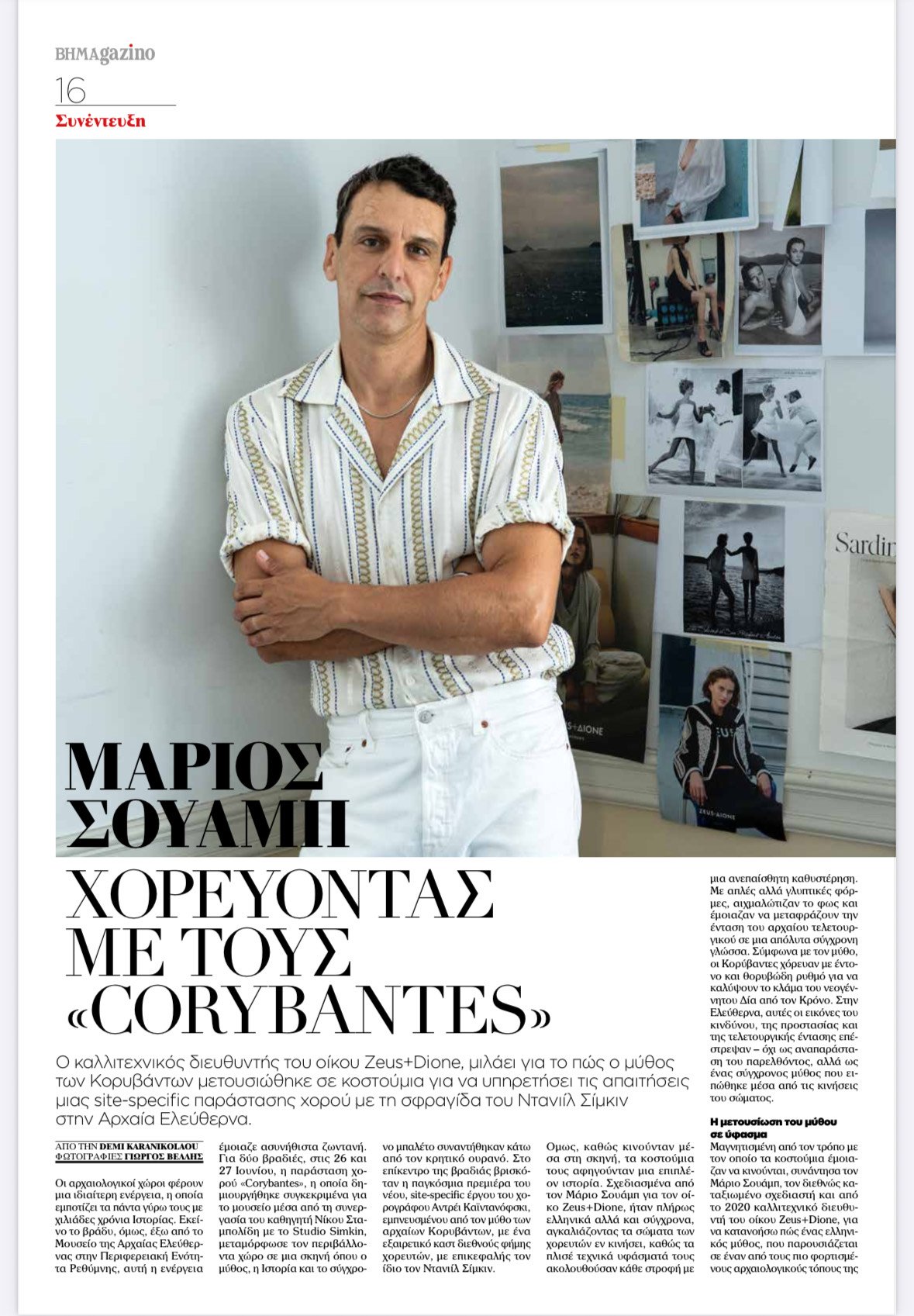
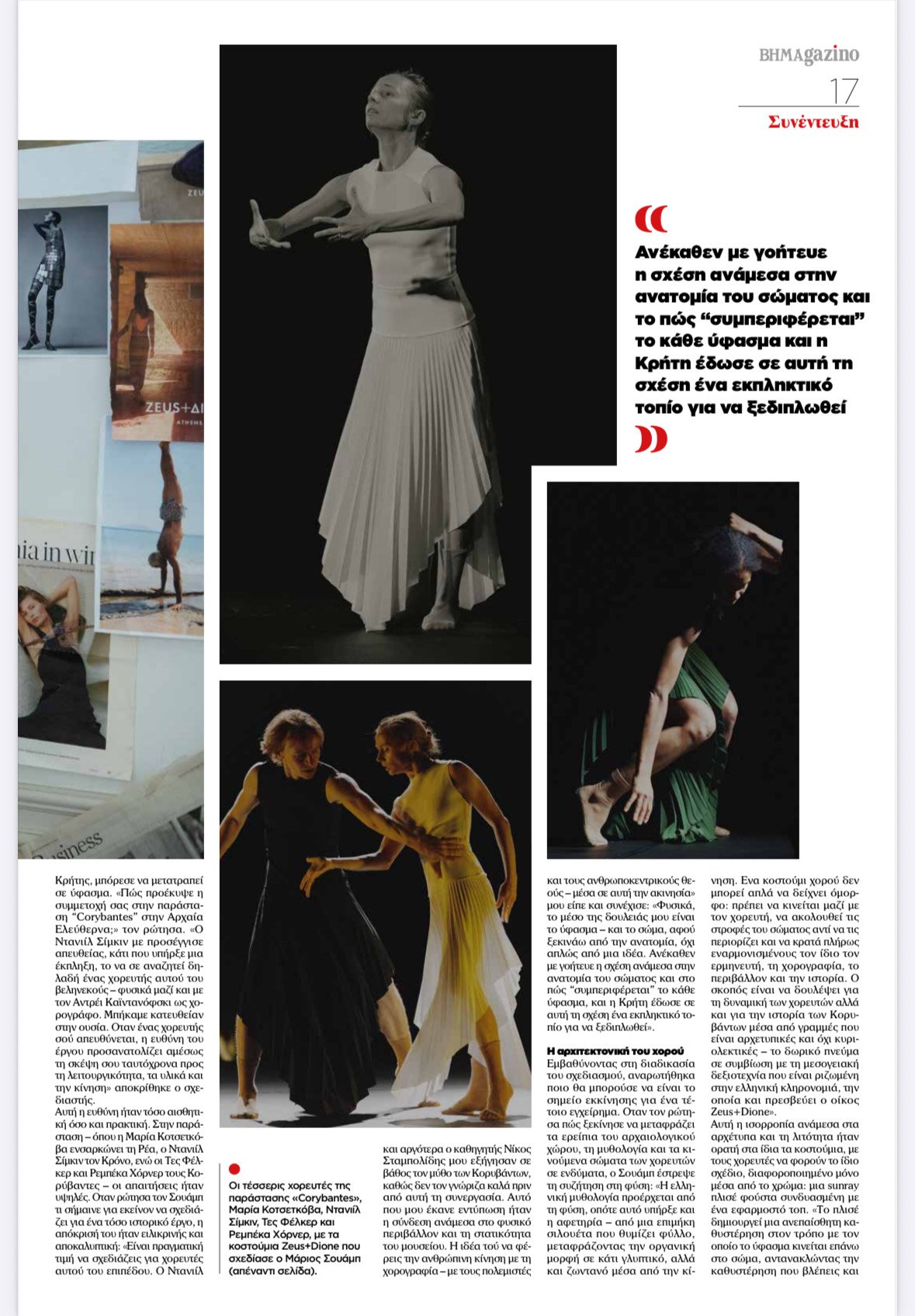
Archaeological spaces always seem to carry a particular kind of energy, one that infuses everything around them with thousands of years of history. Yet outside the Archaeological Museum of Ancient Eleutherna in Crete, that energy felt unusually alive. On 26 and 27 June, CORYBANTES, a two-night site-specific dance production created through a collaboration between Professor Nikos Stampolidis and Studio Simkin, transformed the museum grounds into a stage where myth, history and contemporary ballet met under the Cretan sky. At the centre of the evening was the world premiere of a new work by choreographer Andrey Kaidanovskiy, featuring an exceptional cast of internationally renowned dancers led by Daniil Simkin. As they moved through the scene, the costumes told an additional story. Designed by Marios Schwab for Zeus+Dione, they were distinctly Greek yet modern, holding the dancers’ bodies in motion as their pleated technical fabrics followed each gesture with a subtle delay. Clean yet sculptural, they caught the light and seemed to translate ancient ritual tension into a distinctly contemporary language. In the myth, the Corybantes danced with force, rhythm and noise to conceal the cries of the infant Zeus from Kronus. At Eleutherna, that image of protection, danger and ritual intensity returned not as a reconstruction of the past, but as a contemporary myth - one told through the moving body.
Mesmerised by the way the costumes seemed to move, I sat down with Marios Schwab, the internationally acclaimed designer and creative director of Zeus+Dione since 2020, to understand how a Greek myth, staged in one of Crete’s most charged archaeological landscapes, could be translated into fabric. “How did your involvement with the Corybantes play at ancient Eleftherna come to be?” I asked him. “Daniil Simkin approached me directly, which was a surprise: being sought out by a dancer of that stature, alongside Andrey as choreographer. We went straight into the substance of the piece. When a dancer comes to you, the responsibility shifts your thinking immediately to materiality, function, movement, all at once.” That responsibility was as aesthetic as it was physical. In the performance, Maria Kochetkova embodies Rhea, while Daniil Simkin appears as Kronus in the first duet. Tess Voelker and Rebecca Horner initially appear as Corybantes, signalling danger, before the performance culminates in a collective Corybantic energy. When I asked Schwab what designing for such a historic piece meant to him, his answer was as honest as it was revealing: “It's genuinely an honour to design for dancers of this calibre. I didn't know the Corybantes story in depth before this, but Daniil and later Professor Nikos Stampolidis explained it well. What struck me was the connection between the natural setting, the museum as a static space, and the idea of bringing human movement - warrior, anthropocentric gods, updated through choreography - into that stillness,” he said, before continuing, “My own medium is fabric and the body, starting with anatomy, instead of a storytelling idea. I've always been fascinated by the relationship between the anatomy of the body and the behaviour of fabric, and Crete gave that relationship an extraordinary landscape to play out in.”
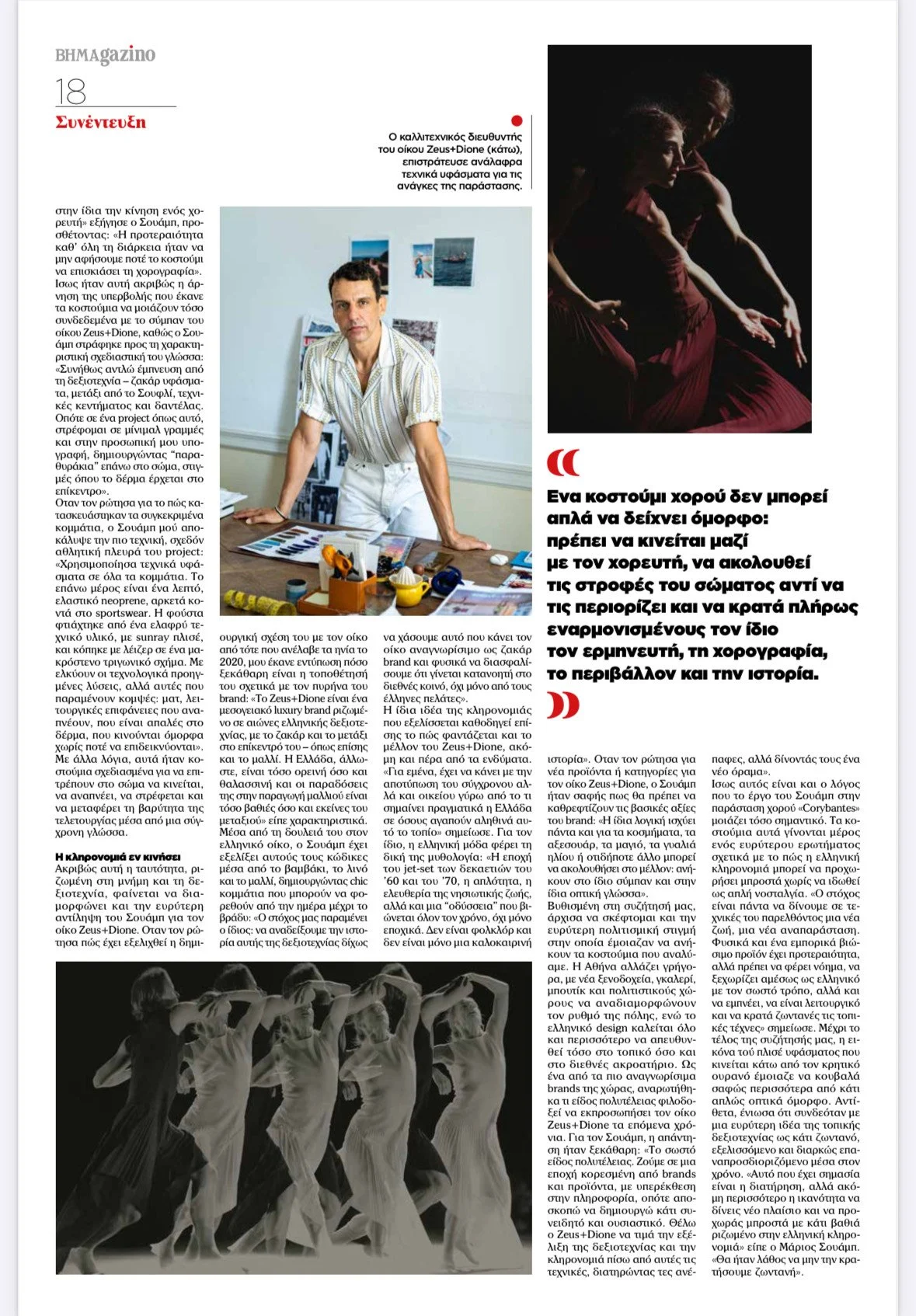
Looking further into the design process, I wondered what the starting point for such a project might be. When I asked him how he began translating ancient ruins, mythology and the moving bodies of the dancers into garments, Schwab returned again to nature. “Greek mythology comes from nature, so that's where I started; an elongated, leaf-like silhouette, translating organic form into something sculptural but alive in motion. A dance costume has to do more than look right: it has to move with the dancer, follow the body's intentions rather than restrict them, and hold the performer, the choreography, the environment, and the storytelling in harmony. The intent is to serve the dynamic of the dancers and the Corybantes story, along lines that stay archetypal rather than literal; the Doric spirit, in symbiosis with the Mediterranean craftsmanship rooted in Greek heritage, which is what Zeus+Δione represents.” This balance between archetype and restraint was visible in the costumes, with the dancers wearing the same design, differentiated only by colour: a sun-ray pleated skirt cut alongside a body-conscious upper part. “The pleating creates a subtle delay in how the fabric moves against the body, echoing the delay you see in a dancer's own motion,” Schwab explained. “The priority throughout was never letting the costume overshadow the choreography.” It is perhaps in that refusal of excess that the costumes felt most connected to the Zeus+Dione universe, as Schwab turned to his signature language: “I usually draw on craftsmanship - jacquard weaves, silk from Soufli, embroidery and lace techniques. So with a project like this, I lean into minimal lines and my personal signature, bringing 'windows' onto the body, moments where skin comes into focus.” When I asked him about the construction of the pieces themselves, he revealed the more technical, almost athletic element of the project. “I used technical fabrics throughout. The upper part is a fine, elasticated neoprene, closer to sportswear. The skirt is a lightweight technical material, sun-ray pleated and laser-cut into an elongated triangular shape. I'm drawn to solutions that are technologically advanced but still elegant: matte, breathable, functional surfaces, soft against the skin, moving beautifully but never showing off.” In other words, these were costumes designed to let the body move, breathe, turn and carry the magnitude of the ritual through a modern language.
That same identity, rooted in memory and craft, seems to shape Schwab’s wider understanding of Zeus+Dione. When I asked him how his relationship with the house has evolved since he took the creative helm in 2020, his understanding of the brand’s core was extremely consistent: “Zeus+Δione is a Mediterranean luxury brand rooted in centuries of Greek craftsmanship, with the jacquard weave and silk at its centre, but also wool. Greece is as mountainous as it is maritime and wool-making traditions run as deep as its silk,” he told me. Since joining the house, Schwab has pushed that language into cotton, linen and wool, creating pieces that move more easily between day and evening. “The goal has always been the same: elevate that origin story without losing what makes the house legible as a jacquard brand, and make sure it reads internationally, not only to Greek clients.” It is this idea of heritage in motion that also guides how he imagines the future of Zeus+Dione beyond clothing. “For me, it's about capturing something contemporary yet familiar about what Greece means to those who truly love this landscape,” he said. For him, Greek fashion carries its own mythology: “the ‘60s and ‘70s jet-set moment, the effortless simplicity, the freedom of island life, but also an odyssey lived year-round rather than seasonally. It's not folkloric, and it's not only a summer story.” When asked about new products or categories for Zeus+Dione, Schwab was clear that they would have to mirror the brand’s core values. “That same logic runs consistently through jewellery, accessories, swimwear, sunglasses, or whatever comes next: one universe, one visual language.”
Immersed in our conversation, I found myself thinking not only about the costumes, but about the wider cultural moment they seemed to belong to. Athens is changing fast, with new hotels, galleries, boutiques and cultural spaces reshaping the city’s rhythm, while Greek design is increasingly being asked to speak both locally and internationally. As one of the country’s most prominent brands, I wondered what kind of Greek luxury Zeus+Dione aims to represent moving forward. For Schwab, the answer was clear. “The right kind of luxury,” he told me. “We live in a time saturated with brands and products, overly informed by all of it, so what I want to create is intentional and meaningful. I want Zeus+Δione to honour the evolution of craftsmanship and the heritage behind these crafts, keeping them intact while giving them a new vision.” Perhaps that is why Schwab’s work on CORYBANTES feels so significant. The costumes become part of a larger question about how Greek heritage can move forward without being flattened into nostalgia. “The goal is always to give techniques from the past a new life, a new representation. A commercially viable product comes first, but it has to carry meaning, read instantly as Greek in the right way, but also inspire, function, and keep the local crafts alive,” he said. By the time our conversation came to a close, the image of pleated fabric moving under the Cretan sky felt like more than a beautiful visual moment. It became connected to a larger idea of local craft as something alive, evolving and constantly recontextualised. “What matters more is preservation, but more importantly, the ability to contextualise and move forward with something deeply rooted in Greek heritage,” Schwab said. “It would be wrong not to keep that alive.”