
Emily Carter London: The Illustrator & designer speaks to Vimagazino
This article was written by Demi Karanikolaou for Vimagazino / To Vima Greece - print
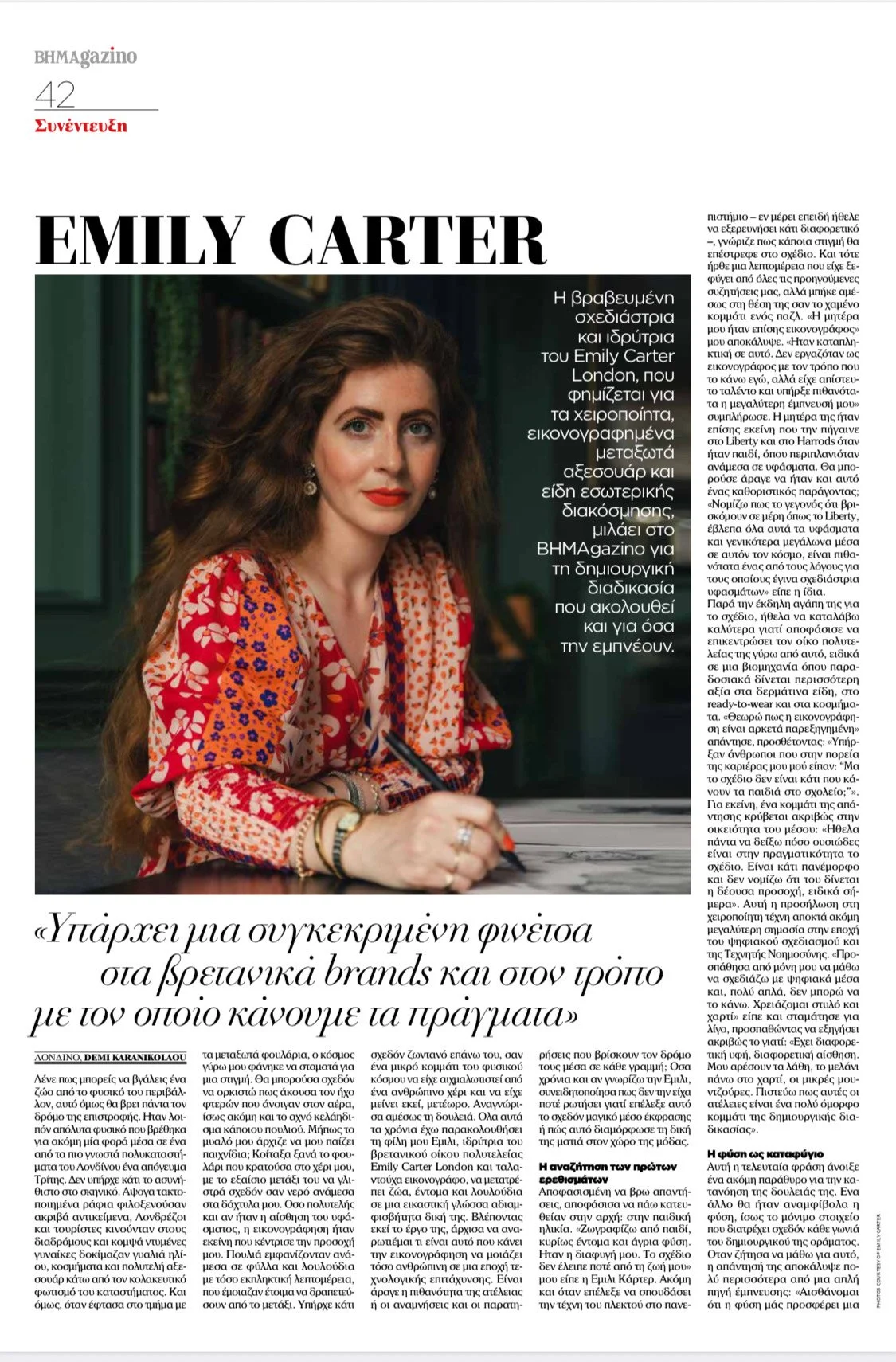
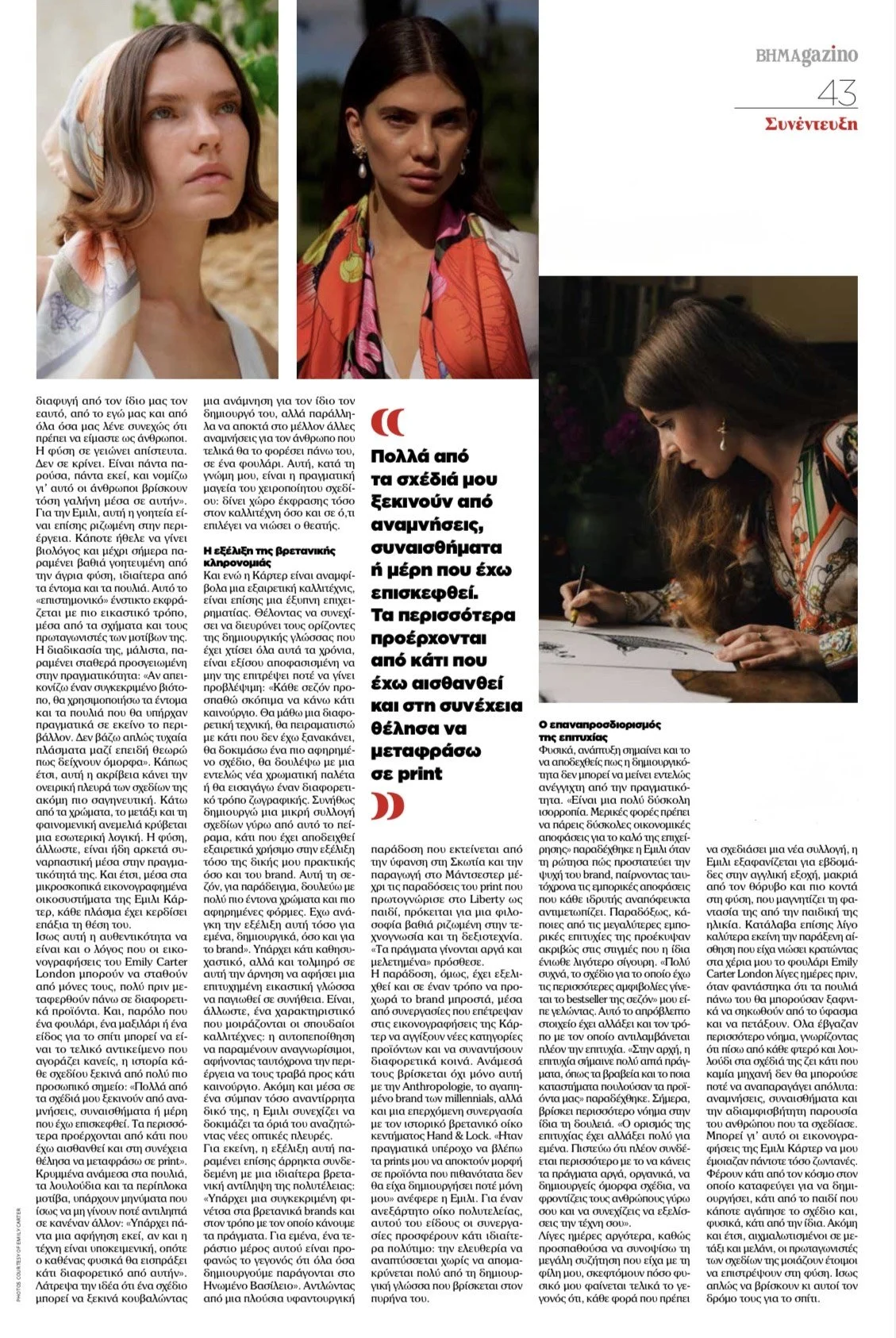
They say you can take an animal out of its natural habitat, but it will always find its way home. Naturally, then, I found myself once again inside one of London’s prominent department stores on a Tuesday afternoon. There was nothing particularly unusual about the scene. Polished shelves held expensive merchandise, Londoners and tourists drifted through the aisles, and beautifully dressed women tried on sunglasses, jewellery and various luxury accessories beneath the flattering department-store lighting. Yet, as I reached the selection of silk scarves, the world seemed to stop for a moment. I could almost hear the sound of feathers opening in the sky, perhaps even the faint chirping of birds. Was my mind playing tricks on me? I looked again at the scarf resting between my fingers, its exquisite silk slipping through them almost like water. As luxurious as the fabric felt, it was the illustration that held my attention. Birds appeared among leaves and flowers with such extraordinary detail that they seemed moments away from escaping the silk altogether. There was something alive about it, as though a fragment of the natural world had been captured by hand and suspended there. I recognised the work immediately. Over the years, I have watched my friend Emily, founder of Emily Carter London, the London-based luxury accessories brand, and gifted illustrator, turn animals, insects and flowers into a visual language unmistakably her own. Seeing it there made me wonder what still makes illustration feel so human in an age of technological acceleration. Is it the possibility of imperfection, or the memories and observations that find their way into every line? For all the years I have known Emily, I realised I had never really asked why she chose this magical medium, or how it shaped her own view of fashion.
Curious to find the answers to my questions, I decided to go straight back to the beginning: childhood. “I’ve been drawing since I was a child, particularly insects and wildlife. It was my escapism. Drawing has never not been part of my life,” Emily told me. Even when she chose to study knitwear at university, partly because she wanted to explore something different, she already knew she would eventually return to drawing. Then came a detail that had somehow slipped through all our previous conversations, yet clicked into place like the missing piece of a puzzle. “My mother was also an illustrator,” she revealed. “She was phenomenal. She didn’t work as an illustrator in the same way I do, but she was incredibly talented at it, and she was probably my biggest inspiration.” Her mother was also the one who took her to Liberty and Harrods as a child, where they would wander through fabrics before going for lunch together. Could that have been a defining factor too? “I think being around places like Liberty, seeing the fabrics and all of that, is probably part of why I became a textile designer in the first place,” Emily said.
But if illustration had always been part of Emily’s life, I was curious about the decision to place it at the very heart of the luxury house she is building, especially in an industry where so much value is traditionally placed on leather goods, ready-to-wear and jewellery. “I think illustration is actually quite misunderstood,” Emily replied. “I’ve even had people say to me throughout my career, ‘Isn’t drawing something you do at school?’” For her, part of the answer lies precisely in the intimacy of the medium. “I’ve always wanted to show how fundamental drawing actually is. It’s a beautiful thing, and I don’t think it is focused on enough, especially now.” That attachment to the hand feels increasingly significant in the age of digital design and AI. “I’ve tried teaching myself to draw digitally and I simply can’t do it. I have to have a pen and paper.” She paused, searching for the exact reason. “It has a different texture and a different feeling. I love the mistakes. The ink on the paper, the little blotches everywhere. I think those imperfections are a beautiful part of the design process.”
This last sentence opened another window into my understanding of her practice. Another would undoubtedly be nature, perhaps the one constant running through almost every corner of her creative vision. When I asked why, her answer revealed far more than a source of inspiration. “I think nature provides us with an escape from ourselves, from our egos and from what we are constantly told we should be as human beings,” she replied. “It’s incredibly grounding. Nature is unjudging. It is always present, always there, and I think that’s why people find so much peace in it.” For Emily, that fascination is also rooted in curiosity. She once wanted to become a biologist and remains deeply fascinated by wildlife, particularly insects and birds. Today, that scientific instinct manifests in a more visual way, through the shapes and protagonists of her prints. Her process remains firmly rooted in reality. “If I’m depicting a particular habitat, I will use the insects and birds that would actually exist within that environment,” she explained. “I don’t just put random creatures together because I think they look beautiful.” Somehow, that precision only makes the dreaminess more seductive. Beneath the colour, silk and apparent whimsy lies an internal logic. Nature, after all, is already extraordinary enough in its own accuracy. And so, within Carter’s tiny illustrated ecosystems, every creature has earned its place.
This authenticity might also be the reason why Emily Carter London illustrations seem to carry their own weight even before being translated into different products. And while a scarf, a cushion or a piece of homeware may be the final object one can purchase, the story of an individual design begins from a much more personal place. “A lot of my designs begin with memories, emotions or places I’ve visited,” she told me. “Most come from something I have felt and then wanted to translate into a print.” Hidden within the birds, flowers and intricate patterns are messages that may never be obvious to anyone else. “There is always a narrative there, although art is subjective, so everybody will naturally take something different from it.” I loved the idea that a design can carry one memory for its creator and quietly become another for the person who eventually wears or uses it. Perhaps that is part of the intimacy of illustration itself, the space between what the artist meant and what the viewer chooses to feel.
And while Carter is undeniably an incredible artist, she is also a smart businesswoman. Keen to keep expanding the horizons of the creative language she has built over the years, she is equally determined never to let it become predictable. “Every season I deliberately try to do something new,” Emily confessed. “I’ll teach myself a different technique, experiment with something I haven’t done before, try a more abstract design, work with a completely new colour palette or introduce another way of painting. Usually I’ll create a small selection of designs around that experiment, and it has actually been incredibly useful in developing both my own practice and the brand. This season, for instance, I’m working with much bolder colours and more abstract forms. I need that evolution for myself creatively as much as I need it for the brand.” There is something deeply reassuring, and quietly brave, in that refusal to let a successful visual language harden into habit. It is, after all, a quality shared by great artists: the confidence to remain recognisable while still allowing curiosity to pull them somewhere new. Even within a world so unmistakably her own, Emily continues to test its edges, gently expanding what an Emily Carter illustration can become.
For Emily, that evolution also remains firmly connected to a particularly British understanding of luxury: “There is a certain refinement to British brands and to the way we do things. For me, a huge part of that is obviously the fact that everything we make is produced in the UK.” Drawing from a textile history that stretches from weaving in Scotland and manufacturing in Manchester to the printing traditions she first encountered at Liberty as a child, it is a philosophy rooted in craftsmanship. “Things are done slowly and in a considered way,” she added. However, heritage has also become a way of moving forward for her brand, through collaborations that have allowed Carter’s illustrations to tap into new categories and audiences. Those include not only millennial favourite Anthropologie, but also an upcoming partnership with historic British embroidery house Hand & Lock. “It’s been really lovely for me to see my prints translated into products I would never necessarily have produced myself,” Emily mentioned. For an independent luxury house, that exchange offers the precious freedom to grow without drifting too far from the creative instinct at its core.
Of course, growth also means accepting that creativity cannot exist entirely untouched by reality. “It’s a very difficult balance. Sometimes you have to make tough financial decisions for the greater good of the business,” Emily admitted when I asked how she protects the soul of the brand while making the commercial decisions every founder eventually faces. Funnily enough, some of her greatest commercial successes have come from moments when instinct felt least certain. “Quite often, the design I’m least convinced about becomes the bestseller of that season,” she laughed. That unpredictability has also reshaped Emily’s idea of success. “At the beginning, success was about visible markers like achievements, awards and which stores stocked the brand,” she admitted. Today, she finds more meaning in the work itself. “My definition of success is very different now. I think it’s about doing things slowly, doing them organically, creating beautiful designs, looking after the people around you and continuing to hone your craft.”
A few days later, as I was summarising the long conversation I had with my friend, I thought about how much sense it makes that Emily often disappears for weeks into the English countryside whenever a new collection needs to be drawn, away from the noise and closer to the nature that has followed her imagination since childhood. I also understood a little better the illusion I had felt while holding that Emily Carter London scarf a few days earlier, when I imagined its birds might suddenly lift themselves from the fabric and take flight. It all made more sense now, knowing that behind every feather and flower in her designs lives something no machine could quite reproduce: memories, feelings and the unmistakable presence of the person who drew it. Maybe that is why Emily’s illustrations have always felt so alive. They carry a little of the world she retreats to, a little of the child who first found escape in drawing, and a little of herself. Even captured in silk and ink, they seem ready to return to nature. Perhaps they are simply finding their way home.