
Villa San Michele: A renaissance dream coming back to life.
This article was written by Demi Karanikolaou for Vimagazino / To Vima Greece - print & digital here
Above Florence, where the city slowly dissolves into cypress trees and Renaissance gardens, time and history appear to soften. History, or heritage, as marketing prefers to call it, is the ultimate currency of luxury and a concept constantly debated, packaged and commodified within the industry. And while one might get lost in the beauty of its cobblestone streets, marble statues and impressive cathedrals, Florence is also one of the very few places that can proudly proclaim to have shaped both the concept and the language of luxury in a profound way. During the Renaissance, the city became the epicentre of a civilisation obsessed with beauty, artistry and power, as wealthy dynastic families like the Medici, the Pazzi, the Strozzi and the Guicciardini built residences and public spaces that acted as temples projecting their ever-growing influence. The deep political division between city states across the Italian peninsula meant that popes, dukes and merchant princes constantly competed to hire the greatest architects and artists in order to prove that their city was the most sophisticated of all. Inside these stone fortresses, the human senses were intentionally overwhelmed: velvet brocades and rare silk textiles draped the walls, monumental hand-carved furniture anchored the rooms, and frescoes were commissioned from masters like Michelangelo. Many of these artists occupied a status that allowed them to operate outside the panic of time. They had the ultimate luxury: the ability to devote themselves entirely to beauty and craftsmanship - the permission to never rush.
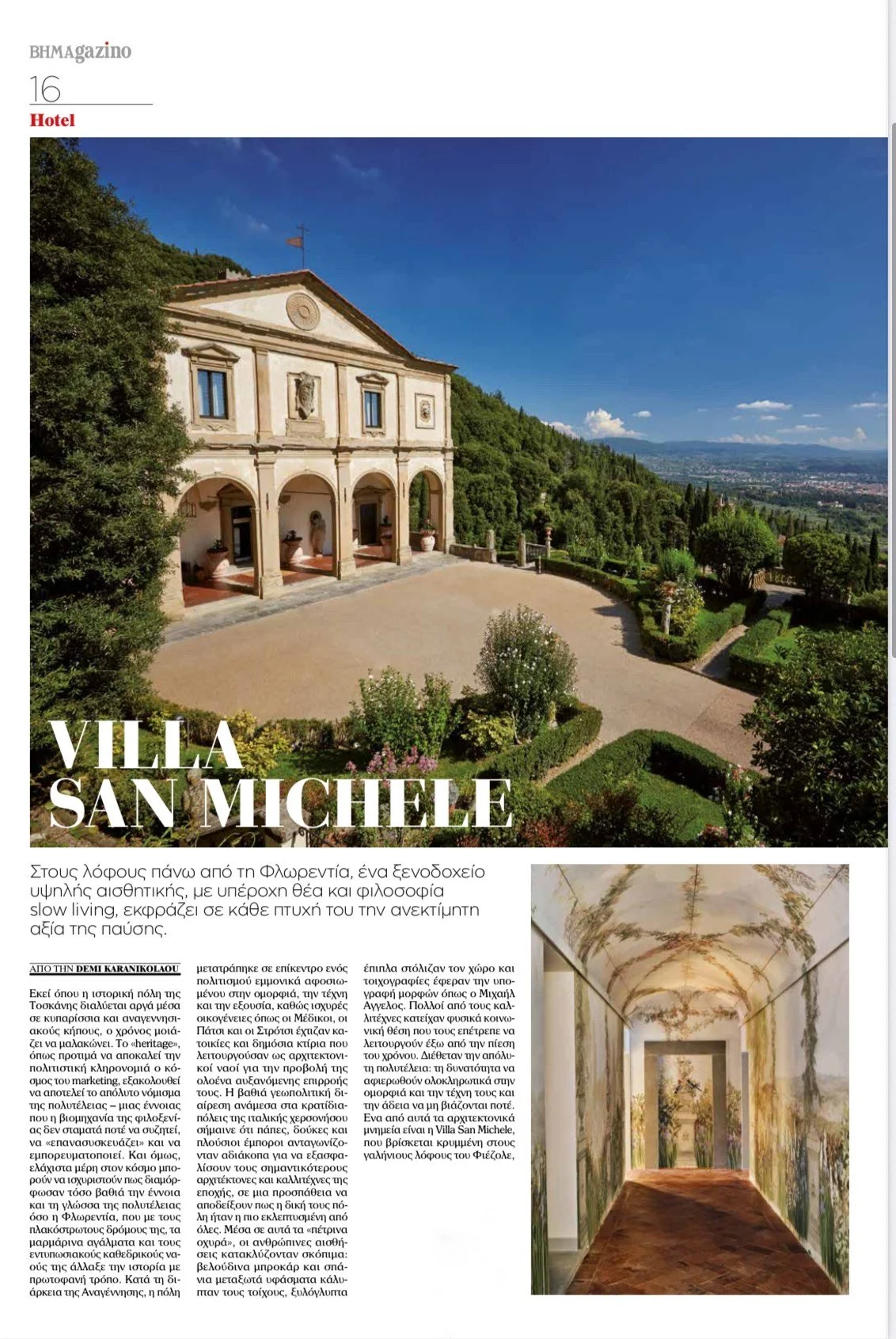
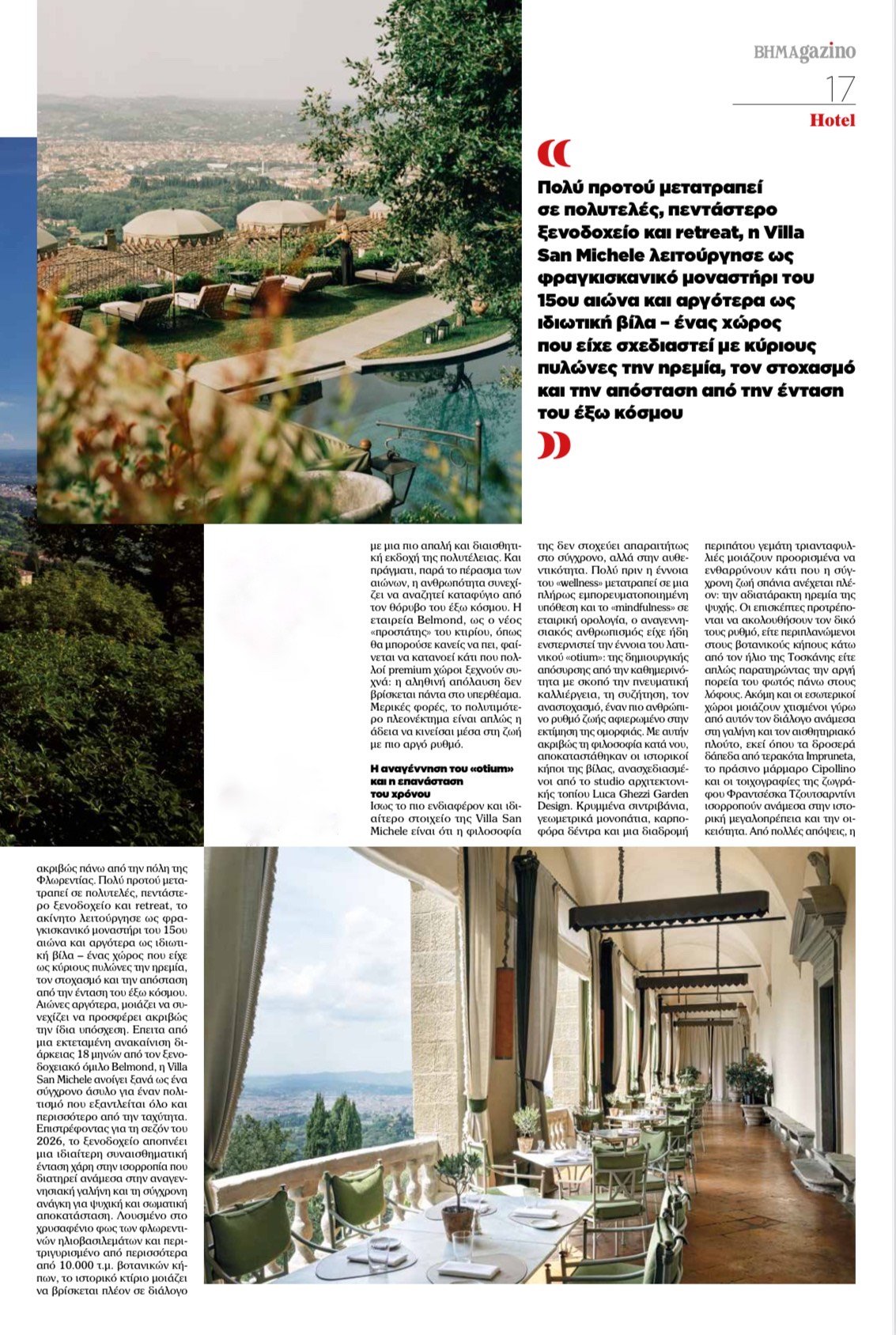
Perched just above the city of Florence and nestled in the quiet hills of Fiesole stands Villa San Michele, one of the region’s most extraordinary architectural monuments. Long before it became a luxury retreat, the property functioned as a fifteenth-century Franciscan convent and later a private villa - a place intentionally designed around silence, contemplation and distance from the urgency of the outside world. Centuries later, it somehow continues to offer the exact same emotional promise. Following an extensive eighteen-month restoration by Belmond, the luxury hospitality group, Villa San Michele has reopened as a modern sanctuary for a civilisation increasingly exhausted by speed. Now reopened for the 2026 season, the property feels emotionally resonant because of the balance it maintains between Renaissance stillness and contemporary restoration. Wrapped in the golden warmth of Florentine sunsets and surrounded by more than 10,000 square metres of botanical gardens, the historic building now exists in dialogue with a softer, more intuitive vision of luxury. Despite the passage of time, humanity continues searching for sanctuary from the noise of the outside world. Belmond, the building’s new protector, as one might say, appears to understand something many luxury spaces often forget: true indulgence is not always spectacle. Sometimes, it is simply the rare permission to move through life more slowly.
Perhaps the most fascinating aspect of Villa San Michele, and its greatest strength, is that its philosophy does not actually feel modern, but authentic. Long before wellness became a heavily commercialised industry and “mindfulness” transformed into corporate vocabulary, Renaissance humanism had already introduced the concept of otium: a form of contemplative leisure devoted to conversation, reflection and the appreciation of beauty. With that philosophy in mind, the villa has restored its terraced gardens, redesigned by Luca Ghezzi Garden Design. Hidden fountains, geometric pathways, citrus groves and a contemplative rose-lined walk seem intentionally designed to encourage uninterrupted attention, something modern life rarely tolerates anymore. Guests are encouraged to experience the property entirely at their own rhythm, whether wandering through the botanical gardens beneath the Tuscan sun or simply observing the slow movement of light across the hills. Even the interiors themselves appear built around this dialogue between stillness and sensory richness, where cool Impruneta terracotta floors, green-veined Cipollino marble and Francesca Guicciardini’s hand-painted murals soften the boundary between historical grandeur and emotional intimacy. In many ways, Villa San Michele feels less like a traditional hotel and more like a quiet rebellion against acceleration itself. It stands as a living expression of Florence’s layered past and creative present.
Of course, contemporary luxury can no longer survive on the passive weight of architecture and heritage alone. In a culture saturated by permanent stimulation, emotional restoration demands something far more rigorous than simple comfort; it requires ritual. What makes Villa San Michele particularly compelling is that it approaches wellness through direct historical continuity rather than as a standard hotel amenity. The elegant purity of the silence sought by Franciscan friars centuries ago as a form of spiritual retreat has been masterfully reinterpreted, combining the cathartic nature of that ancient pause with the sensory mastery of French skincare. The newly unveiled Villa San Michele Spa by Guerlain translates this primal human instinct into a modern language of longevity and emotional recalibration. Set on the first floor of the historic convent itself and featuring three treatment rooms, the spa mirrors the heavy stillness of the Fiesolan hills through muted, earthy textures and restorative rituals designed to ground the physical body. Crafted by Guerlain, bespoke treatments embody the holistic philosophy of the revered French maison, combining beauty, preventive health and longevity. Each experience is designed to nurture the body, restore emotional balance and support long-term vitality. Exclusive treatments created specifically for the villa include Floral Delight in Tuscany, a relaxing face-and-body ritual infused with delicate floral notes; The Art of Renaissance, an exclusive deep-sculpting massage treatment for face and body; and Iris di Grazia, an anti-ageing facial paying homage to Florence’s emblematic flower. Even the journey into the spa is engineered as a symbolic threshold: entering through a “Secret Garden” framed by Elena Carozzi’s hand-painted frescoes, the boundary between the internal sanctuary and the surrounding vegetation becomes deliberately blurred. It is a surprisingly cinematic transition. Listening to the philosophy behind the project, it becomes increasingly obvious that the villa is attempting something far more ambitious than simple indulgence. It is selling psychological decompression to a civilisation completely exhausted by its own speed.
This same philosophy extends into the villa’s collaboration with Milanese lifestyle brand La DoubleJ, founded by JJ Martin and globally renowned for its maximalist prints and commitment to conscious living. Together, the two have created a wellness programme that moves far beyond the conventional language of luxury hospitality. Named the “Energy Raising Programme”, the first-of-its-kind collaboration unites design, spiritual programming and Italian heritage through a series of immersive experiences intended to encourage emotional restoration and contemplative practice. Designed by La DoubleJ within the grounds of the villa’s woodland, three dedicated spaces attempt to reimagine how energetic reawakening can exist within a luxury setting. Beginning with the “Energy Chapel” - a former place of worship transformed into an intimate sanctuary featuring a gong, bespoke zafu meditation pillows and a custom light-and-sound installation - the programme invites guests into a space designed entirely around stillness and introspection. For a more immediate reconnection with the surrounding landscape, the adjoining “Sungazing Lounge” garden hosts sunset rituals overlooking the Florentine hills, while a dedicated open-air Yoga Deck completes the experience through movement and breathwork sessions beneath the Tuscan sky. While undeniably introducing a contemporary layer into the stone walls of San Michele, these experiences feel unexpectedly coherent. Perhaps because the property already carries centuries of spiritual memory within its architecture, these modern rituals never feel performative, but strangely fitting and emotionally natural instead. Increasingly, luxury hospitality is no longer selling simple comfort, but emotional recalibration. Villa San Michele seems to understand this instinct almost intuitively.
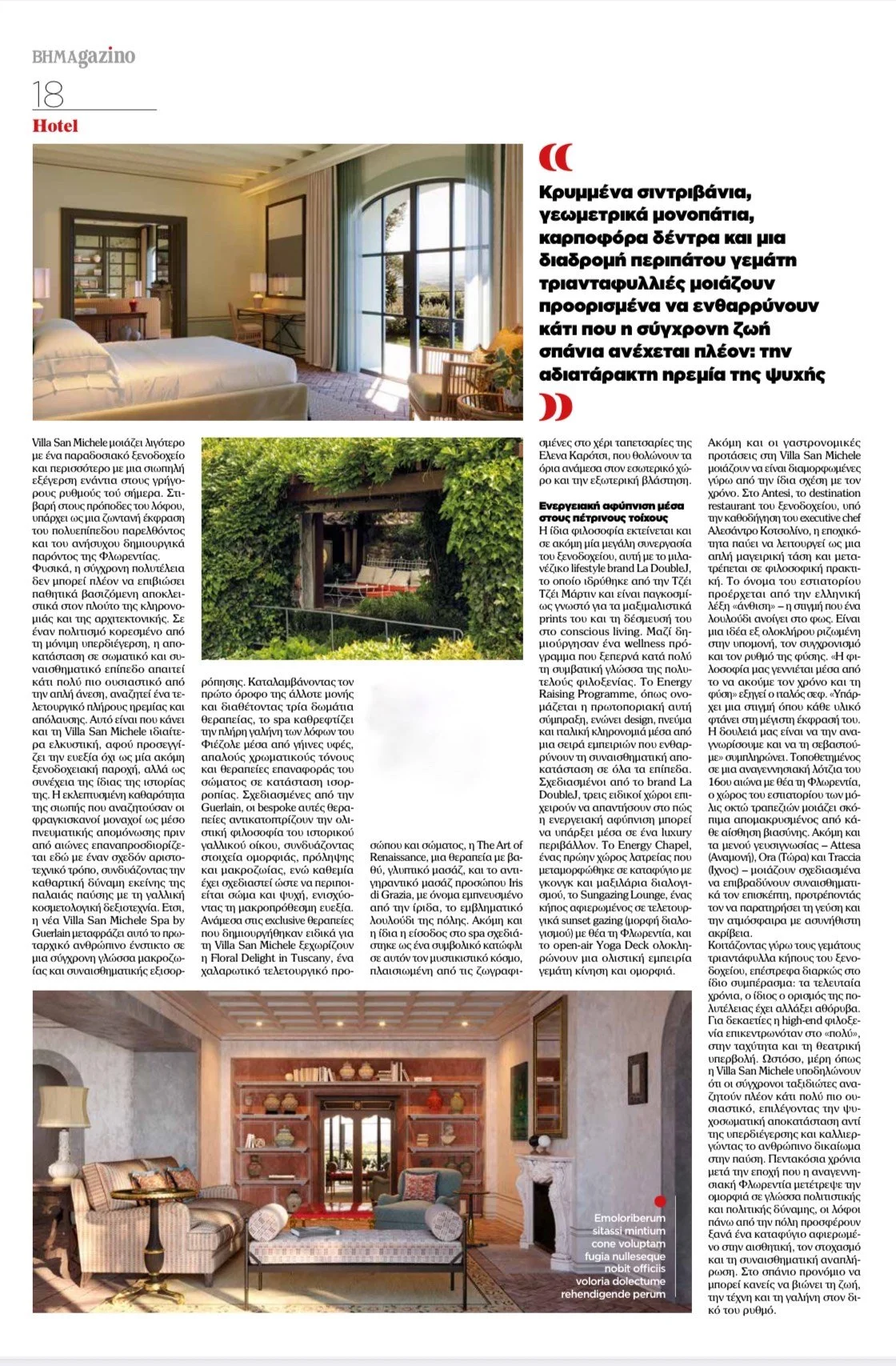
Even gastronomy at the property appears shaped by this same relationship with time. At Antesi, the villa’s destination restaurant led by Executive Chef Alessandro Cozzolino, seasonality becomes less of a culinary trend and more of a philosophical practice. The restaurant’s name derives from the Greek word anthesis - the precise moment a flower opens to the light. It is a concept rooted entirely in timing, patience and natural rhythm. “Our concept is born from listening to time and nature,” Cozzolino explains. “There is a moment when every ingredient reaches its maximum expression. Our job is to recognise and respect it.” Housed beneath a sixteenth-century Renaissance loggia overlooking Florence, the intimate eight-table dining space feels intentionally removed from urgency. Even the tasting menus themselves - Attesa (Waiting), Ora (Now) and Traccia (Trace) - seem designed around slowing the diner down emotionally, encouraging guests to notice flavour, atmosphere and temporality with unusual precision.
Looking around the rose-filled gardens, I kept returning to the conclusion that, over the past few years, the definition of luxury itself has quietly changed. For decades, high-end hospitality revolved around accumulation, speed and performative excess. Yet places like Villa San Michele suggest that modern travellers increasingly crave something far more important, choosing restoration over overstimulation and nurturing the human right to pause. Five hundred years after Renaissance Florence transformed beauty into a language of cultural and political power, the hills above the city once again offer sanctuary devoted to aesthetics, contemplation and emotional replenishment. Only now, the ultimate luxury is no longer simply possessing and showcasing beauty, but having the rare privilege to truly experience life, art and stillness entirely at your own pace.