
The Return of the Minaudière
This article was written by Demi Karanikolaou for Vimagazino / To Vima Greece - print
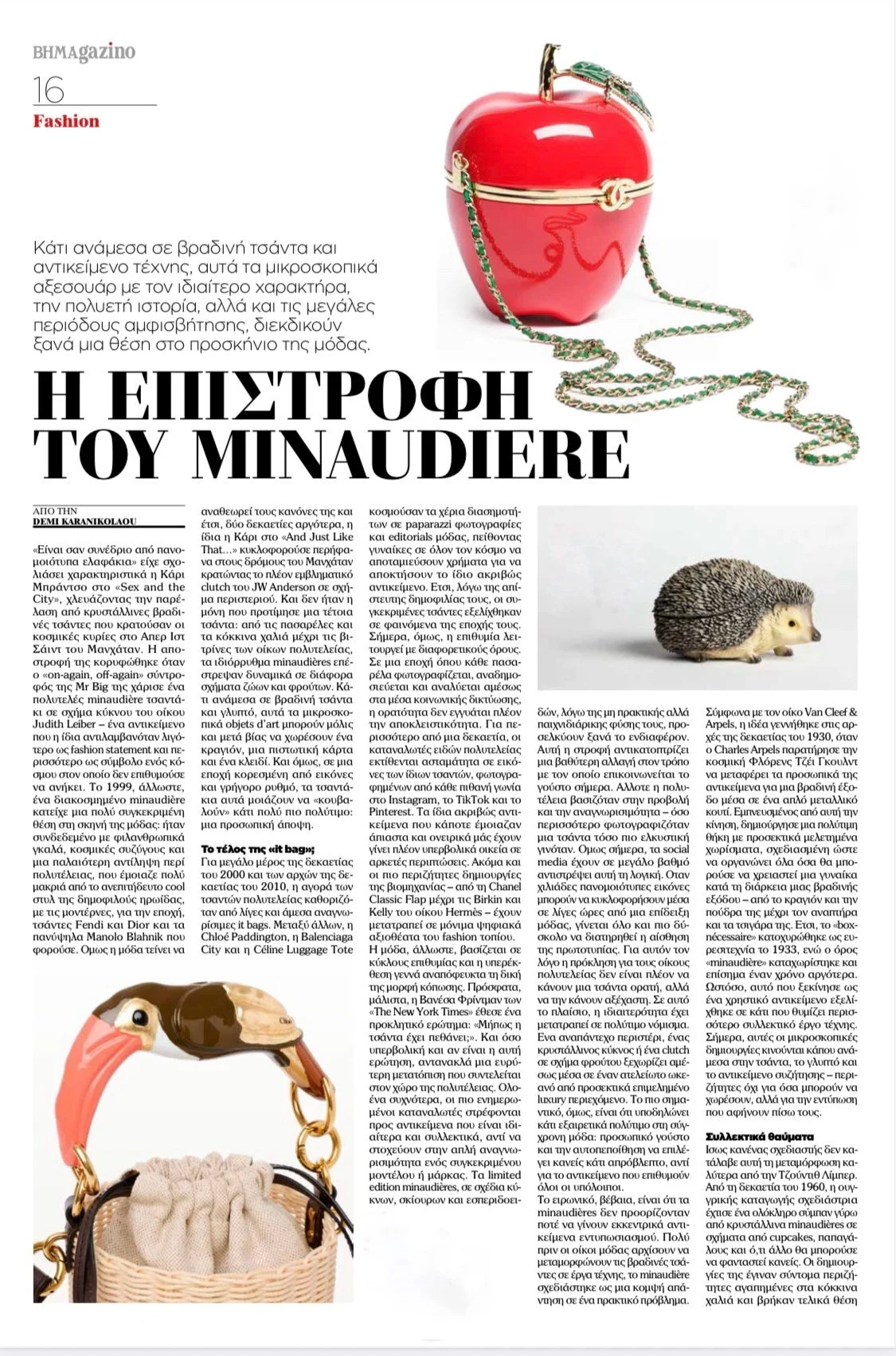
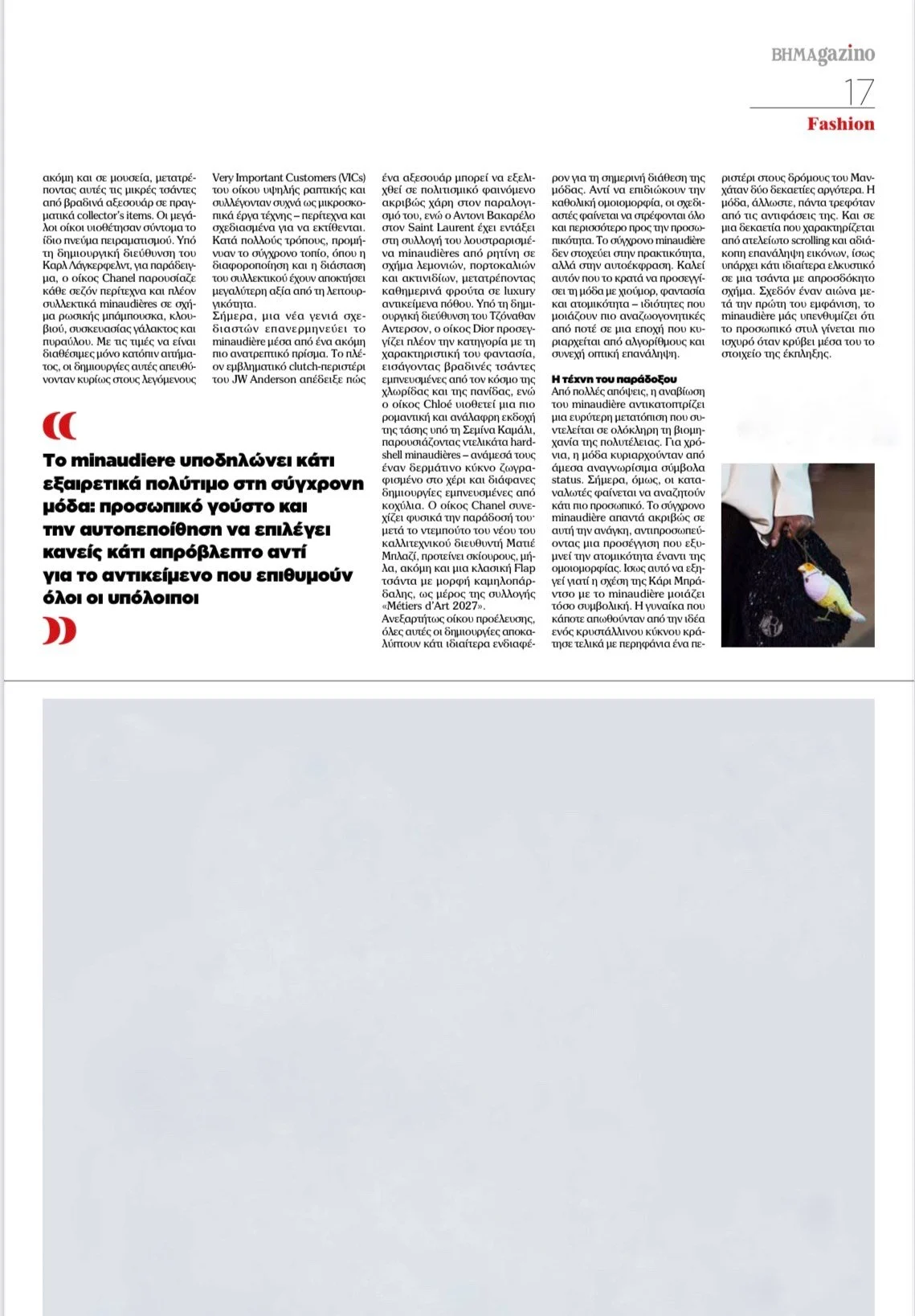
"It's like a white-tailed deer convention," Carrie Bradshaw famously remarked in Sex and the City, while mocking the parade of crystal-encrusted evening bags carried by Manhattan's Upper East Side elite. Her disdain reached its peak when her on-again, off-again boyfriend Mr. Big gifted her a lavish Judith Leiber swan minaudière - an object she regarded less as a fashion statement and more as a symbol of a world she had no desire to join. Back in 1999, the embellished minaudière occupied an awkward place within the fashion hierarchy: associated with charity galas, society wives and a certain old-guard vision of luxury that felt distinctly removed from the carefree cool of Carrie Bradshaw's Fendi Baguettes, Dior Saddle bags and towering Manolo Blahniks. Yet fashion has a habit of rewriting its own rules. Two decades later, Carrie herself was proudly carrying JW Anderson's now-iconic pigeon clutch through the streets of Manhattan in And Just Like That. She is hardly alone. Across runways, red carpets and luxury boutiques, whimsical minaudières shaped like swans, squirrels, hedgehogs, birds, grapefruits and kiwis have returned with surprising force. Part handbag, part sculpture, these miniature objets d'art can barely accommodate a lipstick, a credit card and perhaps a key. Yet in an era increasingly defined by visual oversaturation, they appear to carry something far more valuable: a point of view.
For much of the 2000s and early 2010s, luxury handbags were defined by a handful of instantly recognisable "It Bags". Amongst others, the Chloé Paddington, the Balenciaga City and the Céline Luggage Tote graced the arms of celebrities in paparazzi photographs and fashion editorials, convincing women around the world to save for the very same object. These bags became cultural phenomena precisely because everyone wanted them. Yet in 2026, desirability follows an entirely different pattern. In an era where every runway debut is instantly photographed, reposted and analysed across social media, visibility no longer guarantees exclusivity. For more than a decade, luxury consumers have been exposed to a relentless stream of the same handbags, photographed from every conceivable angle across Instagram, TikTok and Pinterest. What was once aspirational has, in some cases, become overly familiar. Even the industry's most coveted creations - from the Chanel Classic Flap to Hermès' Birkin and Kelly bags - have become permanent fixtures of the digital fashion landscape.
Fashion, however, is built on cycles of desire, and overexposure inevitably creates its own form of fatigue. Earlier this year, Vanessa Friedman of The New York Times even posed a provocative question: "Is the Handbag Over?" While that conclusion may be premature, it speaks to a broader shift taking place within luxury. Increasingly, fashion's most discerning consumers are gravitating towards objects that feel unique and collectible rather than universally recognisable. Limited-edition minaudières shaped like swans, pigeons, squirrels, kiwis and citrus fruits are once again capturing attention - not despite their impracticality, but because of it. The shift reflects a broader change in how taste is communicated. For decades, luxury relied on aspiration and visibility. The more a handbag was photographed, the more desirable it became. Social media has largely reversed that equation. When thousands of identical images can circulate across Instagram, TikTok and YouTube within hours of a runway show, novelty becomes increasingly difficult to sustain. The challenge facing luxury houses is no longer how to make a bag visible, but how to make it memorable. In this environment, individuality has become a powerful form of currency. A whimsical pigeon, a crystal swan or a fruit-shaped clutch immediately stands apart from an endless sea of carefully optimised luxury content. More importantly, it suggests something increasingly valuable in contemporary fashion: personal taste and the confidence to choose something unexpected, instead of the object everyone else desires.
Yet the irony is that the minaudière was never intended as a novelty object at all. Long before fashion houses began transforming evening bags into pigeons, squirrels and citrus fruits, the minaudière was conceived as an elegant solution to a practical problem. According to Van Cleef & Arpels, the concept emerged in the early 1930s after Charles Arpels noticed socialite Florence Jay Gould carrying her evening essentials inside a simple metal box. Inspired by the idea, the Maison created a precious compartmentalised case designed to organise everything a woman might require for an evening out - from a lipstick and compact to a lighter and cigarettes. The "box-nécessaire" was patented in 1933, while the name Minaudière was officially registered a year later. However, what began as a discreet object of utility has evolved into something closer to a collectible artwork. Increasingly, these miniature creations exist somewhere between handbag, sculpture and conversation piece - sought after not for what they can carry, but for the impression they leave behind.
Perhaps no designer understood this transformation better than Judith Leiber. Since the 1960s, the Hungarian-born designer has built an entire universe around crystal-encrusted minaudières shaped like swans, poodles, cupcakes, parrots and even asparagus bundles. Part handbag and part fantasy object, her creations became red-carpet favourites and eventually entered museums, transforming these little bags from evening accessories into legitimate collector's items. Luxury houses soon embraced the same spirit of experimentation. Under Karl Lagerfeld, Chanel famously introduced elaborate runway minaudières season after season, ranging from Russian dolls and birdcages to milk cartons, rockets and slot machines. With a hefty price upon request price tag, these creations catered primarily to what couture houses call Very Important Customers (VICs) and are often collected as miniature works of art - highly crafted, highly memorable objects designed to be on display. In many ways, they anticipated the contemporary fashion landscape, where individuality and collectability increasingly matter as much as functionality.
Today, a new generation of designers is reinterpreting the minaudière through an increasingly whimsical lens. JW Anderson's now-iconic pigeon clutch demonstrated that an accessory could become a cultural phenomenon precisely because of its absurdity, while Anthony Vaccarello at Saint Laurent has embraced hyper-polished resin minaudières shaped like lemons, oranges and kiwis, transforming everyday produce into objects of luxury desire. Under Jonathan Anderson, Dior has approached the category with characteristic imagination, introducing animal-inspired evening bags that blur the boundaries between accessory and collectible design. Chloé, meanwhile, has embraced a softer and more romantic vision under Chemena Kamali. Long celebrated for its handbag offering, the French house recently introduced delicate hard-shell minaudières including a hand-painted leather swan and transparent shell-inspired designs that feel closer to objets d'art than traditional evening bags. Even Chanel - a house synonymous with timeless classics - continues to invest in novelty. Matthieu Blazy's highly anticipated debut has already continued that tradition, introducing squirrels, nuts, apples and even a giraffe Chanel flap bag as part of the Métiers d'Art 2027 collection. Taken together, these creations reveal something interesting about the current mood in fashion. Rather than pursuing universal desirability, designers appear increasingly interested in personality. Whether shaped like a swan, a pigeon, a citrus fruit or a woodland creature, the contemporary minaudière is less concerned with practicality than self-expression. It invites the wearer to participate in fashion with a sense of humour, individuality and imagination - qualities that feel increasingly refreshing in an era dominated by algorithms and endless visual repetition.
In many ways, the revival of the minaudière reflects a broader shift taking place across the luxury industry. For years, fashion was dominated by instantly recognisable status symbols. Today, however, consumers appear increasingly interested in something more personal. Whether discovered through vintage archives, acquired as a limited-edition runway piece or purchased simply because it sparks joy, the modern minaudière represents a different approach to luxury - one that favours individuality over uniformity and curiosity over conformity. Perhaps this explains why Carrie Bradshaw's relationship with the minaudière feels so symbolic. The woman who once recoiled at the sight of a crystal swan eventually found herself carrying a pigeon through the streets of Manhattan. Fashion, after all, has always thrived on contradiction. And in a decade defined by algorithms, endless scrolling and visual repetition, perhaps there is something particularly appealing about a handbag shaped like a swan, a squirrel or a grapefruit. Nearly a century after its original iteration, the minaudière reminds us that personal style is often at its most powerful when it offers an element of surprise.