
The Promise of Happiness: A Conversation with Ileana Makri
This article was written by Demi Karanikolaou for Vimagazino / To Vima Greece - print
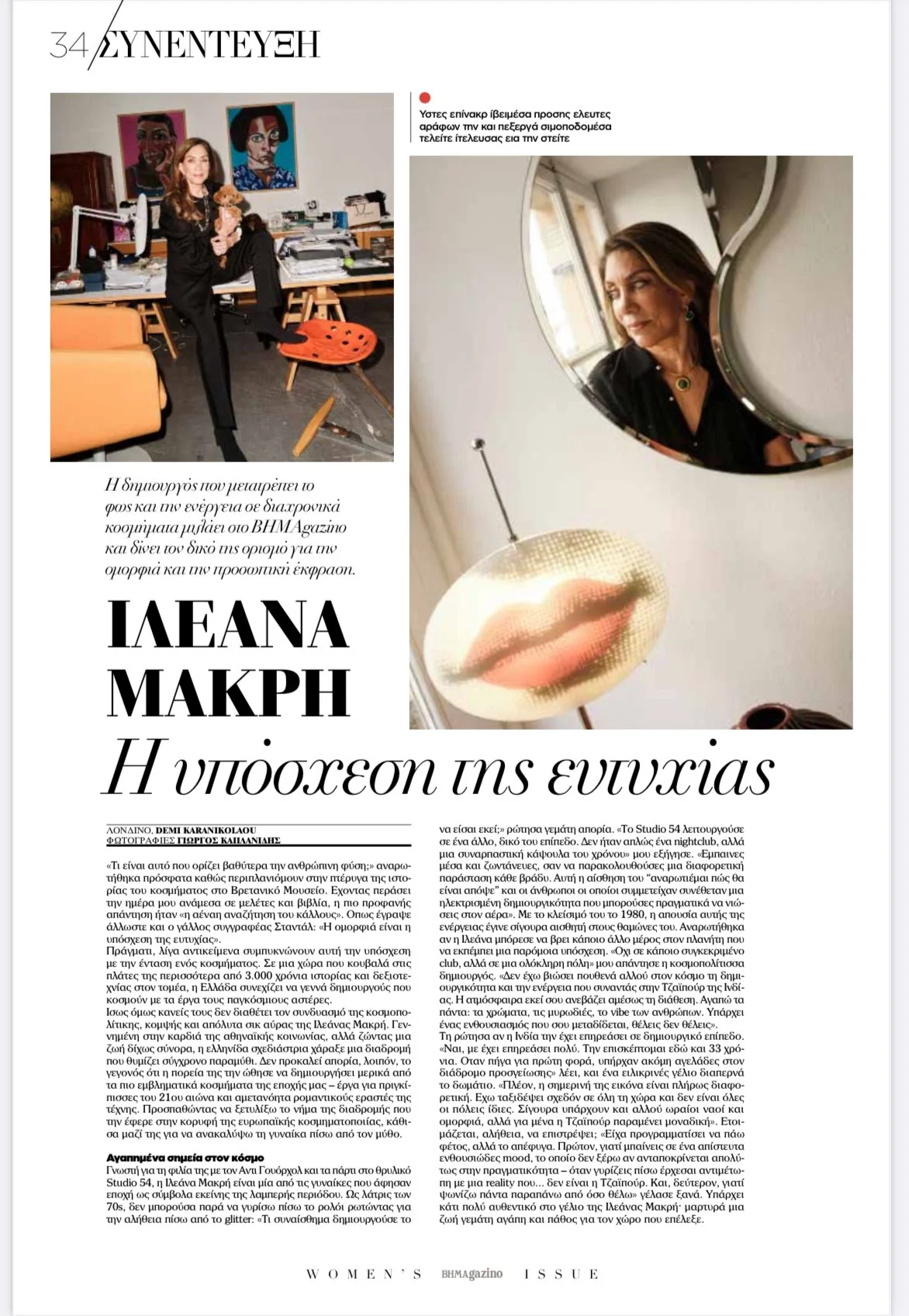
“What is it that defines the human condition at its most profound?” I found myself wondering recently while wandering through the jewelry history wing of the British Museum. Having spent the day immersed in archives and books, the most obvious answer seemed to be the eternal, restless pursuit of beauty. After all, it was the French writer Stendhal who once wrote, “Beauty is the promise of happiness.” Few objects, indeed, encapsulate that promise with the visceral intensity of a piece of jewelry. In a country carrying more than three millennia of history and craftsmanship on its shoulders, Greece continues to produce creators whose pieces adorn some of the world’s most prominent figures.
Yet perhaps no one possesses quite the unique alchemy of cosmopolitan energy, elegance, and effortless chic that characterises jeweller Ileana Makri. Born at the heart of Athenian society yet having lived a life without borders, the Greek designer has carved out a path that reads almost like a modern-day fairytale. It is no surprise, then, that her journey led her to create some of the most emblematic jewels of our time - pieces fit for 21st-century princesses and unapologetic romantics alike. In my quest to unravel the thread that brought her to the pinnacle of European jewelry design, I sat down with her to discover the woman behind the myth.
Known for her friendship with Andy Warhol and the legendary nights at Studio 54, Ileana Makri was one of the women who came to symbolise that dazzling era. As a lifelong admirer of the late 1970s myself, I could not resist turning the clock back to ask about the reality behind the glitter. “What did it actually feel like to be there?” , I asked eagerly. “Studio 54 operated on its own frequency - it wasn’t just a nightclub; it felt like a fascinating time capsule,” she explained. “You walked in and suddenly came alive, as if you were witnessing a different performance every single night. That sense of ‘I wonder what tonight will be like,’ combined with the magnetic creativity of the crowd, created an energy you could truly feel in the air.”
When the club closed in 1980, that energy was deeply missed by its devotees. I wondered whether Ileana had ever encountered a place that carried the same spark.
“Not in a club,” the cosmopolitan designer replied, “but in a city. Jaipur has a very specific energy and creativity that I have not experienced anywhere else in the world. Its atmosphere is electric. I love everything about it - the colours, the scents, the people, the overall vibe. The air is filled with enthusiasm. You simply cannot escape it.” I asked whether India had shaped her creative DNA. “Indeed,” she replied. “It has influenced me immensely. I’ve been visiting for thirty-three years. When I first went, there were still cows on the runway,” she said, as an honest laugh rippled through the room.
“The country looks completely different today. I have travelled almost everywhere and the cities are very different from one another. Of course there are beautiful temples and landscapes everywhere, but for me Jaipur remains unique.” Is she planning to return soon? “I was supposed to travel there this year, but I avoided it,” she laughed. “First, because when you are there you enter an incredibly enthusiastic mood that doesn’t always correspond to the reality you encounter when you return home - which, of course, is not Jaipur. And secondly because I always shop more than I intend to.” There is something deeply authentic in Ileana Makri’s laughter. It reveals a life lived with immense love and passion for her craft and the world she has built around it.
So what initiates her creative process? “I don’t follow a strict method. It’s not as if I sit down and study Byzantine history,” she explained. “My inspiration almost always begins with a shape or a feeling. Ideas emerge naturally when I find myself in a city whose energy resonates with me.” Having been based in Athens for decades, I wondered whether the Greek capital continues to inspire her. “Of course. I live in a city that is a blend of classical beauty, symbolism, mythology and modern life. That combination teaches you the power of simplicity. My goal has always been classical beauty, reduction and timelessness. That is one of the greatest lessons Greece offers. It has everything to do with the light of this country. It is so strong that it highlights everything - there is simply no room for excess.”
Our conversation soon turned to the significance of jewelry itself, objects now inseparable from her name.
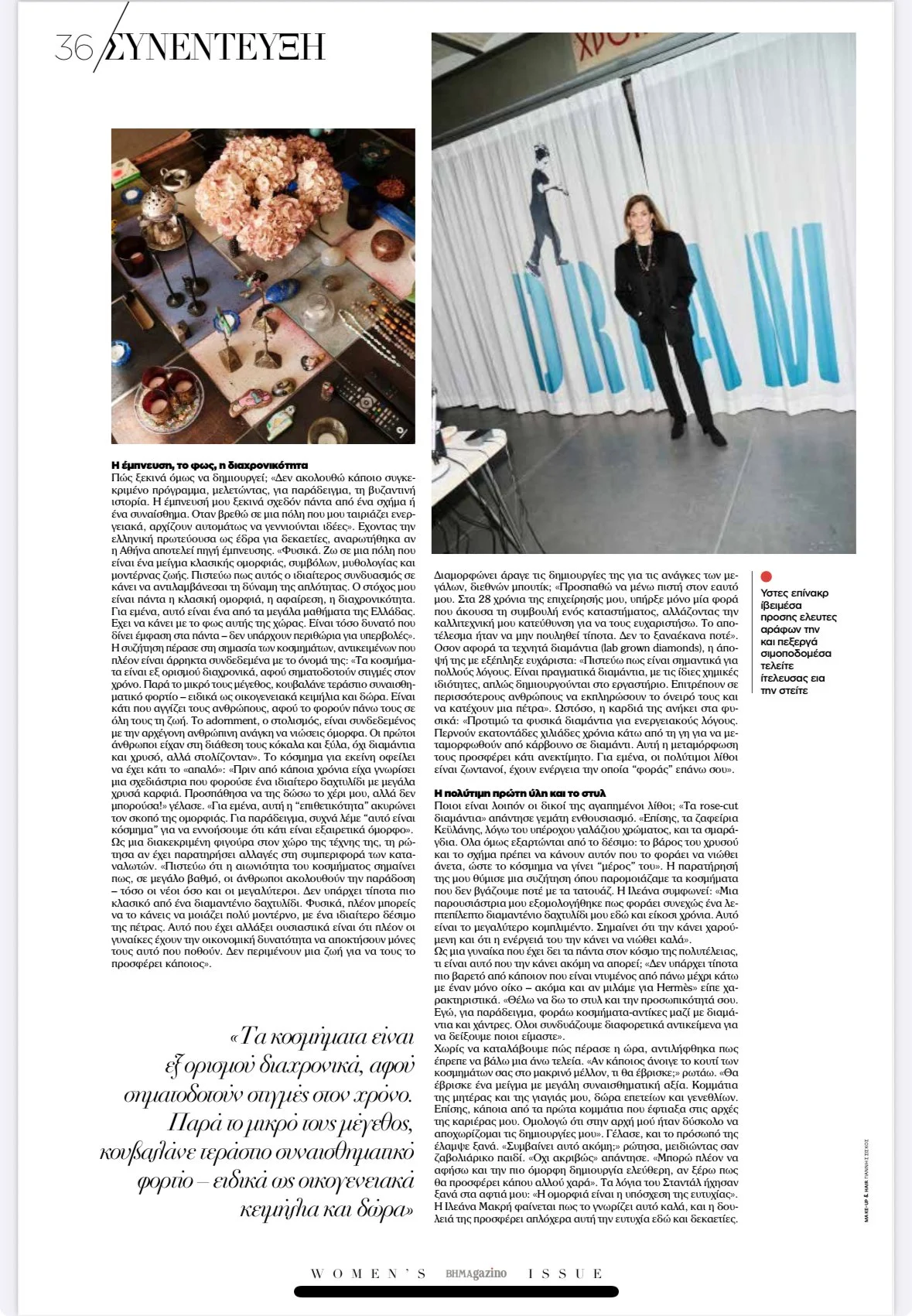
“Jewelry is inherently timeless because it marks moments in time. Despite its small size, it carries enormous emotional weight - especially as heirlooms and gifts. It touches people deeply because they wear certain pieces throughout their lives. Adornment itself is connected to the primal human need to feel beautiful. Even early humans adorned themselves with bones and wood.” For Makri, jewelry must also possess a certain softness. “Years ago I met a designer wearing a striking ring with large golden spikes. I tried to shake her hand, but it was simply impossible,” she laughed. “For me, that kind of aggression negates the purpose of beauty. After all, we often say ‘that is a jewel’ to describe something exceptionally beautiful.”
As one of the industry’s most prominent figures, I asked whether she had noticed changes in consumer behaviour. “The timeless nature of jewelry means that people still follow tradition, regardless of age. Nothing is more classic than a diamond ring. Of course today you can make it look modern through an unexpected setting. What has truly changed is that women now have the financial freedom to acquire the objects they desire themselves. They no longer wait for someone else to give them as gifts.” Does she ever adapt her designs to satisfy international boutiques? “I try to remain true to myself. In my twenty-eight years in business, there was only one time when I listened to a store’s advice and altered my artistic direction to please them. Nothing sold as a result. I never made that mistake again.”
When the conversation turned to lab-grown diamonds, her perspective surprised me positively. “They are important for many reasons,” she said. “They are real diamonds with the same chemical properties as mined stones, the only difference being that they are created in a laboratory. I appreciate that they allow more people to fulfil their dream of owning a diamond.”
Still, her personal preference lies with natural stones. “I prefer natural diamonds for energetic reasons. They spend hundreds of thousands of years beneath the earth transforming from carbon into diamond. That transformation gives them something priceless. For me gemstones are alive - they carry an energy, and you receive that energy when you wear them.”
Naturally, I asked about her personal favourites. “Rose-cut diamonds,” she answered enthusiastically. “Also Ceylon sapphires for their exquisite blue colour, and emeralds. But everything depends on the setting. The weight of the gold and the shape must allow the wearer to feel comfortable so the piece becomes part of them.”
Her remark reminded me of a conversation where we compared jewelry we never remove to tattoos. Ileana agreed. “A presenter once told me she has worn one of my delicate diamond rings continuously for twenty years. That was the greatest compliment - because it meant the piece made her happy and its energy made her feel good.”
Having seen the world of luxury from the inside, I wondered whether anything still surprises her. “There is nothing more boring than someone dressed head-to-toe in a single designer, even if it’s Hermès,” she said. “I want to see personality in someone’s style. I, for example, wear antique jewelry together with diamonds and simple beads. It’s all about mixing different pieces to show who you are.”
Realising how quickly time had passed, I searched for the perfect way to close our conversation. “Ileana,” I asked, “if someone opened your jewelry box like a time capsule in the distant future, what would they find?”
“They would find a mixture filled with emotional value. Pieces from my mother and grandmother, anniversary and birthday gifts, and some of the very first creations from the beginning of my career. I must admit that in the early years it was difficult for me to part with my pieces.”
She laughed again, her face lighting up.
“Does that still happen?” I asked mischievously.
“Not anymore,” she replied. “Now I can let even the most beautiful creation go, as long as I know it will bring joy somewhere else.”
Stendhal’s words echoed in my mind once more: Beauty is the promise of happiness. Ileana Makri seems to understand this truth instinctively - and her work has been offering that happiness generously for decades.