London Fashion Week AW26: The Season London Chose to Believe in Itself
This article was written by Demi Karanikolaou for Harper’s Bazaar Greece. You can find it here.
“Will I be seeing you in London this season?” I asked a friend who happens to be a prominent fellow fashion editor. “Yes,” she replied without hesitation. “I cannot wait for new design blood and grey skies. I’m bringing my Chanel wellies. Take me to a chic pub” she laughed. As I began planning an in-between-show itinerary of spots suitably refined for a seasoned fashion insider, I found myself reflecting on something far more interesting: how those who have witnessed the highest pinnacles of fashion still get genuinely excited to travel to London. They are not, for the most part, seeking direct competitors to Chanel or Dior. Instead, they are drawn to the designers who make the British capital thrilling season after season. Innovation, unconventionality and intellectual risk-taking have long driven the UK’s fashion identity, complemented by a handful of heritage maisons that continue to define a distinctly posh English aesthetic.
And yet, for a few years, London’s brands seemed unsure of themselves. The most visible example was Burberry. Under Riccardo Tisci, it flirted with luxury streetwear. In the early chapter of Daniel Lee’s tenure, it appeared to momentarily aspire to become the Bottega Veneta of the UK - sleek, elevated and somewhat detached from its own cultural soil.
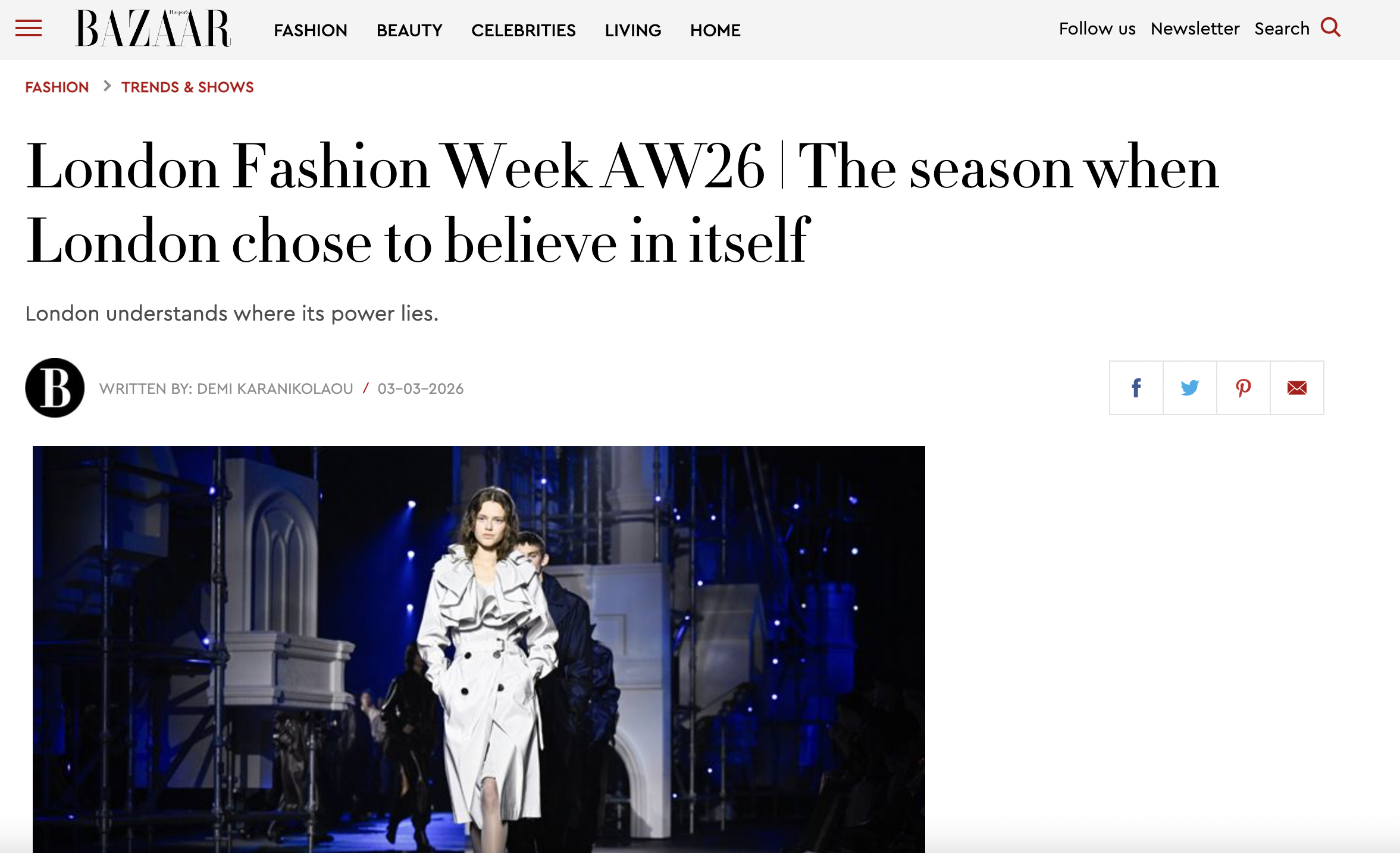
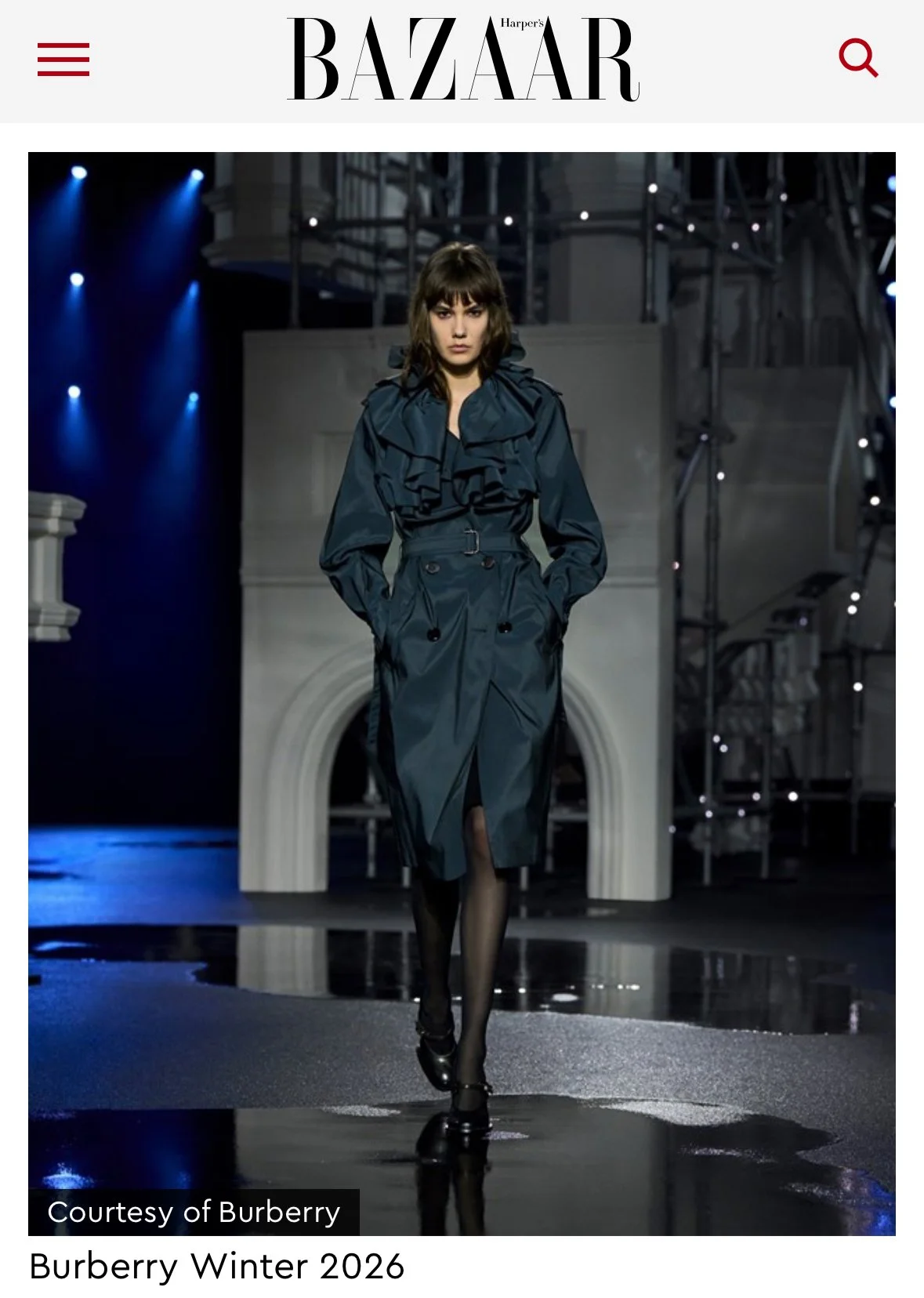
This season, however, the recalibration felt complete. Inside a darkened show space that echoed London’s damp streets - complete with man-made resin “puddles” reflecting the light - Burberry leaned fully into its reality. Impeccable coats dominated the runway, while its signature check appeared with conviction. A new print referenced the map of the London Underground. It was atmospheric, but not theatrical, confident, but not cheesy. Instead of reinventing itself, Burberry refined itself, searching for beauty in grey skies, rather than escaping them. And while the famed British maison traditionally closes the week, the same powerful sentiment resonated across the calendar.
If Burberry represented British reality with pride, the emerging designers - a true UK signature - embodied London’s restless experimentation. At Grete Henriette’s second showing, staged as a descent into Tartarus, Victorian hysteria became both reference and metaphor. Corsetry, girdle structures and sculptural silhouettes transformed vulnerability into literal armour. Her casting was impressively diverse in an industry often criticised for shrinking representation. A pearl-embellished top dripping in gold threads shimmered under the lights, destined for editorials and performances alike. Seduction here was not passive, but strategic, intellectual and unapologetic.
At Poet Lab, Giuseppe Iaciofano presented what may be his strongest collection to date. Inspired by Lady Diana yet filtered through his signature deconstruction and gender fluidity, lace, sequins and bows felt romantic without tipping into nostalgia. “I don’t go by the rule book,” he told me backstage. “I lead from the heart, not the head.” Known for his activism and inclusive ethics, the Italian designer consistently challenges stereotypes. “I think modern fashion should be much more about finding new ways to feel free rather than feel restrained. Everyone can wear Poet Lab.” Even amid conceptual layering, he remained pragmatic: “It needs to be wearable art, yes, but like any brand, we also need to sell.” That balance of poetry and purpose defined much of the week.
Mithridate, showing at Tate Britain, offered another form of grounded evolution. Under Daniel Fletcher, the brand appears to have found a confident rhythm between its Guangzhou roots and its London home. Rich outerwear, preppy silhouettes, sharp tailoring and carefully considered accessories spoke to a wardrobe that feels genuinely practical and put together, rather than performative. The Mithridate man and woman are relaxed yet refined, like an old-money heiress who has nothing to prove. The narrative of migration and planted roots mirrored London itself - a metropolis steeped in tradition yet shaped by constant change, now even more self-assured in its hybrid identity.
If London’s power lies in discovery, then one of its quietest yet most compelling stars this season was George Trochopoulos. Forgoing a runway spectacle, the Greek designer opted for private appointments - an understated move entirely aligned with his philosophy. His manipulation of wool into sculptural forms revealed extraordinary technical sensitivity. “The idea of this collection is based around tension,” he explained privately, “and how, even though it can be destructive at times, it can also be something beautiful when treated with softness, care and time.” Silhouettes were built through structure and control, softened by slouchy necklines and fluid movement. Trochopoulos’ muse, he says, does not obsess over perfection. “She doesn’t necessarily care about absolute perfection in a strict sense, but about her clothes being good quality and truly reflecting herself. She wouldn’t mind if a dress gets ripped and she has someone sew it for her, because she knows it will reflect her story.” There is something deeply London about that attitude - confident, autonomous and unconcerned with rigid polish. I suggested that a sculptural skirt-suit combination would be perfect for a Solange music video. “Why not also wear this massive wool bubble top to dinner?” he laughed. “It’s outrageous, but it’s about moving out of a rigid space into something more optimistic and dreamy.” In a week defined by recalibration, his quiet confidence symbolised the capital perfectly: promising, brooding and undeniably talented.
Elsewhere, Di Petsa continued to command one of the week’s hottest tickets. Showing in the opulent Apollo’s Muse Room at Bacchanalia, Dimitra Petsa presented Medusa’s Lover - a collection that expanded into menswear and bridal with notable clarity. Her signature wet look was present, but evolved through lace, tulle and new draping techniques that mimicked the movement of a snake. “We developed a new technique that mirrors that motion,” she told me backstage. If past seasons were about emergence, this one felt about ownership. “Erotic fashion has often been considered lowbrow,” she reflected. In her hands, sensuality remains intellectual - a language of empowerment rather than attention. Despite drawing heavily from Greek mythology season after season, the house consistently reinvents itself while delighting its clientele. “We asked ourselves: where does Dipetsa go next? What is this next chapter?” Petsa noted.
Even Fiorucci, the Milanese brand deeply entwined with London’s creative scene, surprised many with a presentation rich in glamour and wearability. Dalmatian-print dresses, lace camisoles paired with patent red skirts and bold headpieces delivered sex appeal without irony. In mostly black, white and red, the collection seemed refined, confident and unapologetically fun.
And perhaps that is what defined London this season. Not noise, spectacle or insecurity, but belief. On a calendar that once struggled with international pull and post-Brexit uncertainty, this February felt fuller, but more importantly, clearer. For the first time in a while, London no longer appeared interested in competing directly with Paris or Milan, but in understanding exactly where its strength lies: in incubation, in risk, in talent still forming but already very promising. Because at the end of the day, London does not promise pretentiousness or absolute perfection - in fact, it often mocks pearl-clutching stereotypes - it promises possibility. And this season, confident in its grey skies and true identity, it chose to believe in itself.