
A Trojan Horse in the Museum: How the Parthenon Marbles Conquered the British Imagination
This article was written by Demi Karanikolaou for Vimagazino / To Vima Greece - print & digital
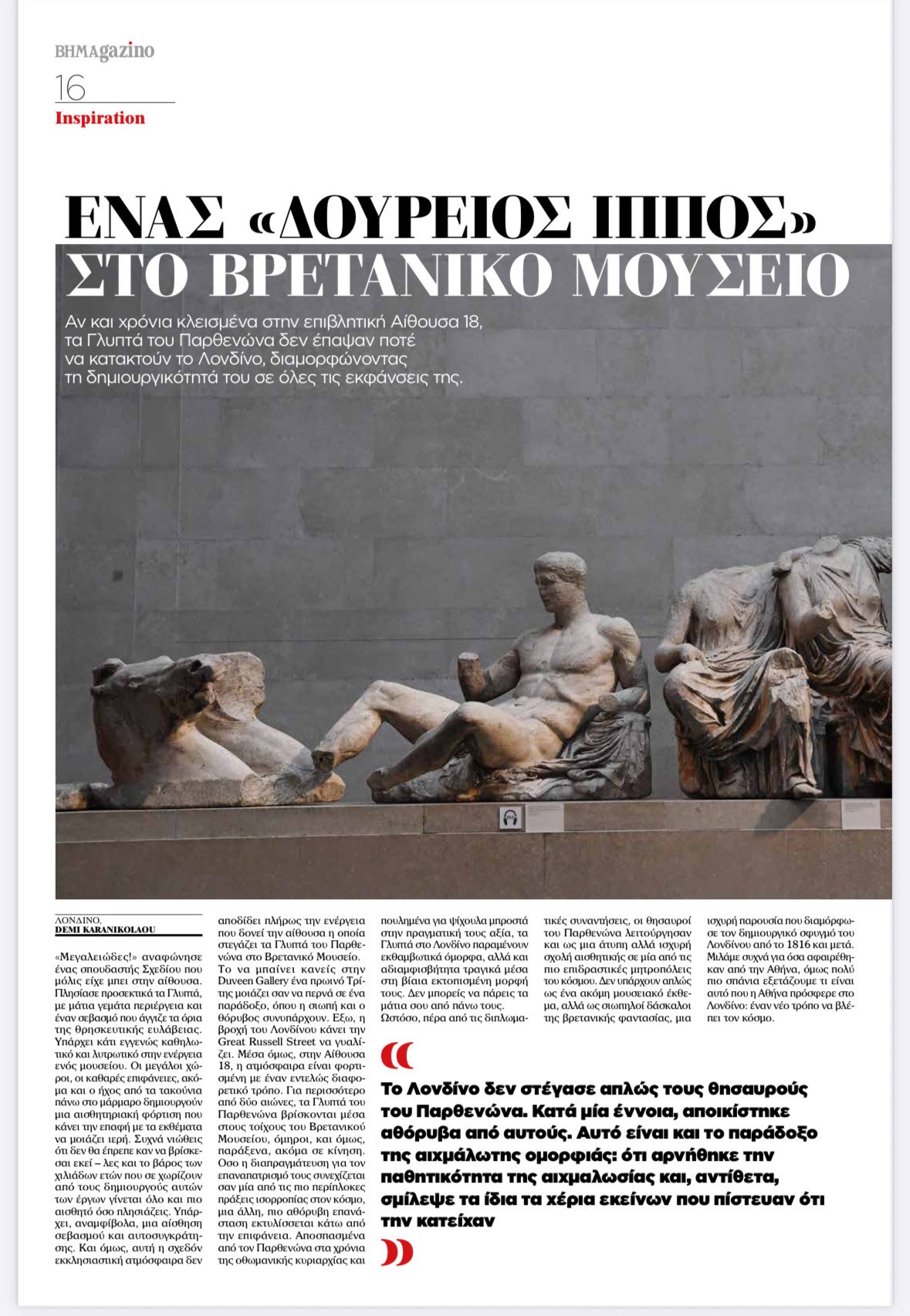
“Magnificent,” exclaimed a drawing student who had just stepped into the room. He moved carefully towards the artefacts, his eyes full of curiosity and a reverence that bordered on the religious. There is something inherently compelling and cathartic about the energy of a museum. The wide spaces, the clean surfaces, even the sound of heels against marble floors create a kind of sensory overload that makes encountering the objects on display feel almost sacred. Often, it feels as though one is not entirely meant to be there, as if the weight of the thousands of years separating the modern viewer from the makers of those works becomes more palpable the closer one moves towards them. There is, undoubtedly, a sense of respect, composure, and even holiness. And yet, that almost ecclesiastical atmosphere does not fully capture the energy that pulses through the room housing the Parthenon Marbles at the British Museum.
Walking into the Duveen Gallery on a Tuesday morning feels like stepping into a paradox where silence and noise coexist. Outside, the London rain makes Great Russell Street glisten. Inside, in Room 18, the air is charged with an entirely different kind of weight. For more than two centuries, the Parthenon Marbles have stood within the walls of the British Museum, hostage and yet somehow still in motion. While negotiations over their repatriation continue like one of the most delicate balancing acts in the world, another, quieter revolution has been unfolding beneath the surface. Removed from the Parthenon during Ottoman rule and sold for a fraction of their true worth, the Marbles in London remain dazzlingly beautiful, yet undeniably tragic in their violently displaced form. You cannot take your eyes off them.
And yet, beyond diplomatic meetings, the Marbles have also functioned as an unofficial but powerful school of aesthetics in one of the world’s most influential metropolises. They do not exist merely as another museum exhibit, but as silent tutors to the British imagination, a powerful presence that has shaped the rhythm of London’s creative pulse since 1816. We often speak of what was taken from Athens, but far more rarely do we consider what Athens, in turn, gave London: a new way of seeing the world.
Is this, perhaps, the ultimate Trojan horse of aesthetics? While fragments of the Parthenon remain fixed in the space they were given, their visual language has long since infiltrated the city’s artistic consciousness from within. They carry the vocabulary of ancient Greece deep into the fabric of British culture, inscribing its ideals so thoroughly that they have become one of its almost invisible foundations. London did not simply house the Marbles. In a sense, it was quietly colonised by them. That is the paradox of captive beauty: it refused the passivity of imprisonment and instead shaped the very hands of those who believed they possessed it.
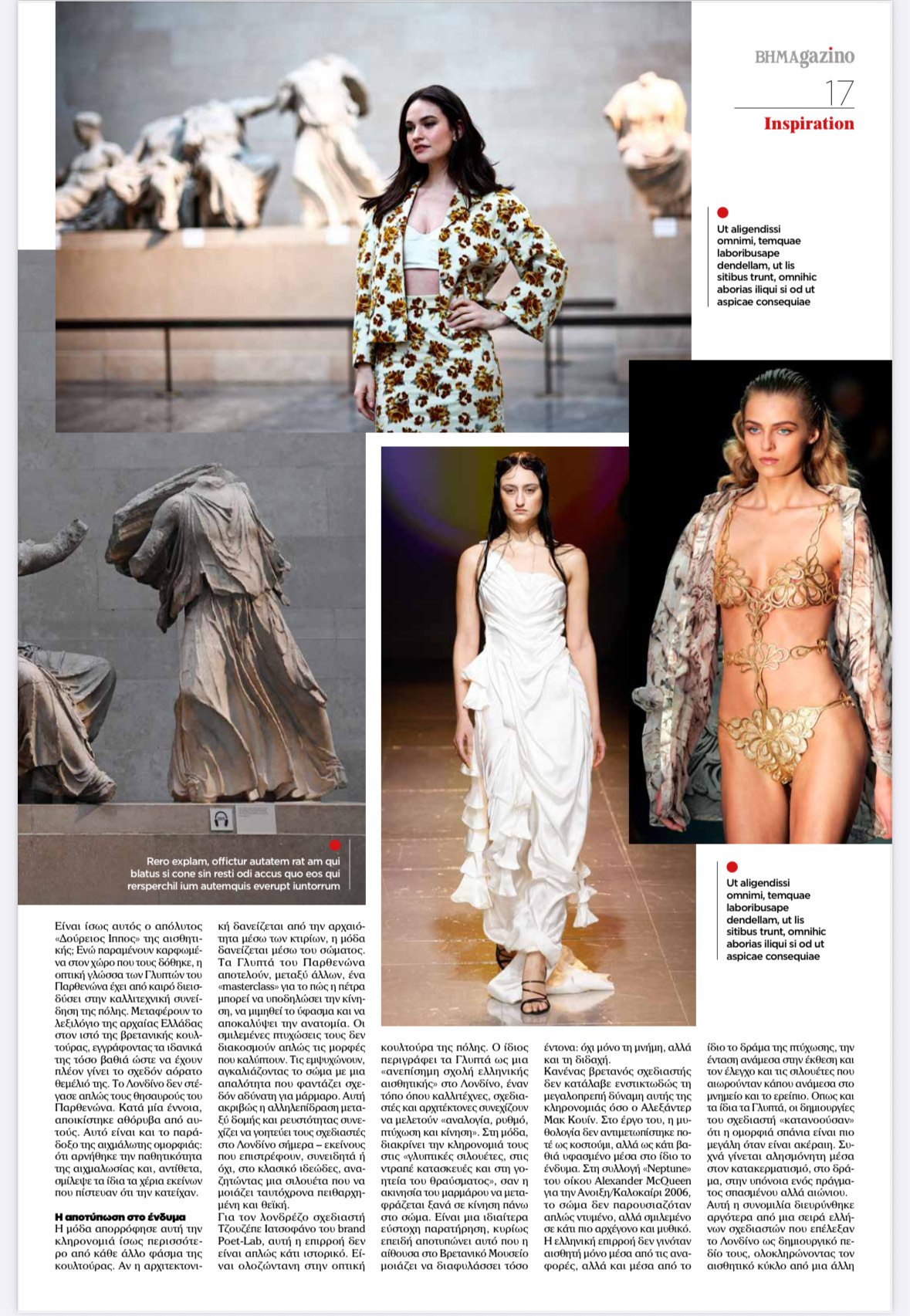
Fashion absorbed this inheritance more intimately than perhaps any other realm of culture. If architecture borrows from antiquity through buildings, fashion borrows through the body. The Parthenon Marbles are, among many things, a masterclass in how stone can suggest movement, mimic fabric, and reveal anatomy. Their carved drapery does not simply decorate the figures it covers. It animates them, clinging to the body with a softness that feels almost impossible in marble. It is precisely this interplay between structure and fluidity that continues to fascinate designers in London today, those who return, knowingly or not, to the classical ideal in search of a silhouette that feels at once disciplined and divine.
For London-based designer Giuseppe Iaciofano of PoetLab, this influence is not simply historical. It is still alive in the city’s visual culture. He describes the Parthenon Marbles as “an unofficial school of Greek aesthetics” in London, a place where artists, designers, and architects continue to study “proportion, rhythm, drapery, and movement”. In fashion, he sees their legacy in “sculptural silhouettes, draped constructions, and a fascination with fragmentation”, as if the stillness of marble were being translated back into motion on the body. It is an especially perceptive observation, not least because it captures what the room at the British Museum seems to preserve so intensely: not only memory, but instruction.
No British designer understood the majestic force of that inheritance more instinctively than Alexander McQueen. In his work, mythology was never treated as costume, but as something woven deep into the garment itself. In his AW06 collection, Neptune, the body appeared not simply dressed, but sculpted into something more elemental and mythic. The Hellenic influence revealed itself not only through reference, but through the drama of drape, the tension between exposure and control, and silhouettes hovering somewhere between monument and ruin. Like the Marbles themselves, McQueen’s work understood that beauty is rarely at its most powerful when it is whole. More often, it becomes unforgettable through fragmentation, drama, and the suggestion of something broken yet eternal.
That conversation was later broadened by a generation of Greek creatives who chose London as their field of expression, completing the aesthetic circle from another direction. The late Sophia Kokosalaki was among the first to prove that something ancient could become radically modern. Her mastery of drapery, intricate and deeply rooted in a Greek sensibility, translated the stone folds of the Marbles into a sharp, contemporary elegance that helped redefine London style in the early 2000s. She did not simply design dresses. She constructed sculptures for the human form.
The baton was later taken up, in very different ways, by designers such as Mary Katrantzou and Dimitra Petsa. Katrantzou’s visual world often turned to the classical past in order to build a hyper-modern future, using the symmetry and decorative intensity of Greek heritage in bold, almost architectural prints. Di Petsa, by contrast, borrowed the wet drapery of the Duveen Gallery and transformed it into something deeply physical: a language of sensuality, feminine power, and emotional exposure. Her wet-look garments echo the way Parthenon figures seem to emerge simultaneously from fabric and stone, reclaiming ancient aesthetics as a dynamic, contemporary language of the body.
If McQueen absorbed the psychic force of antiquity, Erdem staged a more literal dialogue with it. For his AW24 collection, he placed his designs in direct conversation with the Marbles, drawing inspiration from Maria Callas in the 1953 production of Medea. It was a vision of Greekness refracted through multiple layers of displacement: an uprooted icon, Greek by blood and global by myth, placed in a room that has itself become synonymous with exile. Much like the Marbles, Callas belonged to the world, yet remained inseparable from the question of origin. By bringing the operatic drama of Medea into the Duveen Gallery, Erdem proved that these sculptures are not static relics, but living forces in the city’s contemporary imagination. They continue to offer a vocabulary of line, balance, and elegance that can still be translated into cloth.
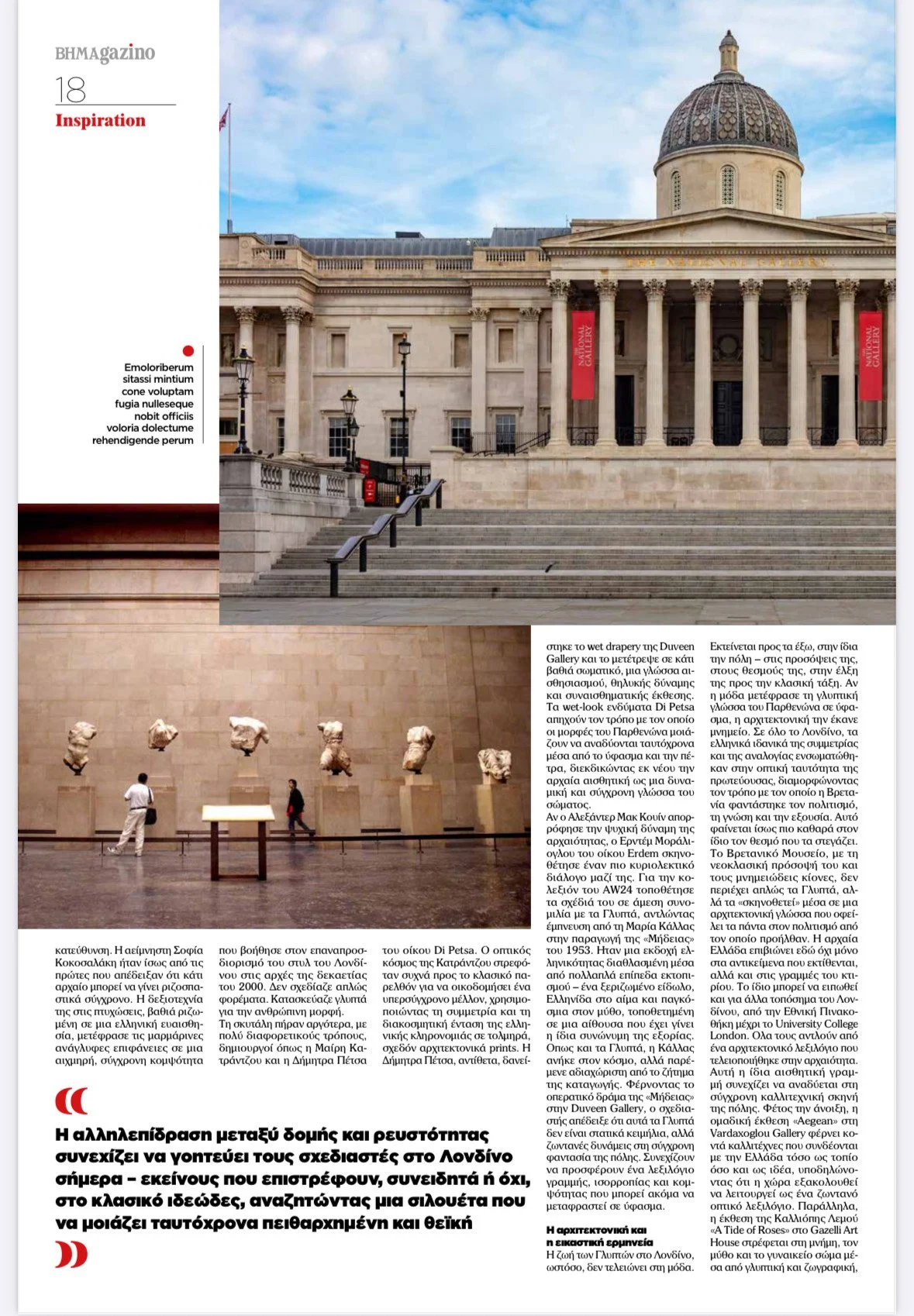
The Marbles’ afterlife in London, however, does not end with fashion. It extends outward into the city itself, into its facades, its institutions, and its attraction to classical order. If fashion translated the sculptural language of the Parthenon into cloth, architecture rendered it monumental. Across London, Greek ideals of symmetry and proportion became embedded in the visual identity of the capital, shaping the way Britain imagined culture, knowledge, and power. This is perhaps most clearly visible in the very institution that houses them. The British Museum, with its neoclassical facade and monumental columns, does not merely contain the Marbles; it stages them within an architectural language that owes everything to the civilisation from which they came. Ancient Greece survives here not only in the objects on display, but in the lines of the building itself. The same can be said of other London landmarks, from the National Gallery to University College London. All of them draw on an architectural vocabulary perfected in antiquity.
That same aesthetic lineage continues to surface in the city’s contemporary art scene. This spring, the group exhibition Aegean at Vardaxoglou Gallery brings together artists connected to Greece both as a landscape and as an idea, suggesting that the country continues to function as a living visual vocabulary. At the same time, Kalliopi Lemos’s A Tide of Roses at Gazelli Art House turns to memory, myth, and the female body through sculpture and painting, extending that Hellenic inheritance into a distinctly contemporary register. If the Marbles remain the city’s most symbolic Greek presence, they are no longer its only one. Across London’s galleries, the ancient language of form continues to reappear, fragmented and reimagined, yet unmistakably alive.
Ultimately, the story of the Parthenon Marbles in London is not only one of displacement, but of influence. Centuries ago, Horace wrote of another conquest: Graecia capta ferum victorem cepit - “Captive Greece conquered her savage victor.” He was speaking, of course, of Rome, and yet the line feels no less apt here: a culture uprooted from its place of origin, returning through beauty, structure, and the slow seduction of the eye, until it begins to reshape the imagination of the very world that seized it.
Walking through London today, you can feel that influence everywhere. In the pleat of a garment, in the city’s facades, in its enduring appetite for classical beauty, the Marbles continue to exert a force far beyond the walls of Room 18. Their influence has passed through the city’s designers, artists, architects, and institutions so deeply that it now feels almost inseparable from London itself. In the end, the Marbles were never passive objects of admiration. They became a Trojan horse, teaching London, slowly and almost imperceptibly, how to dream in Greek.