
The Artist and the Muse - Rewriting the Feminine at London Fashion Week
This article was written by Demi Karanikolaou for Vimagazino / To Vima Greece - print
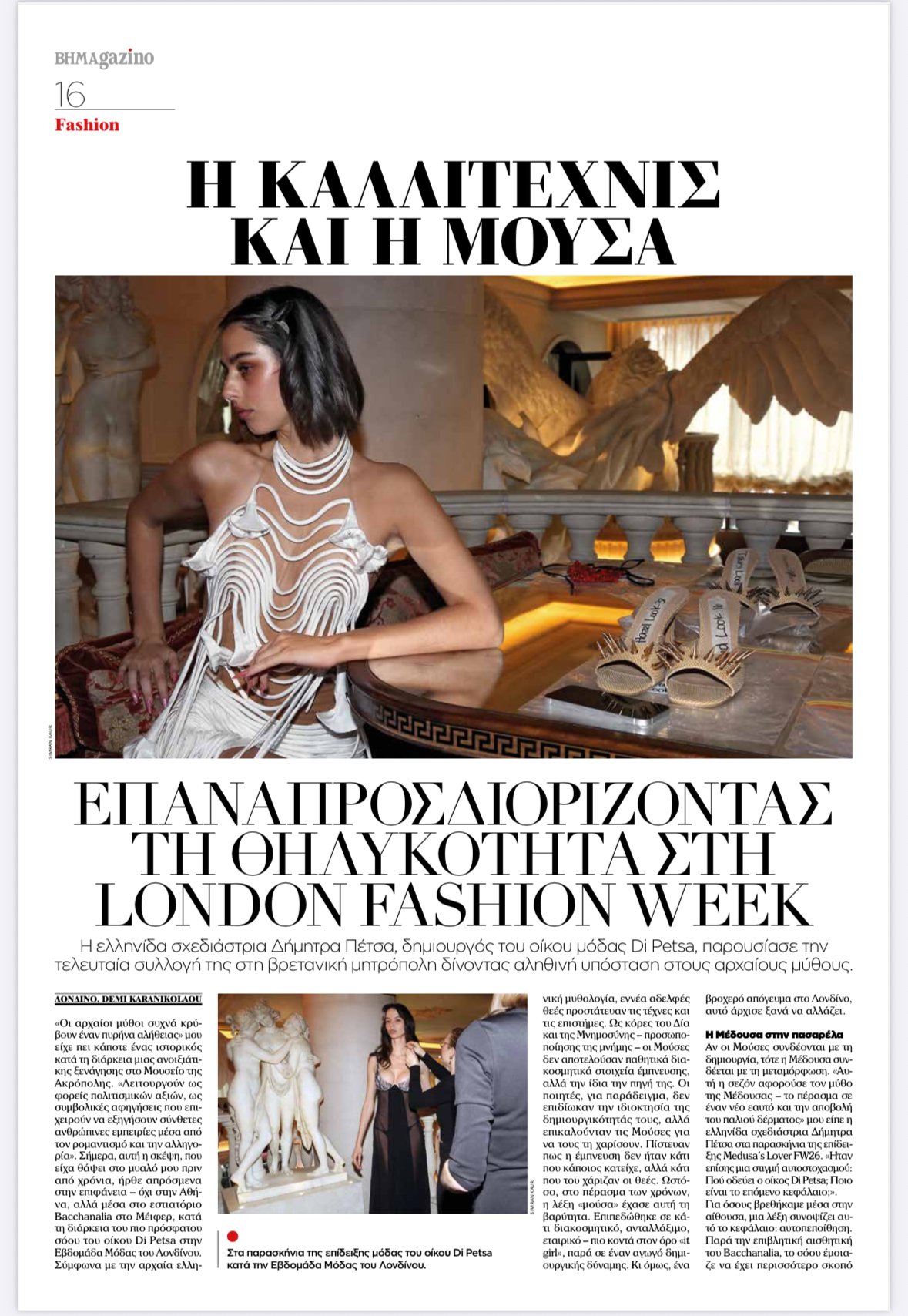
“Ancient myths often carry a kernel of truth,” a historian once told me during a spring afternoon tour of the Acropolis Museum in Athens. “They are vessels for cultural values, symbolic narratives designed to explain complex human experience through romance and allegory.” Today, the thought, which I had quietly filed away years ago, resurfaced unexpectedly - not in Athens, but inside Bacchanalia in Mayfair, during Di Petsa’s FW26 show at London Fashion Week.
In ancient Greek mythology, nine divine sisters presided over the arts and sciences. Born of Zeus and Mnemosyne - Memory herself - the Muses were not passive ornaments of inspiration, but its source. Poets did not claim ownership over their own creativity; they invoked the Muses to bless them with it. Inspiration was something granted, not possessed. Somewhere along the way, however, the word “muse” lost that gravity. It became flattened into something decorative, interchangeable, corporate - closer to an “it girl” than a conduit of divine force. And yet, on a rainy London afternoon, this changed once again.
Medusa on the runway
If the Muses presided over creation, then Medusa presided over transformation. “This season was all about the myth of Medusa - stepping into a new self, shedding old skin,” said Greek designer Dimitra Petsa backstage at her FW26 show, Medusa’s Lover. “It was also a moment of asking ourselves: where does Dipetsa go next? What is this next chapter?”
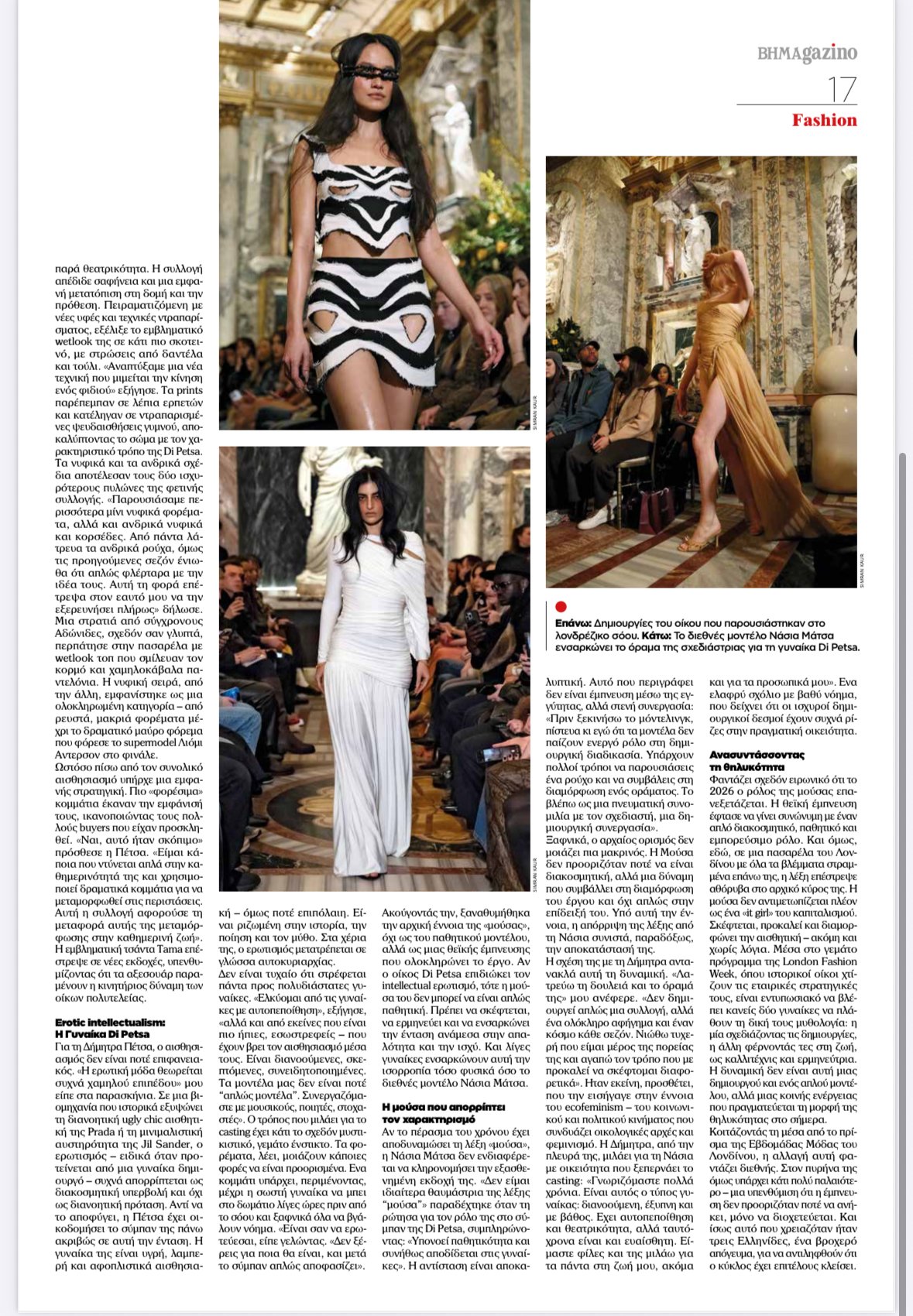
For those in the room, one word summarised that next chapter: confidence. Despite Bacchanalia’s opulent setting, the show felt more deliberate than theatrical. The collection arrived with clarity and a noticeable shift in structure and intention. Playing with new draping techniques and textures, her signature wetlook evolved into something darker, layered with lace and tulle. “We developed a new technique that mimics the movement of a snake,” she explained. Prints referenced serpent scales before diffusing into draped nude illusions, revealing bodies in a distinctly Di Petsa way - sensual yet with an intellectual flair.
Bridal and menswear formed the two strongest pillars of this season’s expansion. “We introduced more bridal minis, bridal for men, corsetry for men. I’ve always loved designing menswear, but in previous seasons it felt like a tease. This time I allowed myself to explore it more fully,” said the designer. An army of sculpted, modern Adonises strode down the runway in wetlook tanks carving out torsos and sharply cut low-rise trousers. Bridal, meanwhile, appeared as a fully fledged category, from long fluid gowns to the dramatic black finale dress worn by supermodel Leomie Anderson.
Beneath the sensuality, there was pragmatism. More wearable pieces emerged, delighting enamoured buyers who filled the room. “Yes, that was intentional,” Petsa added. “I’m someone who underdresses in my everyday life, and then uses dramatic pieces to transform for occasions. This collection was about bringing that transformation into everyday life.” Her signature Tama bag returned in new iterations - a reminder that accessories remain the powerhouse of most luxury maisons.
Erotic Intellectualism & the Di Petsa woman
For Dimitra Petsa, sensuality has never been accidental or shallow. “Erotic fashion has often been considered lowbrow,” she told me backstage. The comment resonated. In an industry that historically idolises the intellectual ugly-chic aesthetic of Prada or the conceptual restraint of Jil Sander, eroticism - especially when proposed by a woman herself - has often been dismissed as decorative excess rather than intellectual proposition. Petsa has built her universe precisely in that tension. Her woman is wet, luminous and unapologetically sexy, yet she is never frivolous. She is rooted in history, poetry and myth, carrying an unapologetic confidence that echoes something almost divine. Eroticism, in her hands, becomes a language of self-assurement.
It is no coincidence that the women she gravitates toward are rarely one-dimensional. “I am drawn to confident women,” Petsa explained, “but also to those who are gentle, introverted - who find sensuality within themselves. They’re intellectual, smart, thoughtful, aware. Our models are never just models. We work with musicians, poets, thinkers.” There is instinct in the way she speaks about casting - almost something mystical. Dresses, she says, sometimes feel destined. A piece exists, waiting, until the right woman walks into the room hours before the show and suddenly the alignment is undeniable. “It’s like when you fall in love,” she laughed. “You don’t know who it will be, and then the universe decides.”
Listening to her, I found myself returning to the original meaning of a Muse - not as a passive model, but as a divinely charged inspiration that completes her work. If Dipetsa reclaims sensuality as intellectual, then her muse cannot simply be looked at. She must think, interpret and embody the tension between softness and command. She must understand that eroticism, in this universe, is not spectacle but an active decision. And few embody that balance more intuitively than fellow Greek model Nassia Matsa.
The Muse Who Rejects the Word
If the word muse has been diluted over time, Nassia Matsa is not interested in inheriting its softened meaning. “I’m not particularly a fan of the word ‘muse,’” she admitted when I asked her about her role within the Dipetsa universe. “It implies passivity and we usually attribute that role to women.” The resistance is justified. What she describes instead is not inspiration by proximity, but collaboration. “Before I started modelling, I also thought models didn’t play an active role in the creative vision. But there are many ways to sell clothes and set a vision. I see it as a conversation with the designer - speaking visually.” Suddenly, the ancient definition feels less distant. The Muse was never meant to be ornamental, but a force that helps shape creation rather than simply adorn it. In that sense, Nassia’s rejection of the word is, paradoxically, its restoration.
Her relationship with Dimitra reflects that dynamic. “I love Di Petsa’s work and vision,” she told me. “She doesn’t just create a collection but a whole narrative and cosmos each season. I’m very lucky to be part of her journey, and I love how she challenges the way I think.” It was Dimitra, she added, who first introduced her to the concept of ecofeminism - an intellectual framework that quietly underpins the brand’s mythology of feminine power. Dimitra, for her part, speaks of Nassia with a familiarity that extends beyond casting. “Nassia and I have known each other for many years,” she said. “She is this kind of woman - deep, intellectual, very smart. She’s confident and theatrical, but also soft and sensitive. We’re friends and I talk to her about everything in my life, even my love life.” A light comment with deep meaning, showing that strong creative bonds are often rooted in real intimacy.
Rewriting the Feminine
It feels almost ironic that in 2026, the role of the muse is once again being renegotiated. What was once divine inspiration became decorative shorthand, softened into something passive and marketable. And yet here, on a London runway defined by global visibility, the word quietly returned to its original gravity. The muse is no longer treated as a marketable “it girl.” She thinks, challenges and shapes the narrative - sometimes without even using words.
On a fashion week schedule filled with heritage houses and corporate machinery, it was striking to witness two Greek women shaping their own mythology - one by crafting the creations, the other by embodying them as an artist and interpreter. Not as creator and ornament, but as a shared force negotiating what femininity can look like now.
Viewed through the lens of London Fashion Week, the shift felt global. But at its core, it was something older. A reminder that inspiration was never meant to be owned - only channelled. And perhaps, all it took was three Greek women, on a rainy afternoon, to notice that it has all come full circle.