
This article was written by Demi Karanikolaou for Vimagazino / To Vima Greece - print & digital here
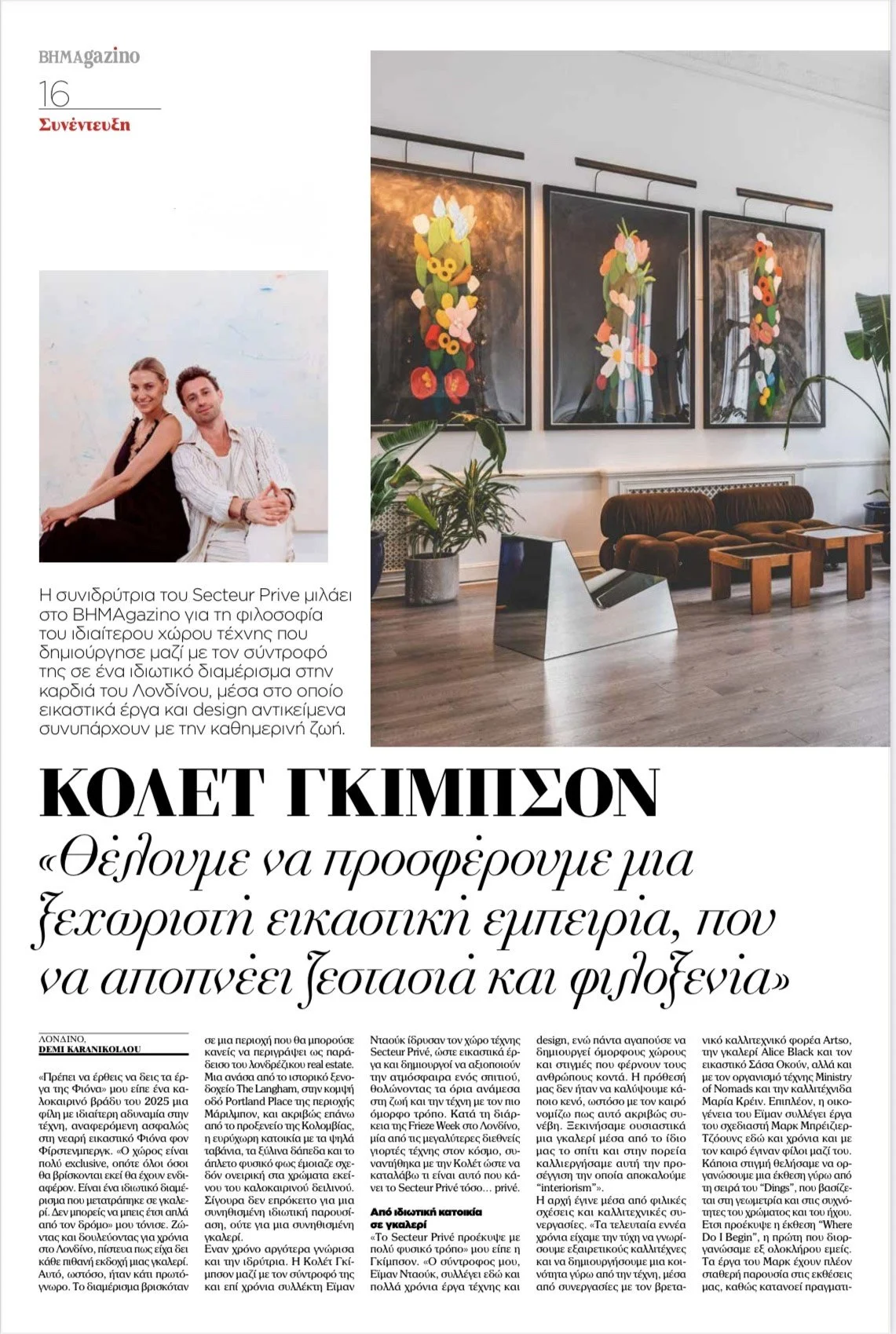
“You should come and see Fiona’s pieces,” a friend and well-known art aficionada told me one summer evening in 2025. “The venue is very exclusive, so everyone there will be interesting. It’s actually a private apartment turned gallery. You can’t just walk in.” She was referring, of course, to the young artist Fiona von Fürstenberg.
After years of living and working in London, among friends for whom art was as much a social pleasure as a cultural pursuit, I thought I had encountered every variation of the gallery experience. This, however, was a first.
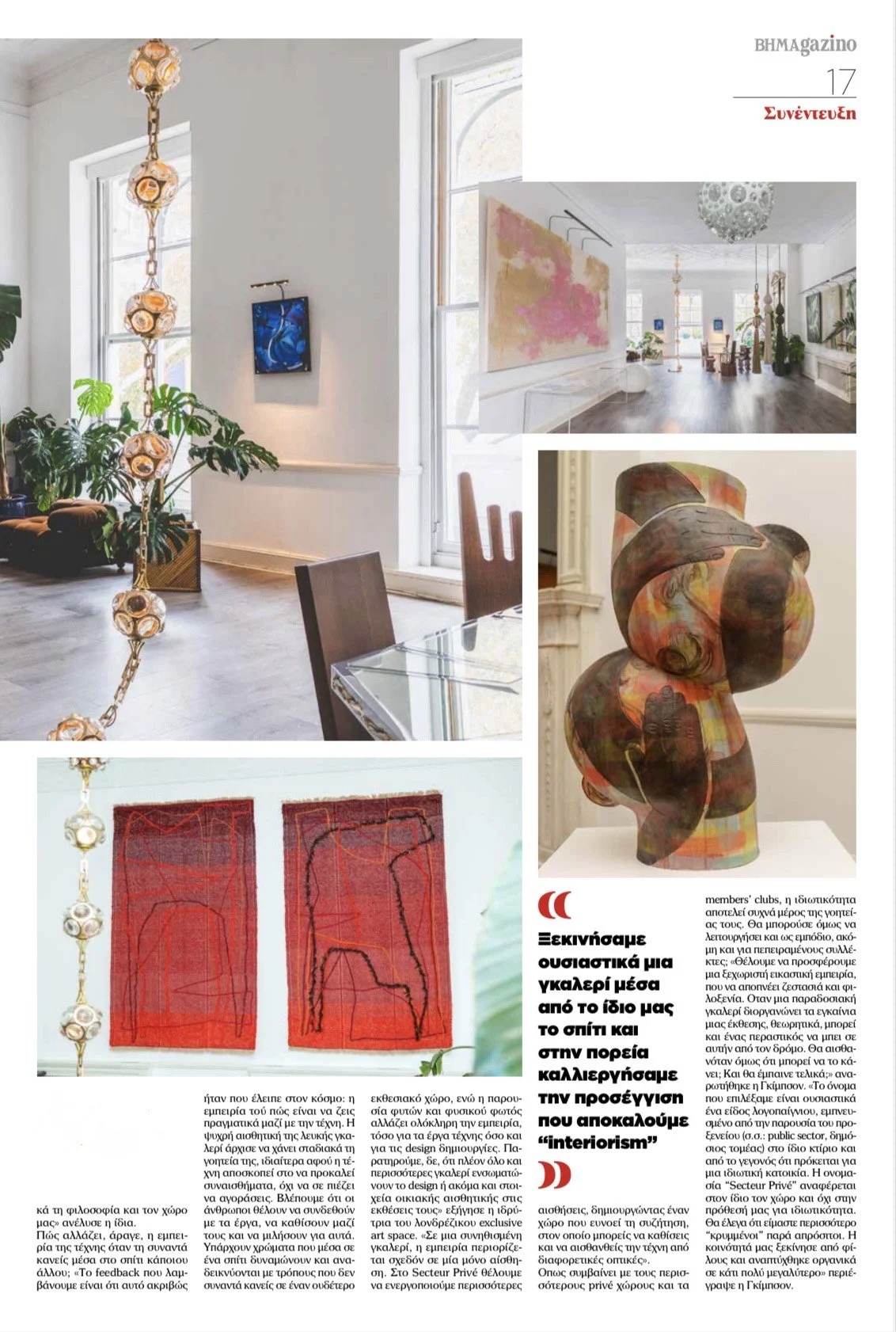
The apartment was situated in something of a London real estate paradise. A stone’s throw from the historic Langham hotel, on elegant Portland Place in Marylebone and just above the Colombian consulate, the spacious residence, with its high ceilings, parquet floors and abundant natural light, looked almost dreamlike in the lingering glow of a summer evening. Except this was no ordinary private view, and certainly no ordinary gallery.
A year later, I was introduced to Colette Gibson, who, together with her partner and longtime art collector Ayman Daouk, had transformed their own home into Secteur Privé, a contemporary gallery where emerging and established artists share space with collectible design, and the boundaries between living and collecting become wonderfully blurred. I caught up with Gibson during London’s Frieze Week to discover what makes Secteur Privé quite so privé.
From private home to gallery
“Our journey to Secteur Privé was quite organic,” Gibson told me. “My partner, Ayman Daouk, who founded Secteur Privé, has long been a collector of both art and design and has always had a passion for creating beautiful spaces and moments with people. We weren’t trying to fill any gaps, but over time, that is perhaps what inevitably happened. We started a gallery basically from our private home, which became a concept we really honed as an act of ‘interiorism’.”
It began with friendships and artistic collaborations. “Over the last nine years, we were fortunate to meet incredible artists and build an art community, collaborating with Artso and Alice Black with artist Sasha Okun, and with Ministry of Nomads and Maria Kreyn. Ayman’s family had been collecting Mark Brazier-Jones’s work for years, and he became a dear friend. We wanted to create a show around his new series, the Dings, based on sacred geometry and frequencies of colour and sound. That led to Where Do I Begin, our first self-produced exhibition. Mark’s works are now a regular feature in our shows; he really understands our concept and space.”
How, I wondered, does seeing art in a private home change the experience?
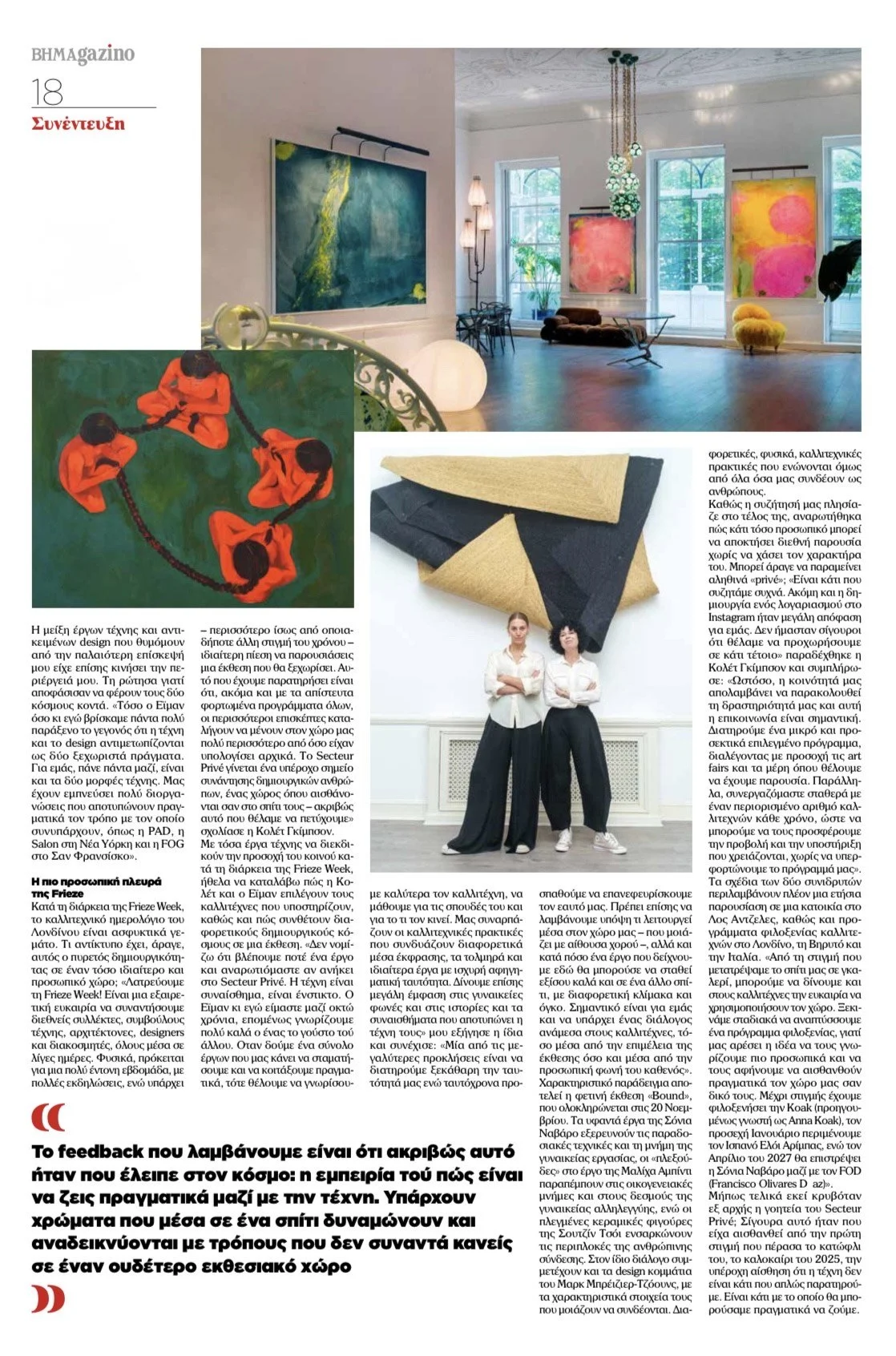
“Since we launched, the feedback we received was that this was what was missing in the art world: the experience of living with art. The cold aesthetic of the white cube was becoming less desirable, especially when art is meant to evoke a feeling, not apply pressure to buy,” she explained. “We find that people want to relate to the works, to sit with them and talk about them. There are colours that challenge or amplify in a domestic environment in ways that aren’t reflected in a white-cube space. Having plants and natural light changes the whole experience, both for art and design. We are definitely seeing more art galleries include design or a domestic aspect in their booths at art fairs and exhibitions.”
As she put it, “In a gallery, you are just hit with one sense. At Secteur Privé, we aim to hit multiple senses, while creating a place to build a conversation, to sit and feel the art from different perspectives.”
As with most private spaces and members’ clubs, privacy is often part of the appeal. Could it, however, also be a barrier, even for serious collectors?
“We want to offer a unique experience that feels warm and inviting. When traditional galleries have an opening, yes, anyone can walk in from the street, but would they, and does it feel like they could?” Gibson asked. “The name is really a play on words, from our location inside a consulate and the fact that it is a private home. Secteur Privé refers to the space rather than our concept being private and exclusive. We think we’re more caché, hidden, than exclusive. Our community started with friends and organically grew into something much bigger.”
The mix of artworks and design objects I remembered from my visit also made me curious. I asked her why they decided to bring the two together.
“Ayman and I have both found it really odd that the two have always been separated. For us, they go hand in hand; both are art and should be looked at together. We’ve always been inspired by fairs like PAD, which really embody how art and design live together, alongside Salon in New York and FOG in San Francisco.”
An intimate Frieze
During Frieze Week, London’s art calendar seemed to compete for every available hour. What did that whirlwind bring to such an intimate space?
“We love Frieze Week! It’s a perfect chance to connect with international collectors, advisers, architects, designers and decorators all at once. Of course, it’s an overwhelming week with so many events, and there’s a certain pressure to have a show that stands out, perhaps more than at any other time. What we’ve witnessed is that, even with everyone’s incredibly busy schedules, once they visit our space, most end up staying a lot longer than they intended. It’s a wonderful meeting hub of creativity and a place to feel at home, which is exactly what we intended.”
With so much art competing for attention during Frieze Week, I was equally curious about how Colette and Ayman select the artists they champion, and what brings their individual creative worlds together in an exhibition.
“I don’t think we ever think of something as belonging to Secteur Privé. Art is a feeling; it’s instinctive. Ayman and I have been together eight years, so we know each other’s tastes,” she said. “When we see a body of work and it makes us stop and really look, we want to get to know the artist better, learn about their education and what drives them. We’re fascinated by multidisciplinary practices, bold, unique work and strong narratives. We have a strong focus on female voices and the stories and feelings their art portrays.”
“One of our biggest challenges is keeping our identity defined while also pushing to reinvent ourselves,” Gibson reflected. “We also need to accommodate what works in our ballroom-style space, while keeping in mind that it should translate into another home with a different volume. And it’s important to us that there is a dialogue between the artists, both curatorially and vocally.”
The October exhibition Bound offered an example: Sonia Navarro’s woven textiles explored inherited craft and labour, Maliha Abidi’s recurring braids evoked memory and sisterhood, and Soojin Choi’s intertwined ceramic figures embodied the complications of human connection. Mark Brazier-Jones’s linked design pieces joined the conversation. Different practices, united by what binds us together.
As our conversation drew to a close, I wondered how something so intimate could grow internationally without losing its character. Could it remain truly privé?
“It’s something we discuss regularly. Even having an Instagram account was a big deal for us; we weren’t sure we wanted to take that route,” Colette admitted. “But our community enjoys seeing our activity, and that engagement is important. We run a very small, tight programme and carefully select the art fairs and places where we want to be present. We also keep a small roster of artists we want to work with every year, giving them the visibility and support they need rather than oversaturating our schedule.”
Their ambitions now extend to an annual presentation in a lived-in space in Los Angeles and artist residencies in London, Beirut and Italy.
“Since this is our home that we have made into a gallery space, it also allows us to offer artists an opportunity to use the space. We are softly beginning to build a residency programme, because we love the idea of being able to meet artists more intimately and let them feel our space fully. So far, we’ve had Koak, formerly Anna Koak, stay with us. Eloy Arribas from Spain is due in January 2027, and Sonia Navarro will return with FOD, Francisco Olivares Diaz, in April 2027.”
Was this what made Secteur Privé so intriguing all along? I had felt it from the moment I stepped through its doors that summer of 2025. Certainly, there was something intimate about being invited into a private home, but once inside, what struck me even more was the rather wonderful idea that art was no longer something we merely observed. It was something we could actually live with.