
This article was written by Demi Karanikolaou for Vimagazino / To Vima Greece - print & digital here
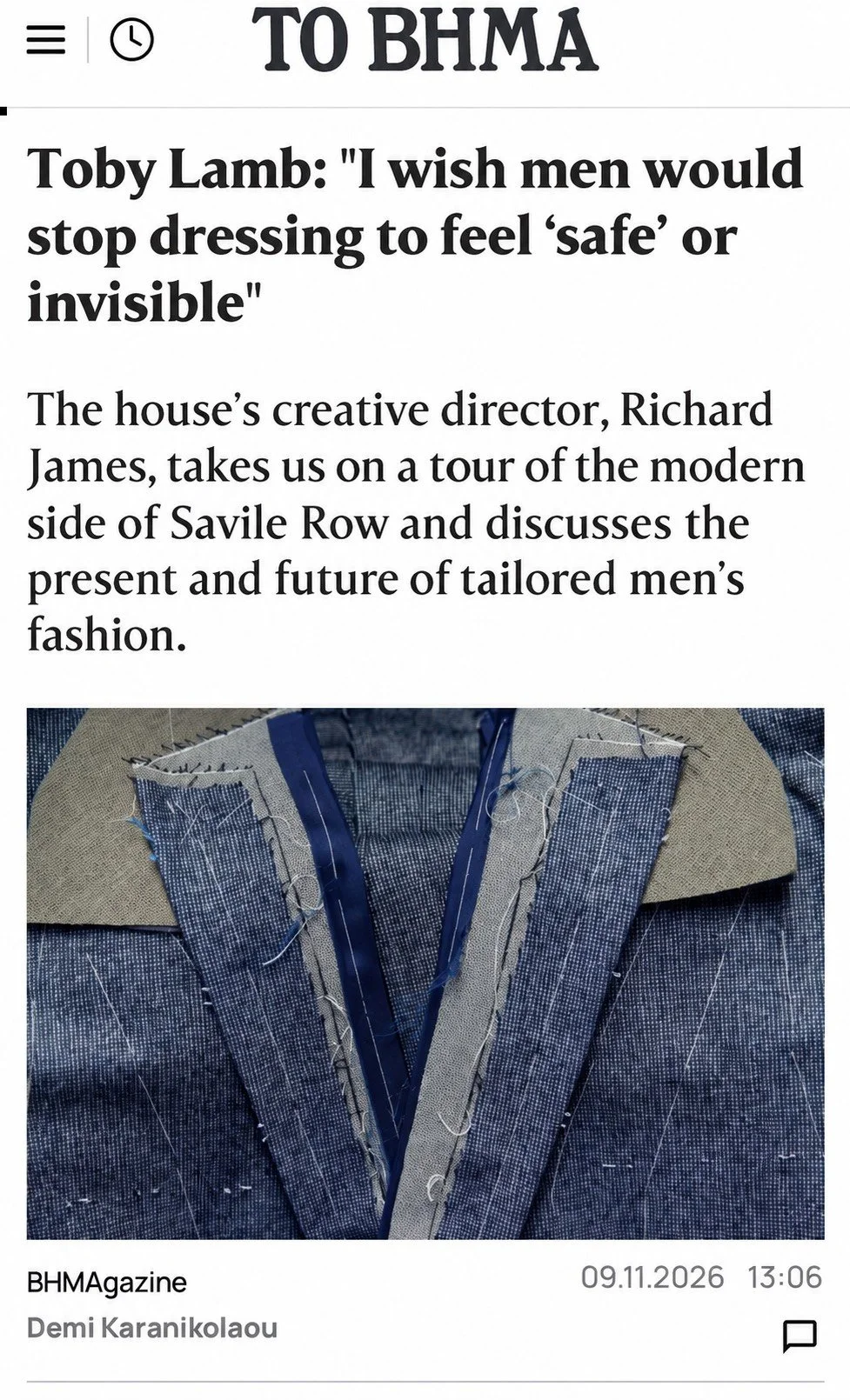
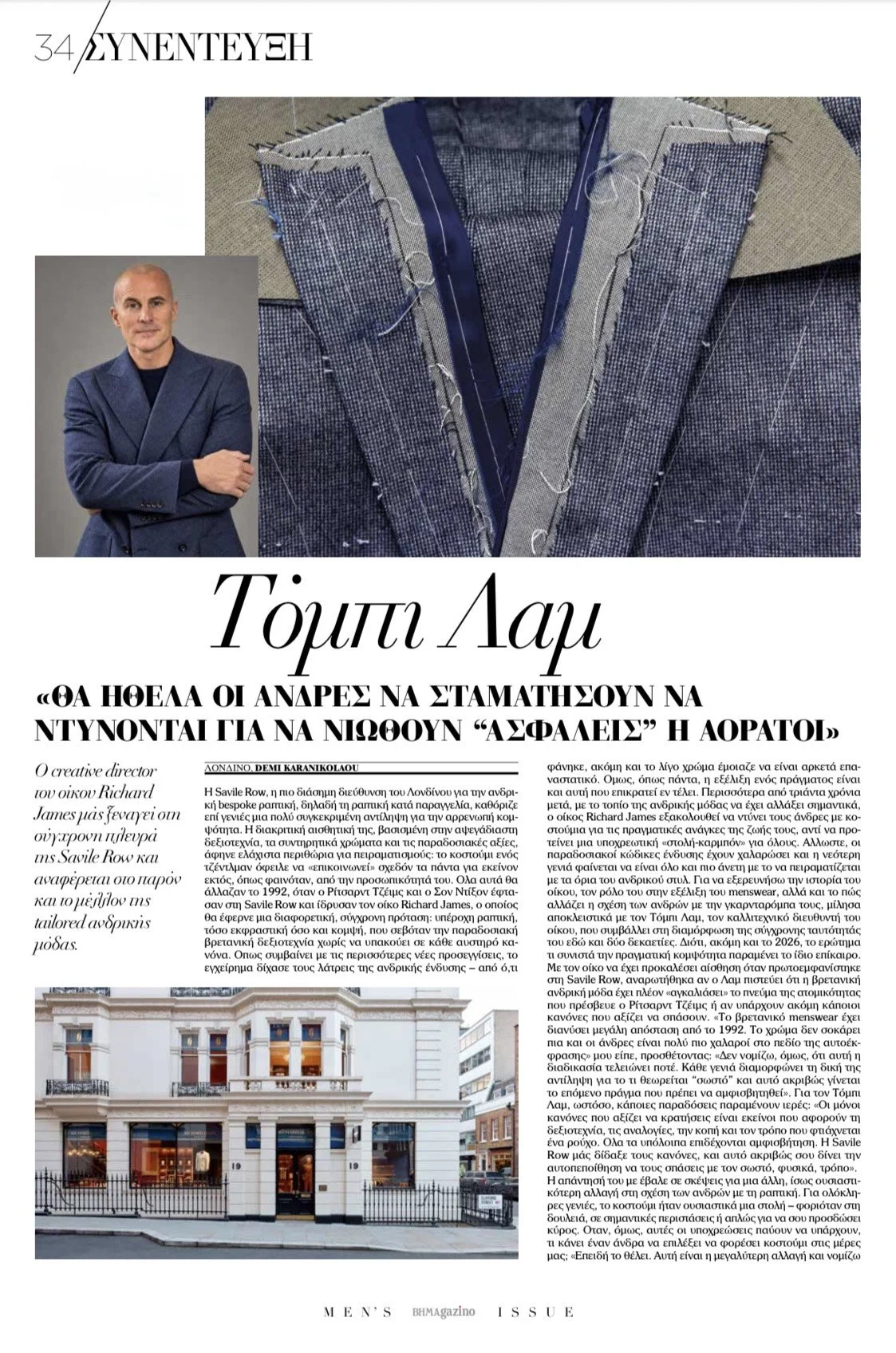
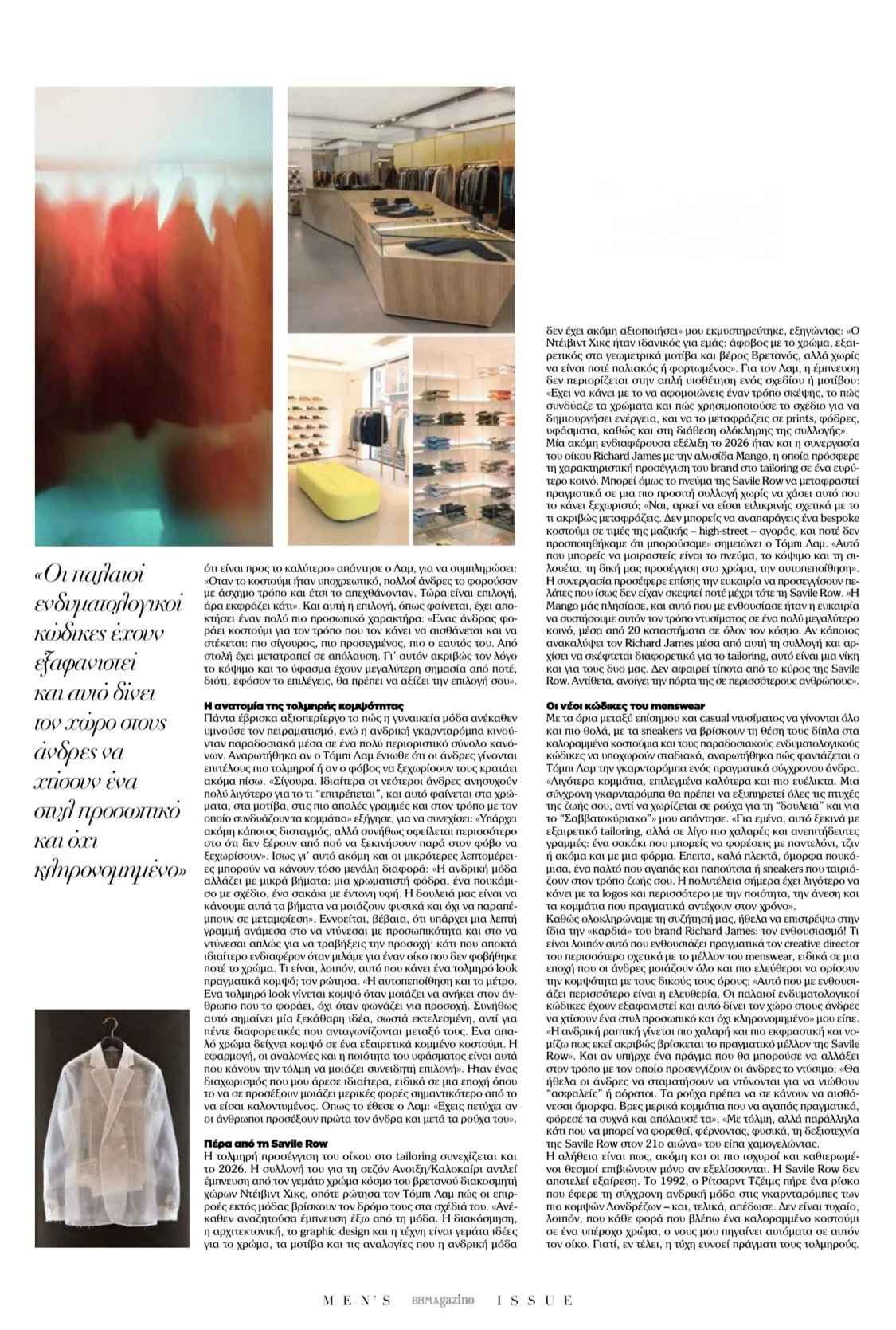
Savile Row, London's most celebrated address for bespoke tailoring, had been defining a very particular look for men for generations. Its discreet elegance, based on impeccable craftsmanship, conservative colours and traditional values, ensured that it allowed very little room for experimentation: a gentleman's suit was expected to communicate almost everything about him except, it seemed, his personality. All that was to change in 1992, when Richard James with Sean Dixon arrived, founding a Savile Row house that would introduce a different, modern, proposition: beautiful tailoring that was just as expressive as it was elegant, respecting traditional British craftsmanship without obeying every strict rule. As with most new approaches, the undertaking divided menswear enthusiasts: evidently, a little colour could be quite revolutionary. Yet, as always, evolution prevails. More than three decades later, with the landscape of menswear considerably changed, Richard James continues to dress men in suits for their real lives instead of copy-paste obligatory uniforms, traditional dress codes have loosened, and a younger generation of men seems increasingly comfortable experimenting with the boundaries of masculine style. To explore the house's story in helping menswear evolve and how the relationship between men and their wardrobes is changing, I spoke exclusively with Toby Lamb, the Creative Director of Richard James, who has spent two decades helping shape the brand's contemporary identity. Because, even in 2026, the question of what constitutes elegance remains as fascinating as ever.
Having caused quite a stir when it first arrived on Savile Row, I wondered whether Toby believed British menswear had finally embraced the spirit of individuality that Richard James championed, or whether there were still a few rules worth breaking. “British menswear has come a long way since 1992. Colour isn't shocking any more, and men are far more relaxed about expressing themselves,” he told me. “But I don't think the job is ever finished. Every generation settles into its own idea of what's ‘correct,’ and that becomes the next thing to push against.” For Toby, however, some traditions remain sacred. “The only rules worth keeping are the ones about craft, proportion, cut and how a garment is made. Everything else is open to question. Savile Row taught us the rules and that's exactly what gives you the confidence to break them well.” His answer made me think about another, perhaps more significant change in men's relationship with tailoring. For generations, the suit was practically a uniform, worn to work, to important occasions, or simply to signal respectability. But when those obligations disappear, what makes a man reach for one today? “Because he wants to. That's the big change, and I think it's a good one,” Toby replied. “When the suit was compulsory, a lot of men wore it badly and resented it. Now it's a choice, so it says something.” And that choice, it seems, has become rather personal. “A man puts on a suit because of how it makes him feel and how it makes him stand: more confident, more considered, more himself. It has gone from uniform to enjoyment. That's also why the cut and the cloth matter more than ever, because if you're choosing it, it should be worth choosing.”
I've always found it curious how women's fashion has long celebrated experimentation, while men's wardrobes have traditionally operated within a much narrower set of rules. I wondered whether Toby felt that men were finally becoming more adventurous, or whether the fear of standing out still held them back. “Definitely. Younger men especially are far less worried about what's ‘allowed,’ and you see it in colour, pattern, softer shapes and how they mix pieces together,” he explained. “There's still some hesitation, but it tends to be about not knowing where to start rather than fear of standing out.” Perhaps that's why even the smallest details can make such a difference. “Menswear changes in small steps, a coloured lining, a patterned shirt, a textured jacket. Our job is to make those steps feel natural rather than like a costume.” Of course, there's a fine line between dressing with personality and simply dressing to attract attention, something that becomes particularly interesting when discussing a house that has never been afraid of colour. So what, I asked Toby, makes a bold look genuinely elegant? “Confidence and control. A bold look becomes elegant when it feels like it belongs to the person wearing it, not when it's shouting for attention,” he replied. “Usually that means one purposeful idea, carried well, rather than five competing ones. A soft colour in a beautifully cut suit looks elegant. Fit, proportion and quality of cloth are what make boldness look intentional.” It was a distinction I rather liked, particularly in a fashion landscape where being noticed can sometimes seem more important than being well dressed. As Toby put it, “If people notice the man first and the clothes second, you've got it right.”
The house's adventurous attitude towards tailoring continues in 2026. Its Spring/Summer collection draws inspiration from the colourful world of British interior designer David Hicks, so I asked Toby how influences beyond fashion find their way into his designs. “I've always looked outside fashion. Interiors, architecture, graphic design and art are full of ideas about colour, pattern and proportion that menswear hasn't used yet,” he explained. “David Hicks was perfect for us, fearless with colour, brilliant with geometric patterns, and very British but never stuffy.” For Toby, the inspiration goes beyond borrowing a particular print or motif. “It's about absorbing a way of thinking, how he put colours together and how he used pattern to create energy, and translating that into prints, linings, cloths and the mood of the whole collection.” Another interesting development in 2026 was Richard James's collaboration with Mango, bringing the house's distinctive approach to tailoring to a wider audience. But could the spirit of Savile Row really be translated into a more accessible collection without losing what makes it special? “Yes, as long as you're honest about what you're translating. You can't recreate a bespoke suit at high-street prices and we never pretended to,” Toby told me. “What you can share is the spirit, the cut and silhouette, our attitude to colour, the confidence.” The collaboration also offered an opportunity to reach customers who might never have considered Savile Row before. “Mango came to us, and what excited me was the chance to introduce that way of dressing to a much wider audience, in 20 stores around the world. If someone discovers Richard James through that collection and starts thinking differently about tailoring, that's a win for both of us. It doesn't dilute Savile Row. It opens the door.”
With the boundaries between formal and casual dressing increasingly blurred, trainers finding their way into tailored wardrobes and traditional dress codes gradually disappearing, I wondered what Toby believed a truly modern man's wardrobe should look like. “Fewer things, better chosen, and more versatile. A modern wardrobe should work across your whole life rather than being split into ‘work’ and ‘weekend,’” he responded. “For me that starts with great tailoring that's a little softer and more relaxed: a jacket you can wear with trousers, jeans or even a tracksuit bottom. Then good knitwear, beautiful shirts, a coat you love, and shoes or trainers that suit the way you live. Luxury today is less about logos and more about quality, comfort and pieces that genuinely last.” As we were wrapping up our conversation, I wanted to return to the very heart of Richard James: excitement! What really excited its Creative Director most about the future of menswear, particularly at a time when men seem increasingly free to define elegance on their own terms? “What excites me most is the freedom. The old dress codes have gone, and that leaves room for men to build a style that's personal rather than inherited. Tailoring is becoming more relaxed and more expressive, and I think that's where Savile Row has a real future.” And if there was one thing he could change about the way men approach dressing? “I'd want men to stop dressing to be safe or invisible. Clothes should make you feel good. Find a few pieces you really love, wear them often, and enjoy them.” “Bold, but wearable, bringing Savile Row craftsmanship into the 21st century,” I said with a smile. The truth is, even the strongest and most established institutions only survive if they evolve. Savile Row is no exception. In 1992, Richard James took a risk that brought modern menswear into the wardrobes of London's most stylish men, and ultimately, it paid off. It's no coincidence, then, that whenever I see a beautifully tailored suit in a gorgeous colour, my mind immediately turns to this fashion house. Because, as it turns out, fortune really does favour the bold.