
Marina Raphael Brings Architectural Elegance to Elie Saab
This article was written by Demi Karanikolaou for Vimagazino / To Vima Greece - print & digital here
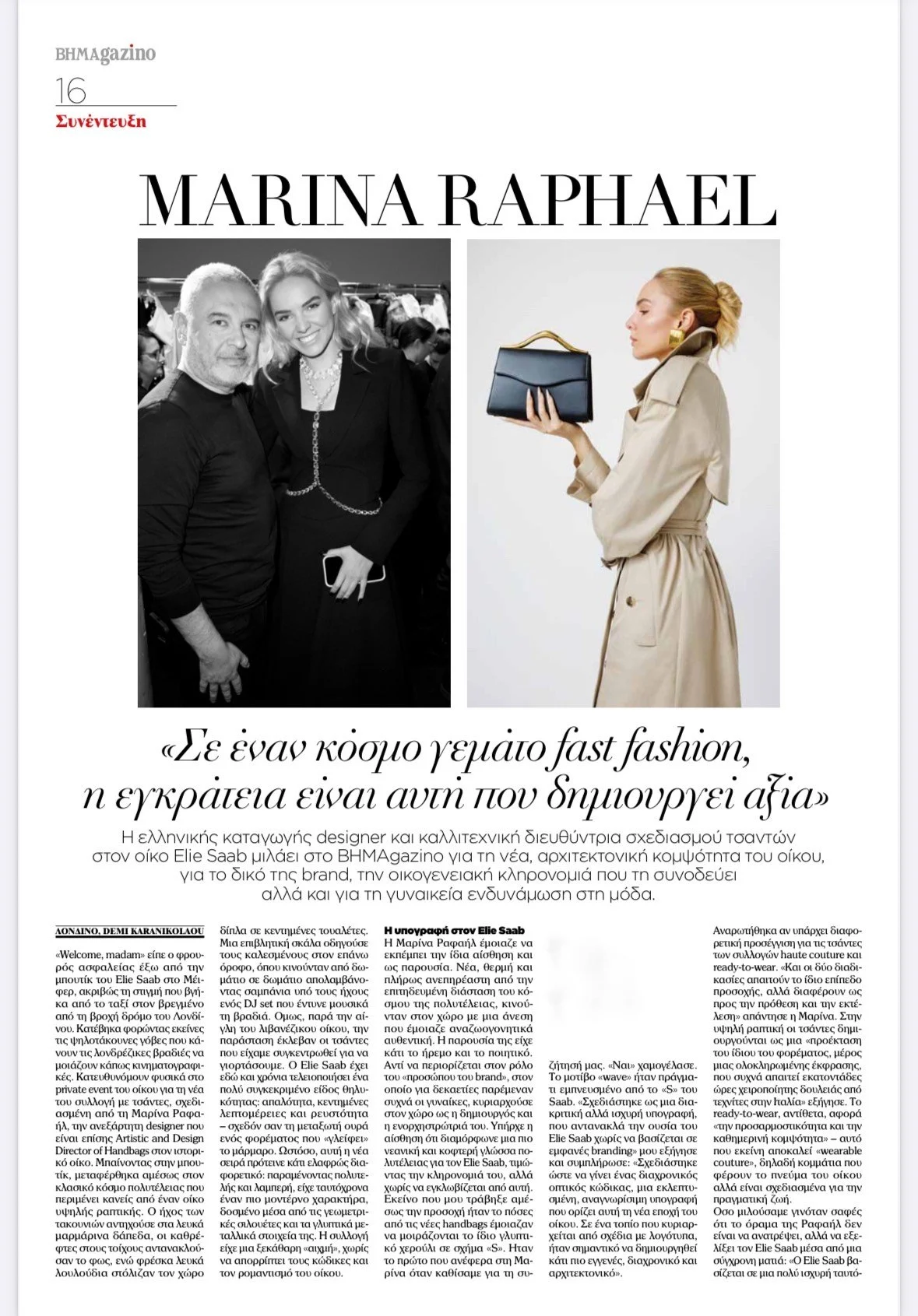
“Welcome, madam,” said the security guard outside Elie Saab’s boutique in Mayfair, just as my taxi pulled up on the rain-slick London street. I stepped out in the kind of high-heeled stilettos that make a London evening feel briefly cinematic. I was heading, of course, to the house’s private event for its new handbag collection, designed by Marina Raphael: the independent designer and Artistic and Design Director of Handbags at the storied maison. Inside, I was immediately transported into the classic world of luxury one expects from a haute couture house. White marble floors echoed with the sound of heels, mirrored walls caught the light, and fresh white flowers stood beside embroidered couture gowns. A grand staircase led polished guests upstairs, where they drifted between rooms over champagne and a DJ set that soundtracked the night. Yet despite the recognisable glamour of the Lebanese maison, it was the handbags we had gathered to celebrate that stole the show. Elie Saab has long mastered a particular kind of femininity: fluid, embellished, luminous, almost as though a silk train were forever sweeping across marble. But this new handbag line offered a slightly different proposition - still sparkling and evening-ready, yet fresher in its control, sharp silhouettes, and sculptural hardware. The collection had a clear edge without rejecting the codes and romance of the heritage maison.
Marina Raphael herself seemed to carry that same essence. Young, warm, and entirely untouched by the performative aspect of the luxury world, she moved through the room with an ease that felt refreshingly genuine. There was something quietly poetic about her presence. Rather than occupying the role women were so often relegated to in decades past - the face of the brand - she commanded the room as something far more interesting: its author and orchestrator. It felt as though she was shaping a younger, sharper language of luxury for Elie Saab, one capable of honouring heritage without becoming defined by it.
What struck me immediately was how many of the new handbags seemed to share the same sculptural, S-like handle. It was the first thing I mentioned to Marina when we sat down. Yes, she smiled - the “Wave” motif was indeed inspired by the “S” in Saab. “It was conceived as a subtle yet powerful signature, one that reflects the essence of ELIE SAAB without relying on overt branding,” she explained. “I designed it to become an enduring visual code, a sophisticated, recognisable signature that defines this new era of the house. In a landscape so often dominated by logo-driven design, it felt important to create something more intrinsic, enduring and architectural.”
I wondered whether couture and ready-to-wear handbags require a different approach. “Both processes demand the same level of attention, but they differ in intention and execution,” Marina replied. In couture, handbags become “an extension of the gown itself, part of a complete expression, often requiring hundreds of hours of handwork by artisans in Italy.” Ready-to-wear, by contrast, is about “adaptability and everyday elegance” - what she calls “wearable couture”: pieces that carry the spirit of the house but are designed for real life. The more we spoke, the clearer it became that Raphael’s vision for Elie Saab’s accessories is not to disrupt, but to refine with a modern edge. She embraces the house’s established codes, but views them through a new lens. “ELIE SAAB is grounded in a very distinct and powerful identity, and preserving that essence is essential,” she told me. “The goal is not to reinvent the brand, but to evolve it in a way that feels relevant to a new generation without losing its emotional and visual core. Where the house is known for softness and fluidity, I explore structure and precision; where there is delicacy, I introduce strength.” The result, she suggested, is “a more dynamic expression of femininity”, one that feels contemporary, confident and multidimensional. For a younger global audience, luxury today is “less about ornamentation and more about identity and attitude” - pieces that feel personal.
Hearing her reference a younger generation of luxury consumers made it clear that Raphael is an entrepreneur with a keen understanding of her audience. Separate from her work with Saab, she also runs her namesake accessories brand, where she has created coveted pieces such as the Riviera line, loved by figures including Olivia Palermo and Jennifer Lopez. I was curious what she considered the most important lesson from building a brand in her own name. “One of the most important lessons is the value of creating a clear, recognisable identity, something that feels iconic yet has the flexibility to evolve over time,” she said. “Longevity comes from that balance: establishing strong, consistent codes while allowing them to adapt naturally to the present.” She went on to emphasise that craftsmanship is the foundation of credibility. “In today’s market, luxury is defined less by excess and more by precision. Design must be in constant dialogue with real life. A handbag should be functional and versatile, without compromising on elegance. It has to feel effortless, something a woman can rely on daily, not just admire.”
Indeed, Marina’s designs already possess a certain timelessness, owing in no small part to their structured elegance and classic design language. When I brought up what has become her signature, it quickly became clear that her attraction to structure reflects a personal philosophy. “Structure has always felt instinctive to me,” she said. “I’ve been drawn to clean lines, precise geometry, and the sense of clarity that comes from a well-defined form. There’s a quiet strength in structure; it gives a piece presence, intention, and identity.” Most interesting was the way she linked that instinct to a broader rethinking of femininity itself. “Structure became my signature because it allows me to create objects that feel distinctive and empowering. Choosing it over traditional softness was a way to redefine femininity. I’ve never seen strength and femininity as opposites.”
That instinct towards structure also shapes the way Raphael thinks about time. “From the outset, each Marina Raphael bag is conceived as a lasting object, something designed to exist beyond the rhythm of trends.” The foundation of that longevity, she explained, is discipline: timeless design, precise proportions, and exceptional materials. It is also inseparable, for her, from the future of responsible design. “For me, sustainability is not a limitation; it’s a catalyst for better design,” she said, emphasising craftsmanship, traceability, and reduced production. “In a world of fast fashion, restraint is what creates value.” In an age still dominated by disposability, it was refreshing to hear a young designer at the pinnacle of fashion take such a position.
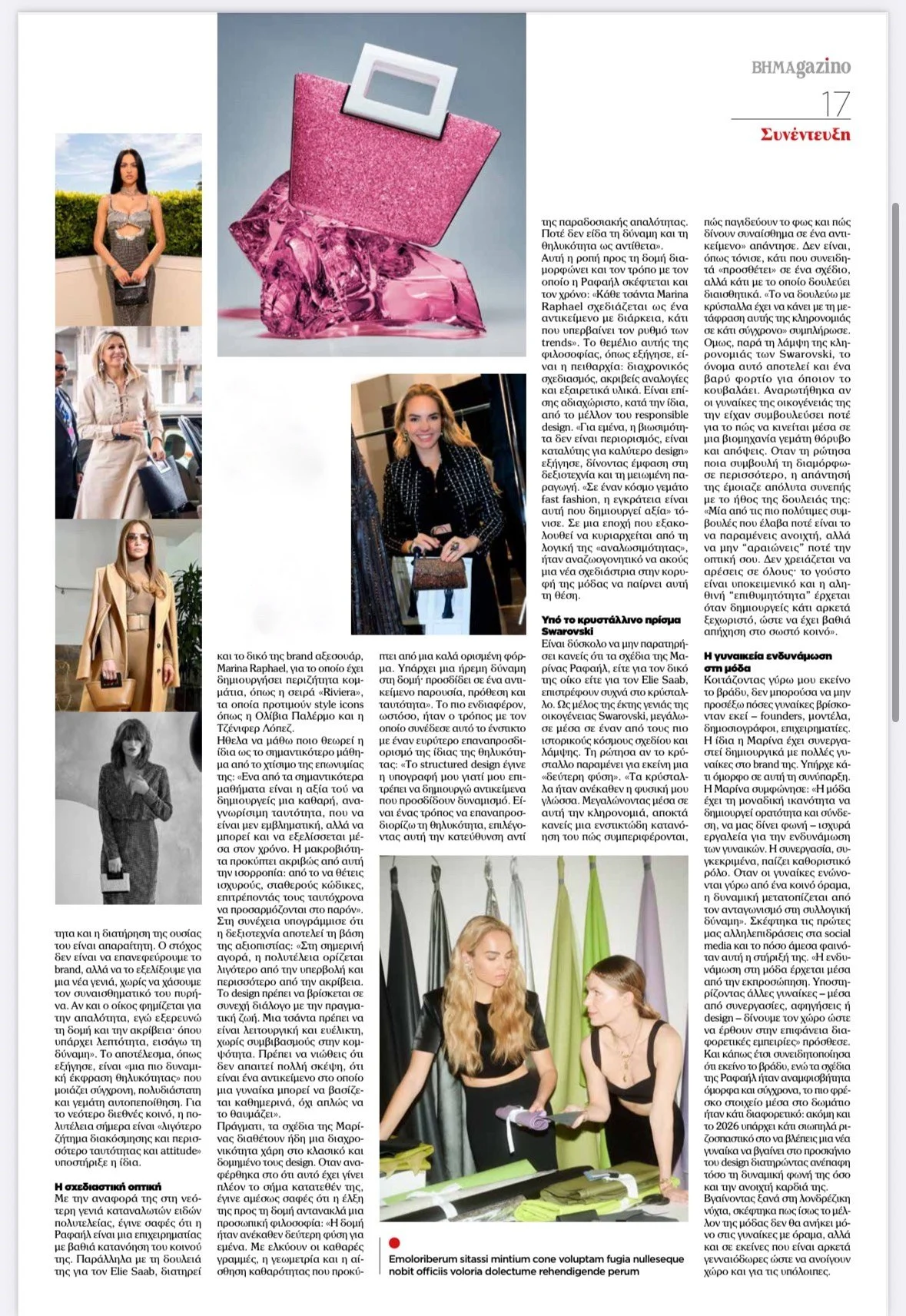
It is hard not to notice that Raphael’s designs often return to crystal. As a sixth-generation member of the Swarovski family, she grew up inside one of Europe’s most storied worlds of design heritage and sparkle. I was curious to know whether crystal still feels, for her, like second nature. “Crystal has always felt like a natural language to me,” she said. “Growing up within that heritage, you develop an instinctive understanding of how it behaves, how it captures light, how it can transform a surface, and how it adds emotion to an object.” It is not, she stressed, something she consciously “adds” to a design, but something she works with intuitively. Most interesting was the way she framed crystal as a structural and emotional tool. “It can define structure, highlight movement, or create contrast within a piece,” she explained. “Ultimately, working with crystal is about translating a heritage into something contemporary.”
As illuminating as the Swarovski heritage may be, it is also a formidable name to carry. I found myself wondering whether the women in her family had ever offered advice on navigating an opinionated industry. When I asked what guidance had shaped her most, her answer felt entirely in keeping with the ethos of her work. “One of the most valuable, and perhaps unconventional, pieces of advice I’ve received from the women in my family is to stay open, but never dilute your point of view. You are not meant to appeal to everyone - taste is subjective, and true desirability comes from creating something distinct enough that it resonates deeply with the right audience,” she said.
Looking around the room that evening, I could not help noticing how many women it held - founders, models, editors, entrepreneurs. Marina herself has collaborated with many women for her brand. There was something beautiful in all of us sharing that space. Marina seemed to agree. “Fashion has a unique ability to create visibility, voice, and connection, and those are powerful tools for empowering women,” she told me. “Collaboration, in particular, plays a key role. When women come together with a shared vision, it shifts the dynamic from competition to collective strength.” I found myself thinking back to our earliest interactions on social media, and how her support for other women was immediately obvious. “Empowerment in fashion comes from representation,” she added. “By supporting and spotlighting other women, whether through partnerships, storytelling, or design, we create space for different narratives and experiences to be seen.” And just like that, it struck me that while Raphael’s designs that night were undeniably beautiful, polished and modern, the most refreshing quality in the room was something different. In 2026, there is still something quietly radical about a young woman stepping to the forefront of design with both authority and openness intact. As I slipped back into a taxi and out into the London night, I found myself thinking that perhaps the future of fashion will belong not only to women with vision, but to those generous enough to make space for other women within it.