
This article was written by Demi Karanikolaou for Vimagazino / To Vima Greece - print & digital here
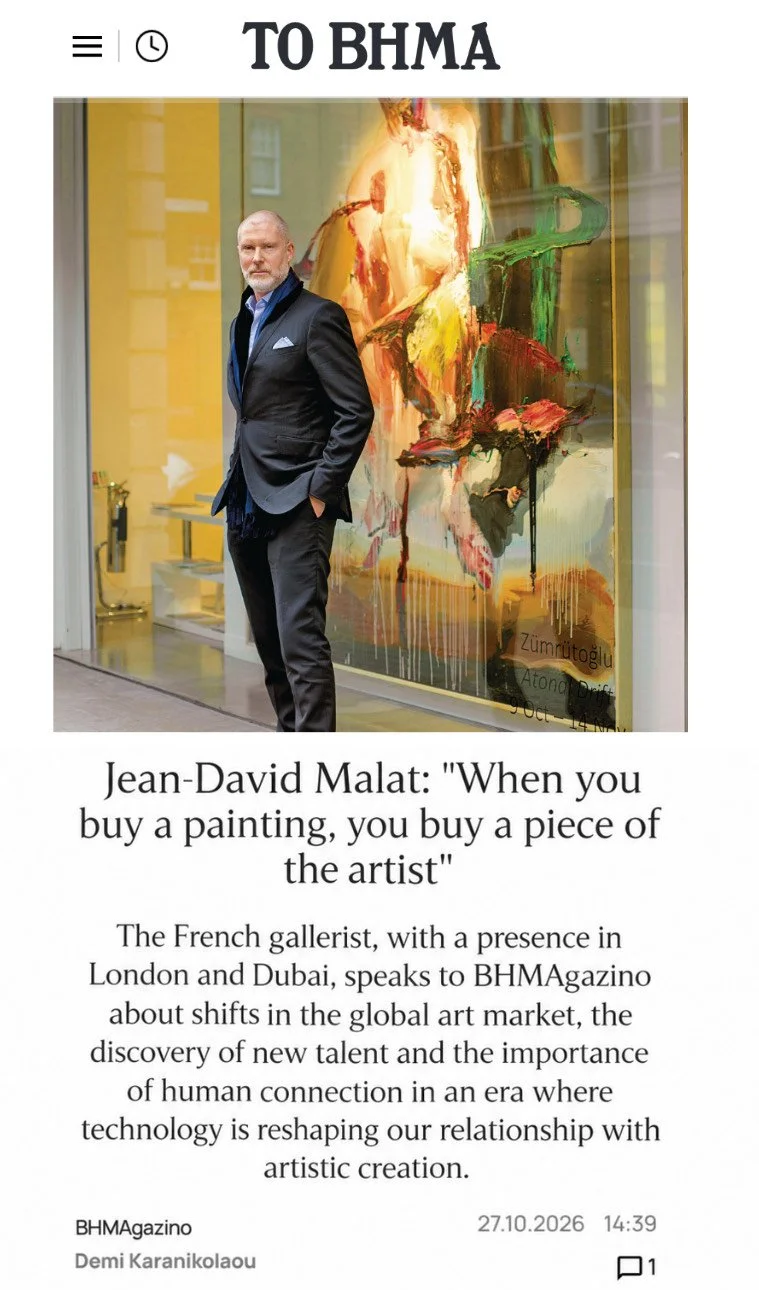
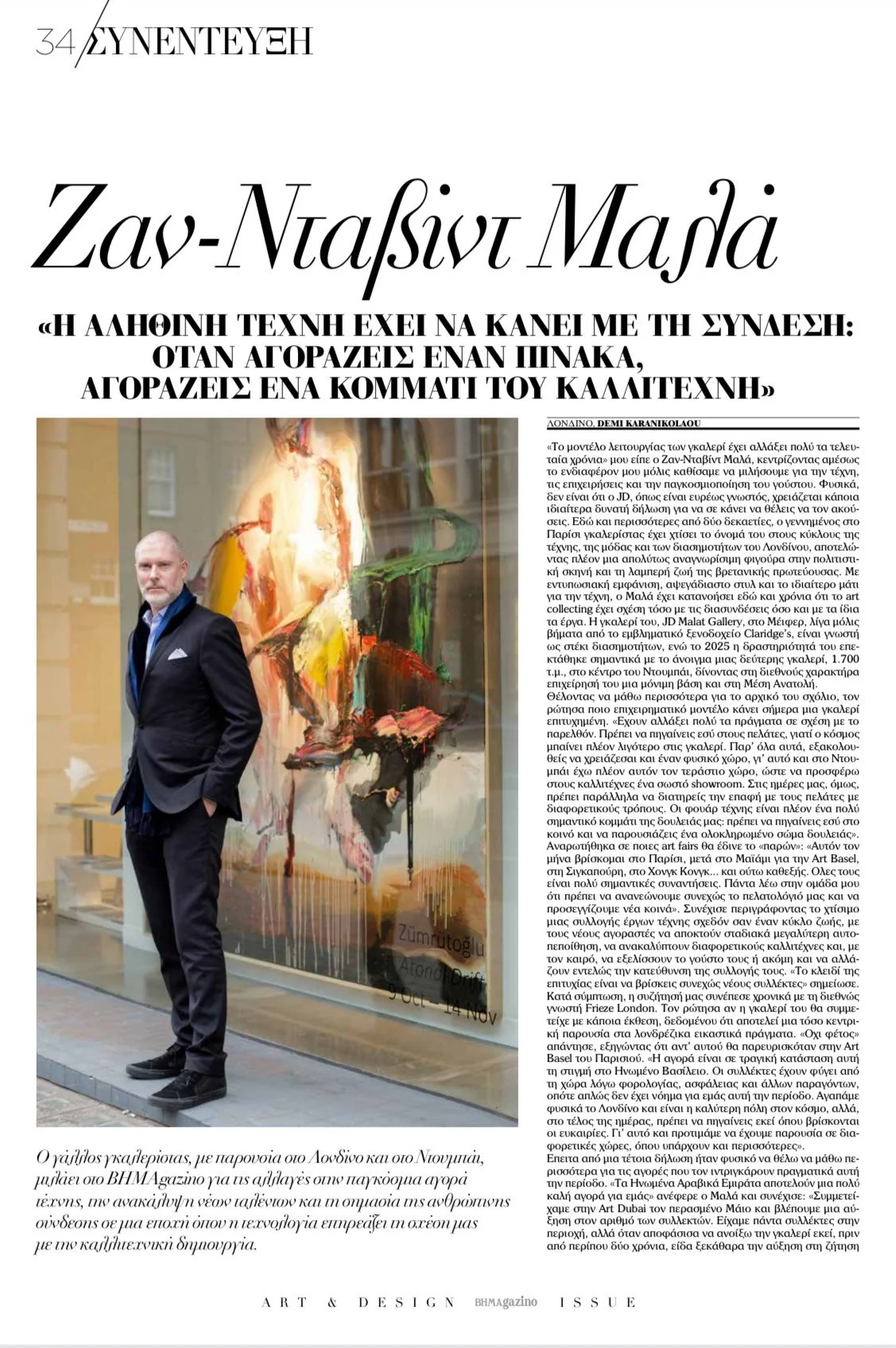
“The gallery model has changed in the last few years,” Jean-David Malat told me, immediately sparking my interest as we sat down to talk about art, business and the increasingly global nature of global taste. Of course, it is not as though JD, as he is widely known, needs a particularly dramatic statement to make you want to listen. For more than two decades, the Paris-born gallerist has built a name for himself across the art, fashion and celebrity circles of London, becoming an easily recognisable figure within the glossier side of the capital’s cultural life. With striking looks, impeccable style and a sharp eye for art, Malat has long understood that collecting is as much about relationships as it is about objects. His Mayfair gallery, only moments from Claridge’s, is known as a celebrity hotspot, but in 2025 his world expanded considerably with the opening of a second, 1,700-square-foot gallery in Downtown Dubai, giving his increasingly international business a permanent base in the Middle East. Eager to know more about his initial comment, I asked him what the current model of success looks like for a gallery business. “It has changed a lot,” he said. “You have to go to the clients because people are walking into galleries less. However, you still need a physical gallery, which is why I have this huge space in Dubai, to give artists a proper showroom. But today, you also have to follow up with clients in different ways. Art fairs are such an important part of our job now: you have to go to the people and show them a body of work.” I wondered which ones he was attending. “I’m doing Paris in October, then Miami for Art Basel, Singapore, Hong Kong... and so on. All of them are very important. I always say to my team that we constantly need to renew our clientele and reach new audiences.” He went on to describe collecting almost as a lifecycle, with new buyers gradually becoming more confident, discovering different artists and eventually developing new tastes or changing the direction of their collection altogether. “The key to success is to always find new collectors,” he noted.
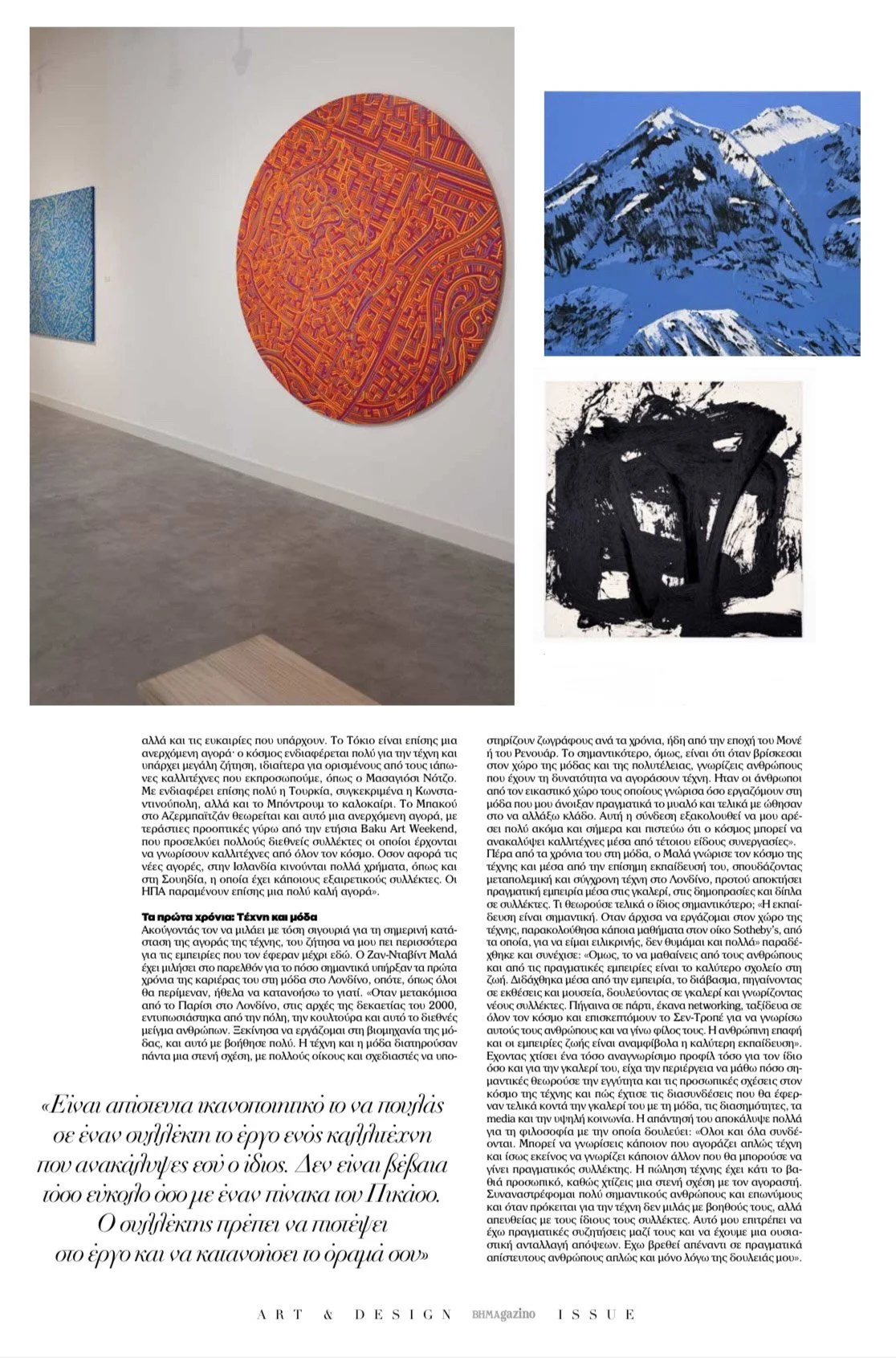
As luck would have it, our conversation coincided with Frieze London. I asked him if he was attending, especially since he is such a central figure in the London art scene. “Not this year,” he replied, noting that he would attend Art Basel Paris soon afterwards instead. “The market in the UK is terrible right now. Collectors have left the country due to taxes, security and more, so it just doesn't make sense for us at the moment. We love London, of course, and it is the best city in the world, but ultimately, you have to go where the opportunity is. That is why we prefer to go to different countries where there is more of it.” After a statement like that, it was only fair that I wanted to know more about the markets that do interest him most right now. “The UAE is a very good market for us. We participated in Art Dubai last May and there has been an increase in collectors. We've always had collectors in the region, but when I decided to open the gallery there two years ago, I could see the increase in demand and the opportunities available. Tokyo is also an up-and-coming market. People are very interested in art, and there is more demand, especially for some of the Japanese artists we represent, like Masayoshi Nojo. I am also very interested in Turkey, specifically Istanbul, and Bodrum in the summer. Baku in Azerbaijan is also an upcoming market, with huge potential around its yearly ‘Art Weekend Baku’, which is attracting many international collectors to see international artists. In terms of new markets, Iceland has a lot of money, just like Sweden, which has some great collectors. The US is still a good market too.” said Jean David.
Early years, Art world & fashion
Hearing him speak so confidently about the current state of the art market made me curious about the experiences that had brought him to this point. JD has spoken publicly about the importance of his early years working in fashion in London, so naturally, I wanted to know why. “When I moved from Paris to London in the early 2000s, I was amazed by London, the culture and the international mix of people, and started working in the industry, which helped me a lot. There has always been a connection between art and fashion throughout the centuries, with many fashion houses and designers historically supporting painters, going all the way back to the time of Monet or Renoir. But most importantly, when you are in luxury and fashion, you meet people who can easily buy art. Meeting people in the arts during my time working in fashion really opened my mind, eventually leading to me jumping industries. I still like that connection nowadays, and I believe people can discover artists through those types of collaborations.” Apart from his time working in fashion, Jean-David also learned the art world through more formal training, studying post-war and contemporary art in London before gaining real-life experience in galleries, at auctions and around collectors. Which did he really think mattered most? “Training is important. I did some courses at Sotheby’s when I started working in art, which I don’t remember much of, to be honest,” he admitted, before continuing: “But learning from people and from real-life experiences is the best school in life. I learned through experience, reading, going to exhibitions and museums, working in a gallery and meeting new collectors. I used to attend parties, network, travel the world and go to Saint-Tropez to meet these people and become friends with them. Human connection and life experiences are the absolute best training.” Indeed, having built such a visible profile for both himself and his gallery, I was curious to learn more about how important he thought proximity and relationships were in the art world, and how he built the connections that would eventually link his gallery with fashion, celebrities, media and high society. His answer revealed much about the ethos of his practice: “Everything is connected. You might connect with someone who buys art, or maybe they know someone else who can become a collector. Selling art is deeply personal because you are establishing a one-on-one relationship with the buyer. I deal with very important people and celebrities, but when it comes to art, you aren’t really dealing with their assistants; you are dealing directly with the collector. That opens up real discussions and meaningful exchanges. I’ve found myself sitting with some truly incredible people simply because of my job.”
The artist of tomorrow
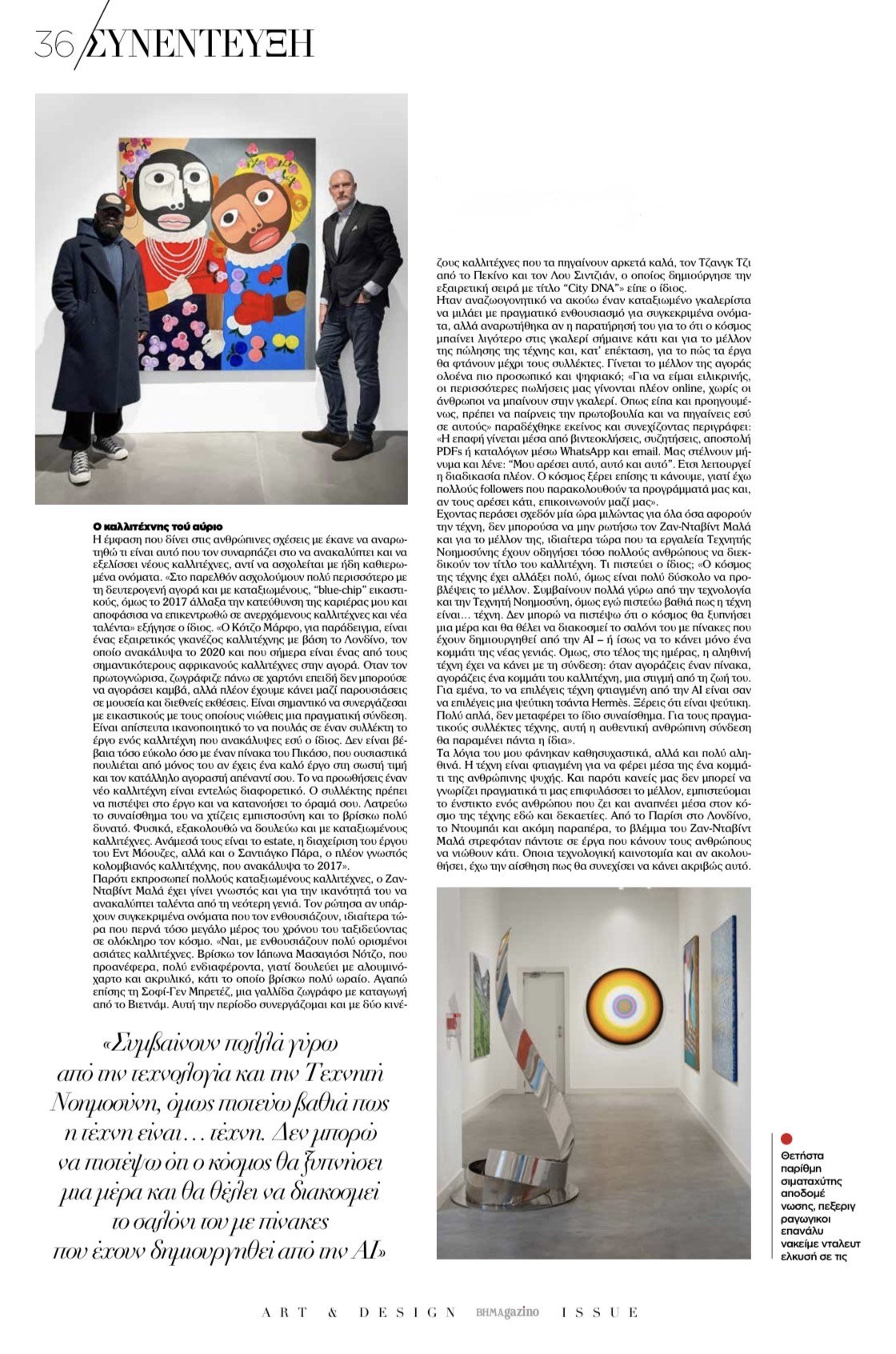
That emphasis on relationships made me curious about what he finds so compelling about discovering and building new artists, rather than simply dealing in established names. “I used to deal much more in the secondary market with blue-chip artists in the past, but I changed my career focus in 2017 to concentrate on up-and-coming artists and new talent,” Jean-David said of his current focus in art dealing. “Kojo Marfo, for example, is an extraordinary London-based Ghanaian artist, whom I discovered in 2020 and who today is one of the most important African artists on the market. When I first found him, he was painting on cardboard because he couldn’t afford canvas, but now we’ve done museum shows and international exhibitions together. It is important to work with artists you share a genuine connection with. Selling an artwork by an artist you discovered to a collector is incredibly rewarding. It is not as easy as selling a Picasso, where, if you have a nice piece at a good price and the right buyer in front of you, it sells itself. Selling a new artist is entirely different. The collector has to believe in the work; they have to listen to your vision. That feeling of building trust is very strong, and I love that. Of course, I also deal with established artists. Examples include the estate of Ed Moses and Santiago Parra, the now-established Colombian artist I discovered in 2017.”
But while he represents many established artists, JD has also become known for discovering emerging talent from a new generation. I asked him whether any names were exciting him in particular, especially given how much time he is currently spending travelling the world. “Yes, I’m very excited by some Asian artists,” he replied. “The Japanese artist Masayoshi Nojo is very interesting because he works with aluminium foil and acrylic, which I find beautiful. Another artist I love is Sophie-Yen Bretez, a French painter originally from Vietnam. I am also currently working with two Chinese artists who are doing quite well, Zhang Ji, from Beijing, and Lu Xinjjian, who created this incredible series called ‘City DNA’.” It was refreshing to hear such an established gallerist speak with genuine excitement about specific names, but I wondered whether his earlier comment about people walking into galleries less often also said something about the future of art sales and, as a result, how these artists might reach collectors. Was the future of the business perhaps becoming increasingly personal and digital? “To be honest, most of our sales now are made online, without people walking into the gallery. You have to be proactive and go to them,” he admitted. “It’s done through video calls, talking, sending PDFs or catalogues by WhatsApp or email. They text us, ‘I like this one, this one and this one.’ That is the way it works now. People also know what we are doing because I have a lot of followers, they follow our programmes, and if they like something, they connect with us.”
Having already spent an hour talking about all things art, I could not help but ask him about the future of the art world, especially now that artificial intelligence tools have led so many to claim the title of artist. What did he make of it all? “The art world has changed a lot, but it is very difficult to predict the future,” he replied. “There is a lot going on with technology and AI, but I fundamentally believe that art is art. I really don’t believe that people will wake up one day and want to decorate their living rooms with AI paintings. Or perhaps only part of the new generation will, but at the end of the day, real art is about connection. When you buy a painting, you are buying a piece of the artist; you buy a moment of their life. To me, buying AI art is a bit like buying a fake Hermès bag. You know it’s fake. It just doesn’t carry the same feeling. For true art collectors, that authentic human connection will always remain the same.” His words felt profoundly reassuring, but also profoundly true. Art is meant to carry a piece of the human soul. And while we can never really know what lies ahead, I found myself trusting the instinct of someone who has spent decades living and breathing the art world. From Paris to London, Dubai and beyond, Jean-David’s eye has always been drawn to work that makes people feel something. Whatever technological innovation comes next, I have a feeling he will keep doing exactly that.