This article was written by Demi Karanikolaou for Harper’s Bazaar Greece. You can find it here.
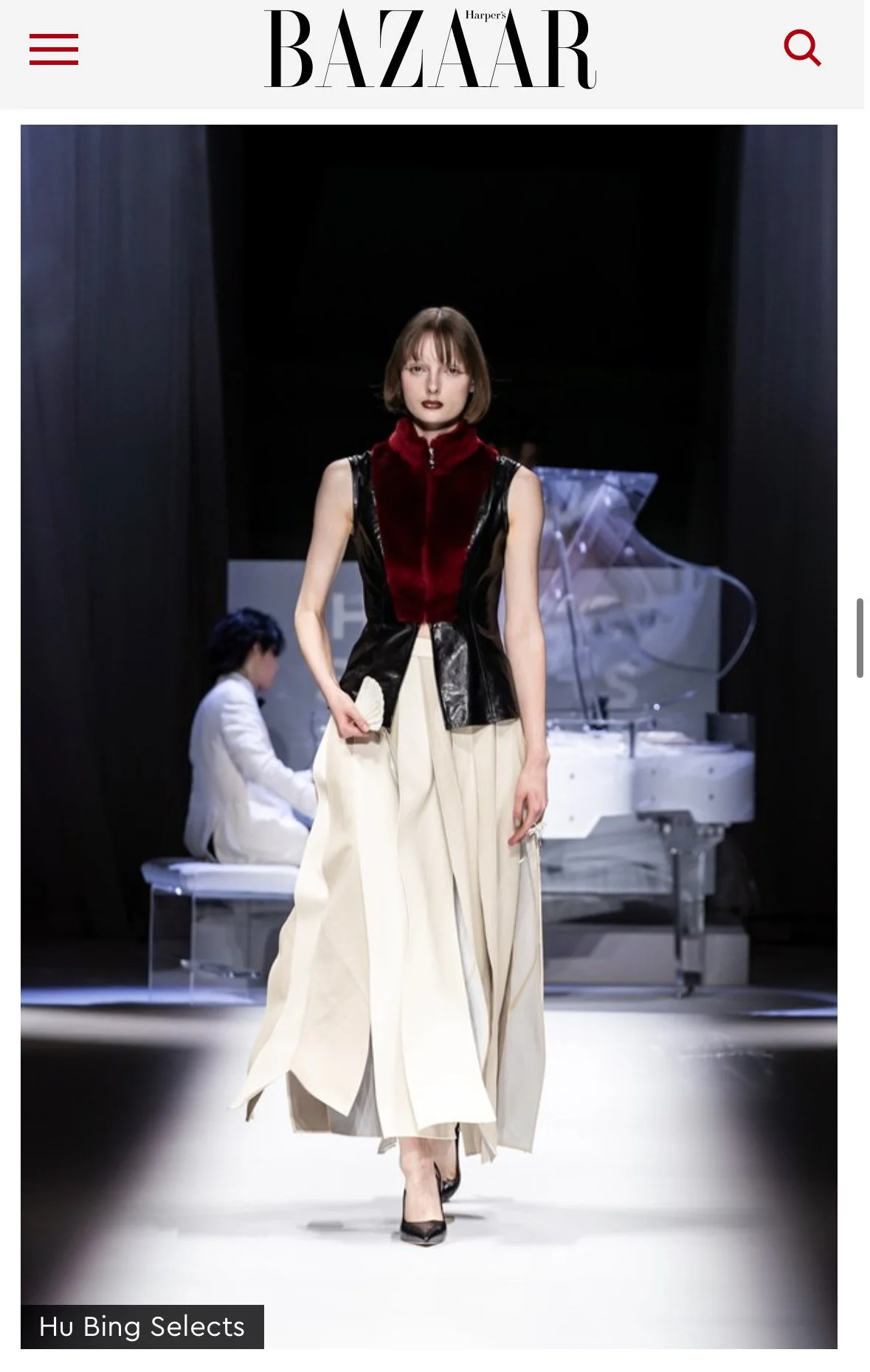
“The line is massive,” said the fashionista next to me, as I tried to contain my surprise, my mouth practically hanging open. We were standing outside Freemasons’ Hall during London Fashion Week, waiting to get into the HUBING SELECTS show, with a queue that had wrapped itself around the building and seemed to keep going despite the rain. It was hardly surprising that Hu Bing’s name alone would draw a big crowd. He is, after all, one of the most prominent figures in Chinese fashion and has spent years representing the country’s industry internationally. Still, I wasn’t expecting quite that level of excitement around a fashion show, an event usually reserved for industry people, editors and buyers. Thanks to my press pass, I was able to slip past the line and head inside. By the time I reached the runway in the building’s grand hall, with its transparent piano sitting beneath the lights and guests slowly filling the enormous room, I was already wondering what, exactly, Hu Bing had built to make so many people want to be part of it.
The answer, it seemed, lay in his multidimensional career, which has spanned almost four decades of high visibility. Having entered the fashion industry in 1988 after being discovered as a model in Italy following the abrupt end of his sporting career, Hu Bing became one of the most recognisable Chinese faces moving through the international fashion system. In 2015, the British Fashion Council named him its first International Ambassador for London Collections for Men, beginning a relationship with the British capital that would eventually develop into something rather different from the usual celebrity-fronted fashion project. HUBING SELECTS was founded by him in 2024 as a platform created to bring Asian designers onto international stages and give emerging talent access to the kind of global visibility he had spent years building for himself. Shortly after the 2026 edition, I got the opportunity to speak one-on-one with the fashion legend, who described that evolution in his career with surprising simplicity. “I’m 55. I have already achieved many of my own dreams,” he told me. “Supporting young designers now feels very important to me.” Was this, then, the answer to his ever-expanding presence at London Fashion Week? Hu Bing spent decades becoming one of the faces through which the West saw Chinese fashion. Now he seems increasingly interested in making sure the next generation no longer needs one face to represent it.
China, of course, has long held an unusually powerful position within fashion. It remains one of luxury’s most important consumer markets, but it is also deeply involved in the way clothes are actually made, from textiles and manufacturing to the technical knowledge needed to turn an idea into a finished garment. And yet, the way the industry thinks about China can at times feel oddly limited. On one side, there is the Chinese customer, courted endlessly by luxury brands. On the other, there is the old idea of China as the “factory of the world”. And while local creative talent and genuinely exceptional craftsmanship can sometimes be overshadowed in the media by the sheer volume of exports coming from the country, many incredibly talented designers are trying to build names of their own beyond China. Sitting inside Freemasons’ Hall, I began to understand that this was exactly what Hu Bing wanted us to discover through his HUBING SELECTS platform.
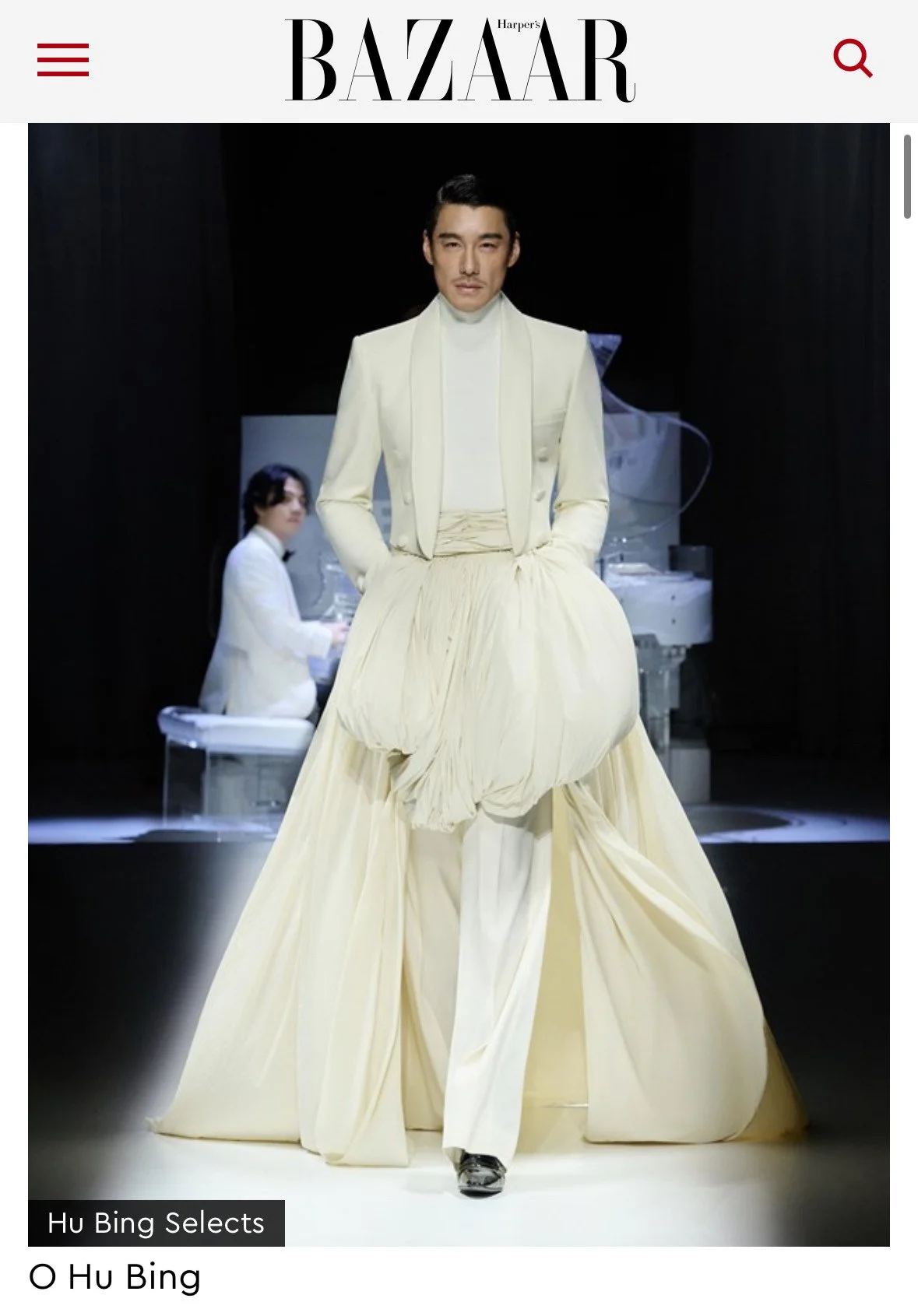
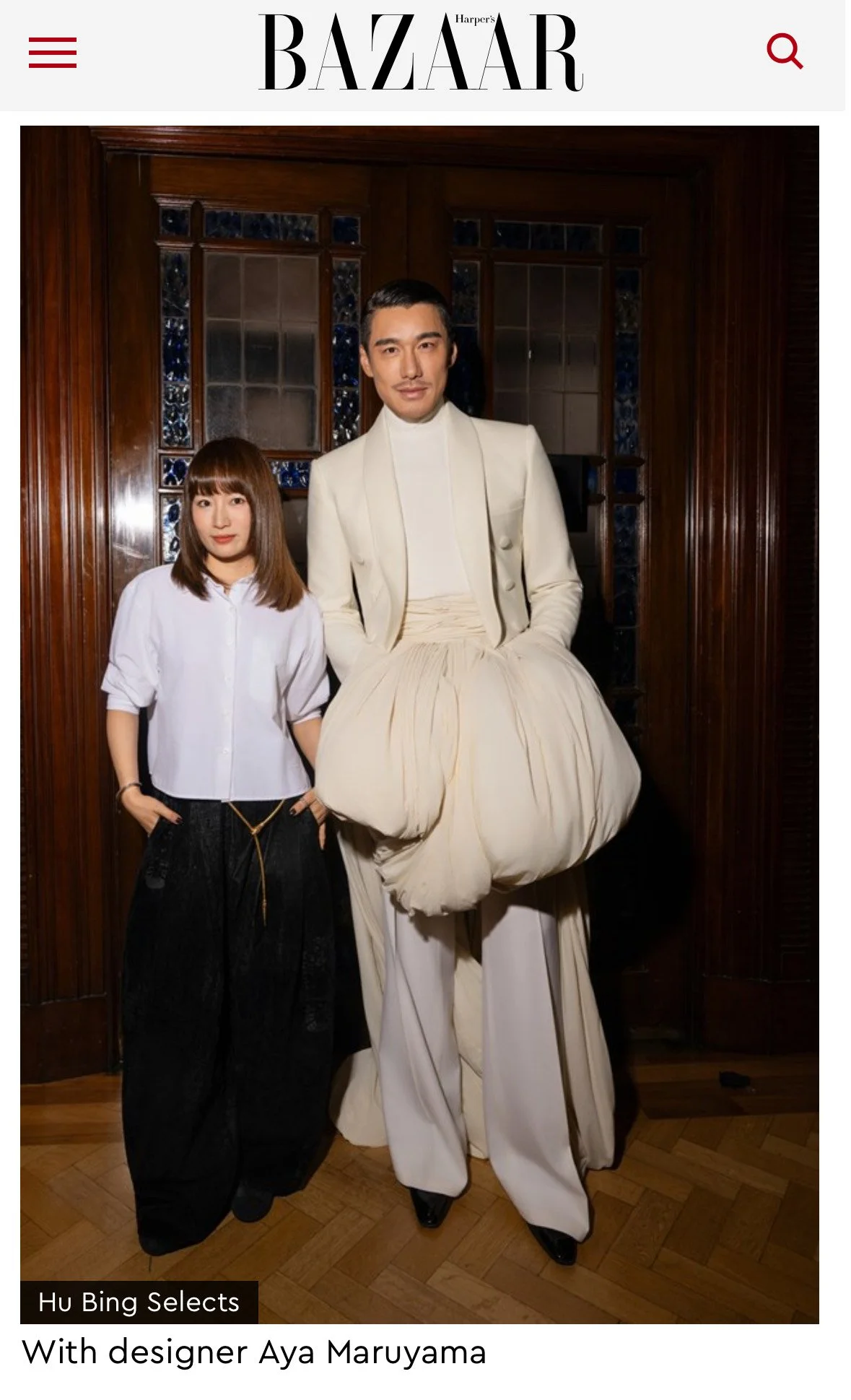
When the lights went down for the September 2026 edition, that ambition became much easier to read through the clothes themselves. Titled URBAN GRACE: Leather & Light, the third season of HUBING SELECTS moved between three imagined moments - 1930, 2030 and 3030 - while Shanghai and London acted almost like parallel points on the same timeline. The opening looks were soft and ethereal, with pale leather, silk and gauze creating long, fluid silhouettes before the mood gradually hardened. I couldn’t help thinking there was something quite true to life in that progression, the softness of the beginning slowly giving way to something more protective. Black, cognac and wine-red leather began to wrap around the body in increasingly sculptural ways, with some of the fitted bodices and sweeping skirts immediately making me think of Alaïa and that familiar tension between control and movement. By the final chapter, metallic surfaces and lighter fabrics pushed the collection somewhere much more futuristic. At the centre of it all was Aya Maruyama, the Chinese-Japanese designer Hu had chosen to spotlight through the show and entrusted with the season. “There are so many beautiful things from the past that we can take with us,” he told me. “At the same time, we have to understand the present and imagine what could come next. We are in the middle of all of those things.” Leather became the point in the collection where Hu’s wider argument about craftsmanship felt most visible. “Leather is very particular. Not everybody can work with it well,” he told me backstage. Rather than simply defaulting to the places traditionally associated with luxury leatherwork, he wanted to see what else existed. “People always talk about Italian leather and Italian finishing, which I love as well. But I started asking myself whether I could find equally interesting leather and craftsmanship in Asia.” That question took him across the region. “I went to Japan, I went to Korea, and I travelled to many different cities in China looking for beautiful leather and good craftsmanship,” he explained. Eventually, that search led him to Haining in Zhejiang province, where URBAN GRACE was developed through the local leather supply chain, from material selection and sampling through to final garment production. “In Haining, China, I found something very interesting because there are so many different manufacturers and so much specialist knowledge there. I also told our manufacturers: if you can create and finish something at a very high level in China for us, you have to be very good at it. The craftsmanship has to be there.” For him, this is where “Finishing in China” comes in. “Everybody knows ‘Made in China’, but I wanted to shift that idea a little, which is why I talk about ‘Finishing in China’.”
In other words, the phrase is less about where a material comes from and more about who has the skill to bring the final piece to life, shifting attention towards the craftsmanship, technical knowledge and aesthetic judgement behind the finished garment. Surrounded by members of his team, from lighting to make-up, it would be easy to assume that a personality of his calibre would be accustomed to remaining firmly at the centre of attention. Yet throughout our conversation on the empty runway after the show, it became increasingly clear that Hu sees his current role in the industry as something more, perhaps even something connected to his legacy. “I have been working in fashion for 38 years now, so in some ways I see myself as a coach,” he told me. “Through experience, I can help young designers understand what people respond to and what can work beyond the runway.” Aya Maruyama, the designer behind this season, seemed to embody exactly the kind of talent he wants HUBING SELECTS to push forward: someone already moving between cultures, references and different ideas of craft, but still looking for the kind of international visibility that can completely change a young designer’s career.
Hu was equally clear about giving young creatives the space to dream and bring their own work to life. “I can give her a beautiful stage. I can give her the lighting, the piano and the environment,” he said. “But then the art and the clothes have to come from her.” That last statement seemed to perfectly summarise the spirit of HUBING SELECTS - creating the conditions in which both fresh creativity and heritage craftsmanship can be properly seen.
By the end of the evening, it was easy to understand why Hu Bing increasingly sees himself as an ambassador not simply for Chinese fashion, but for the craftsmanship and talent behind it. After the show, a huge party brought together designers, editors and the wider fashion community, extending that sense of a creative conversation beyond the runway. After almost four decades spent representing Chinese fashion internationally, Hu now appears determined to use that visibility to make sure its craftsmanship, its designers and its next generation are seen alongside him.