
Hardware Is the New Black: Inside CuteCircuit’s Fashion-Tech Revolution
This article was written by Demi Karanikolaou for WIRED. You can find it here.
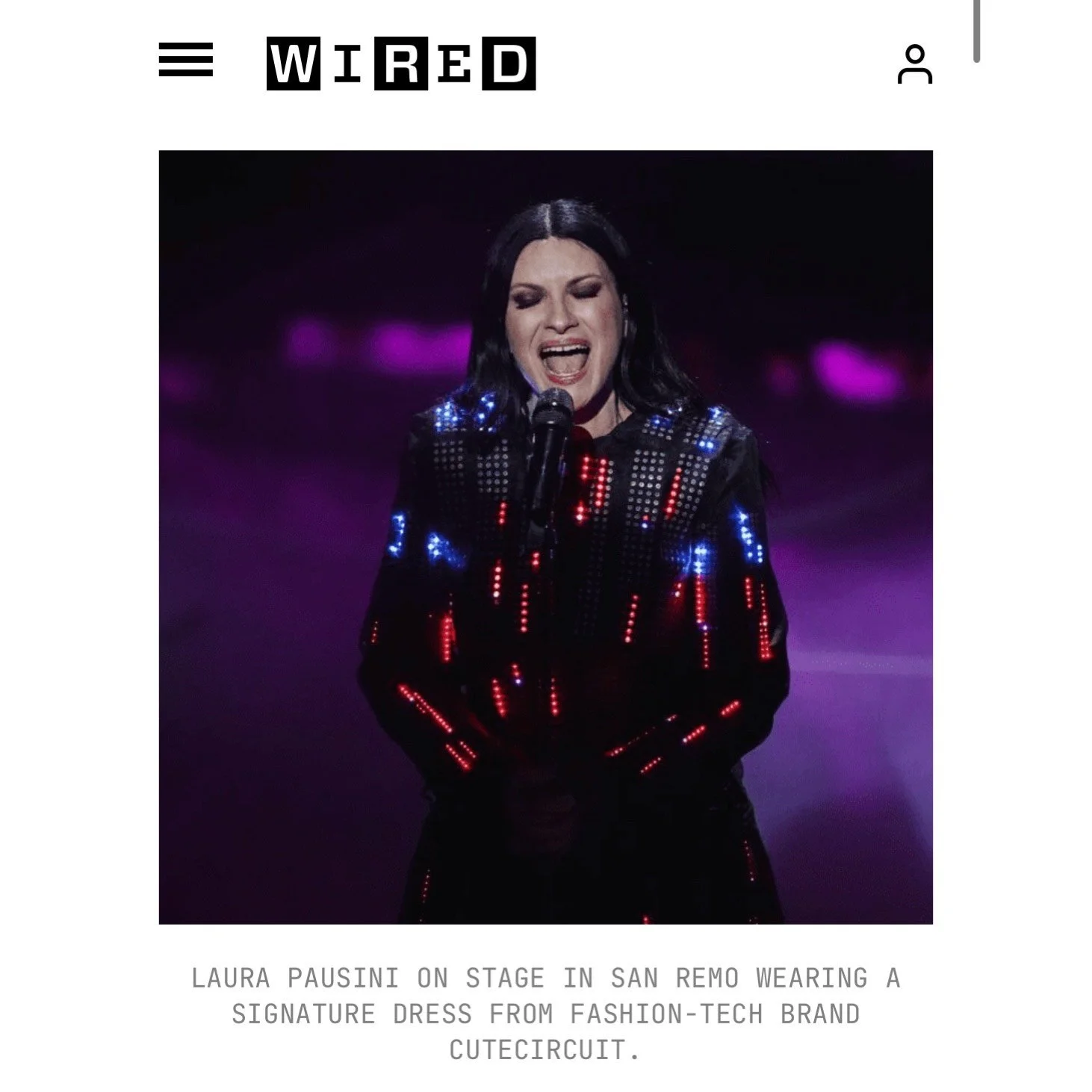
“Che meraviglia!” The exclamation rippled through the crowded Italian bar in London, as hands waved through the electric air. We were gathered for the finale of the legendary Sanremo festival. Host Laura Pausini, an undisputed titan of the Italian music scene, had spent the previous nights in a fashion marathon, wearing custom creations from some of the world’s biggest maisons, including gowns by Armani Privé and Balenciaga. Yet nothing provoked the reaction reserved for a different dress.
The energy in the room shifted the moment Pausini stepped onto the stage for the finale medley tribute. At first glance, it was a feat of couture: an elegant black gown paired with a bolero and a Swarovski-studded corset that sculpted a classic silhouette. But as she began to move and twirl, the garment came alive, revealing layers of silk chiffon and smart textiles lit with LED lights that burst into a rhythmic dance of light. I recognized that distinctly futuristic signature immediately. Those generative pulses of light were not just a stage effect, but the signature of CuteCircuit, the fashion-tech brand founded by Francesca Rosella and Ryan Genz. Having known the duo for years, I reached out immediately to discuss the architecture of Pausini’s gown, their legacy, and how they managed to steal the show in an arena dominated by some of fashion’s biggest houses.
As a fashion-tech aficionado, I wanted every detail as soon as we sat down. “This was actually the third dress we’ve done for Laura Pausini; our collaboration started 14 years ago for her world tour,” Francesca explained. “For the Sanremo finale, the goal was to create something that wasn’t just a garment, but a generative extension of the music. The upper part is a skin-tight, shimmering stretch fabric with crystals that empowers her on stage, but the magic is in the 360-degree design. Most tech-integrated stage wear tethers an artist to a power supply, but we engineered this so Laura could twirl and move with total freedom, because the dress contains tiny embedded batteries. Beneath the silk chiffon and organza is a flexible, laser-cut fabric embedded with micro-LEDs that flicker in response to the musical cues. It’s designed specifically for the television lens, ensuring that as the cameras orbit her, the dress never looks the same twice.”
I asked how such a complex garment could possibly be controlled during a live television broadcast, where there is zero margin for error. “Since it was for a live performance, it was controlled by a computer so that the lighting cues could be perfectly on beat with the music,” Ryan noted. “Apart from the dress itself, we also design the whole back end - the patterns, the integrated technology, the hardware, and the software. For Laura, we created generative animations in real time. The garment updates itself; it will look different every single night throughout her two-year world tour.”
While fashion claims to love newness, that rarely translates into actual fabric or technological innovation. I asked CuteCircuit why they feel compelled to push those boundaries when so much of the industry remains static. “I think wearable technology is not about any one specific type of tech; it’s the broader concept of bringing global innovation into fashion so that it continues to evolve,” Francesca said. She points to the house of Schiaparelli as an example. “It’s said she was the first to put zippers in dresses; before that, zippers were for industrial wear. Elsa understood that they could work perfectly with couture to create seamless closures, bringing fashion into the modern era. Today, you can’t imagine couture without zippers. We are facing a similar moment where our whole world has become digital, yet CuteCircuit is one of the only brands that sees that your digital life can be integrated into your fashion life.”
“It seems strange that fashion is stuck while technology leaps ahead,” Ryan added. “Computers are everywhere; they should be in your clothing, making it do something unexpected. I don’t see a garment as static - I see it in motion, a kinetic wave living on the body.”
This drive to blend the digital with the physical didn’t happen overnight. It was born from the frustration Francesca felt while working within the machinery of heritage houses. “I studied architecture, but my first job was at Valentino in 1998,” she reminisced. “Companies were starting to develop electroluminescent threads. I suggested we embroider an evening gown with them for the red carpet and they looked at me like I was completely insane. The same thing happened later, when I was designing handbags for Esprit and proposed integrating GPS for tracking and user information.” Fashion, it seemed, wasn’t allowed to be “smart.”
The catalyst for change was the Interaction Design Institute Ivrea in Italy - a legendary, short-lived postgraduate hub founded by professors from MIT and Stanford, where the duo found their shared language. “The whole concept was bringing new technology to design - whether architecture or garments,” Ryan explained. “We wanted to see what happens when people wear something that makes them connect in a different way.” This wasn’t about gadgets, but about human interaction. Their first major breakthrough, the HugShirt, allowed people to send and receive the physical sensation of a hug over a distance.
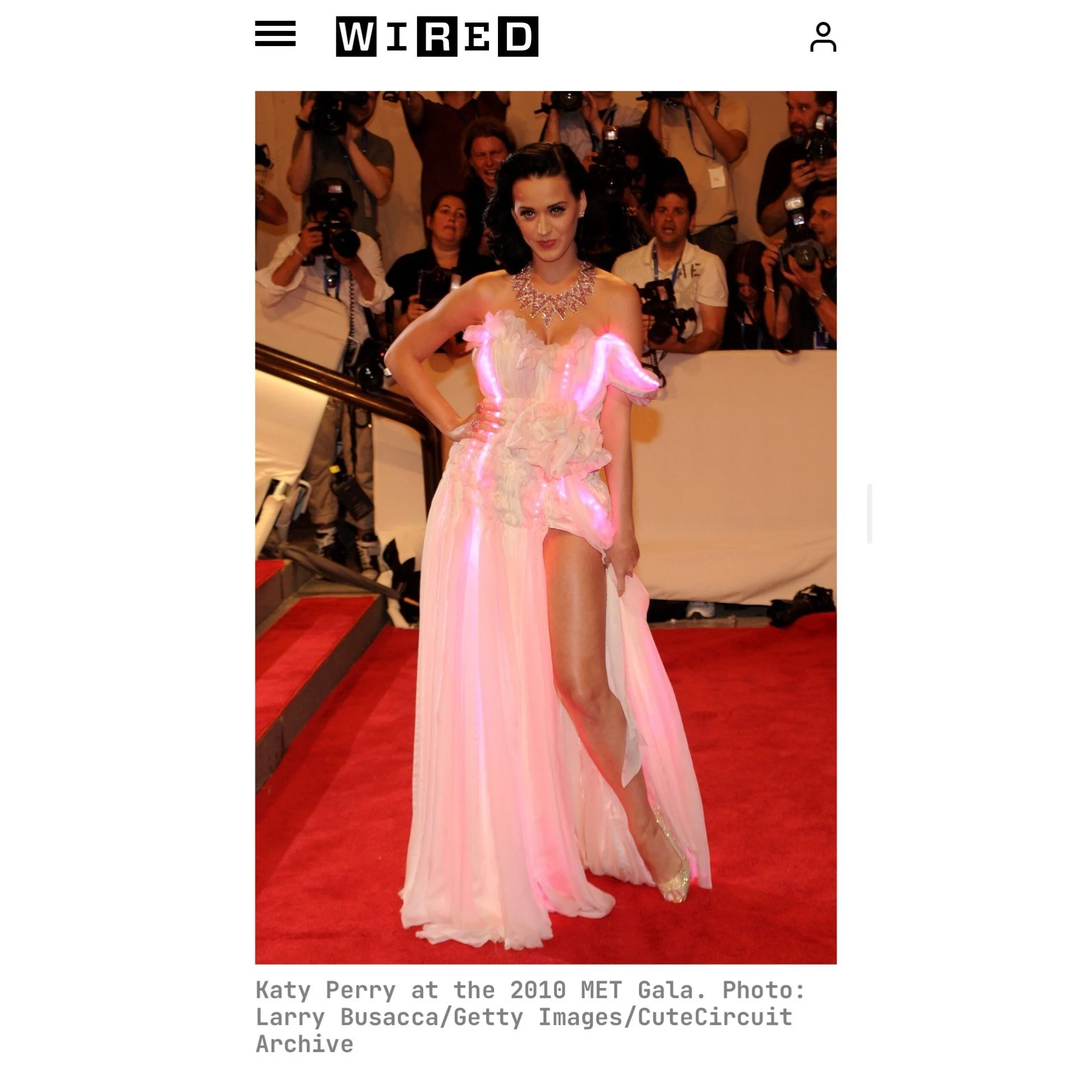
Once they found their niche, CuteCircuit became unstoppable. The duo’s career soon filled with some of the industry’s highest honors: they won Time magazine’s “Best Invention” twice, a Webby, and the prestigious Lumen Prize. Their cultural footprint expanded even further when they dressed Katy Perry for the 2010 Met Gala, placing wearable technology on the industry’s most publicized red carpet. Despite those milestones, I wanted to know what Francesca considered her dream moment. “I manifested it!” she told me, leaning in. “I always said that the only collaboration I truly wanted was Chanel, and 24 hours later, the email arrived.”
The project was for the iconic Data Center Spring/Summer 2017 collection, and CuteCircuit was tapped to create the now-legendary LED Chanel bags, which featured pixelated grids of light scrolling the house’s name and double-C logo. Working with Karl Lagerfeld was a lesson in the kind of obsessive perfectionism that mirrors their own. “Karl didn’t sleep; we would send videos of animations for the handbags and get replies at 4:00 AM saying, ‘Animation number five needs a little more pink,’” Francesca recalled. Lagerfeld, a man who famously claimed there was “nothing new in fashion,” finally changed his mind when he saw these bags, personally photographing the collection for the house archives. I couldn’t help but hold tight the original prototype Lagerfeld gifted Francesca - a glowing piece of fashion history.
Yet beyond the glamour of those global collaborations, CuteCircuit’s most profound impact lies in a far more intimate territory: sensory inclusion. Their SoundShirt, a garment that allows members of the deaf community to “feel” musical and sporting events on their bodies through haptic sensors, has been a major commercial and reputational success for the London-based brand.
When I asked about their plans for the future, Francesca let me in on a world-first announcement: Project Starlight. After two decades of dressing global icons, CuteCircuit is pivoting toward mass-scale human connection. “We want to solve the loneliness of the ‘phone-staring’ era,” Francesca explained. Described as a wearable “social orchestrator,” Starlight is an app-controlled, interactive smart brooch designed to help both introverts and extroverts find “their people” in a crowd. By acting as a digital icebreaker, the accessory helps users signal their interests and remember meaningful social connections in real time. Crucially, unlike their made-to-measure couture, Starlight is designed to be more affordable, making the magic of smart textiles accessible to a wider audience.
As we were concluding our conversation, I kept reflecting on how vital innovators are to the evolution of any industry. Throughout CuteCircuit’s pioneering journey, the duo has consistently built the impossible, proving that fashion does not have to be static. Thinking back to that Italian pub, as the crowd roared at Laura Pausini’s LED-illuminated twirl, I felt a deep sense of joy. Beyond the circuits and the software, I remain deeply inspired by my friends, who are quite literally stitching the future together - one light at a time.