
The new pulse of the London art scene
This article was written by Demi Karanikolaou for Vimagazino / To Vima Greece - print & digital here
The art world is in constant motion. New styles, new mediums, new artists, each bringing their own way of translating emotion into form. It is perhaps inevitable, then, that art gravitates towards environments that can sustain this movement, where ideas are not only exchanged but tested, stretched and redefined. Few cities are as comfortable with that kind of friction as London. In the UK capital, worlds rarely sit neatly apart. The curated quiet of a Mayfair gallery exists only streets away from the raw, disruptive energy of a Shoreditch warehouse, where a fashion show or independent exhibition might unfold in a space never intended for either. It is a city where the established and the emerging constantly brush against one another, where collectors, students and first-time exhibitors move through the same rooms, and where the weight of institutions such as the Tate, the National Gallery, the Royal College of Art and Goldsmiths coexists with a restless network of artist-run spaces across East London and Hackney. London is, above all, a meeting point: an international convergence of aesthetics, movements and perspectives, shaped by those who arrive from elsewhere and choose to stay. It is within this environment that a new generation of artists is taking shape. Working across disciplines and drawing from distinct personal histories, they are redefining what a contemporary practice can look like. Among them, three young women offer a glimpse into this evolving language, with practices that feel modern, bold and deeply personal.
Lydia Smith - Between Matter and Machine
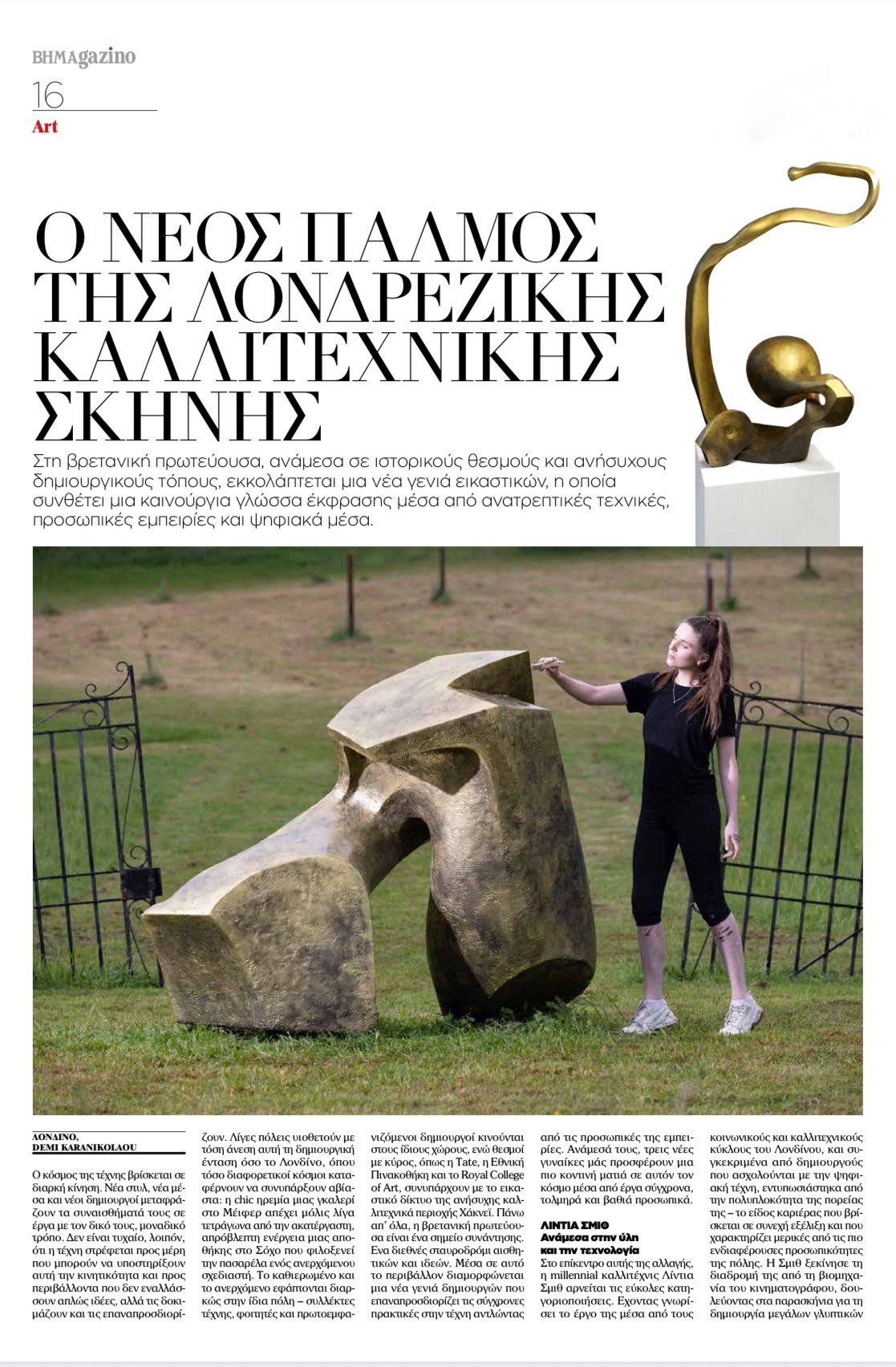
At the centre of this shifting landscape, millennial artist Lydia Smith resists predefined boxes and easy characterisations. I first became aware of her work through London’s social and artistic circles, particularly among artists engaging seriously with digital artwork and NFTs. While for many this was a passing trend, I was struck by her rich trajectory, one that mirrors the same sense of movement I see across London’s most compelling creative figures. Smith began her career in the film industry, working behind the scenes to create large-scale sculptures and sets for some of the world’s biggest blockbusters. Over time, however, she shifted her focus towards her own artistic practice. Unafraid of new materials and technologies, she has embraced digital technologies as an extension of her physical work, whether sculpture or painting. Moving between large-scale production, sculpture and emerging digital mediums, her practice feels inseparable from the conditions of the present moment, where the physical and the virtual no longer exist as separate realms, but as overlapping systems in constant dialogue. Rather than choosing between them, she allows each to inform the other, building a language that is continuously evolving. I wondered how this movement between hand and technology had shaped the way she understands form itself. “Working with clay, I enter a meditative state in which the form emerges through a quiet dialogue between my body and the material,” she told me. “In contrast, the digital world has no gravity, no weight, no fixed environment. Moving between these two modes allows me to understand form as something that continuously translates rather than something fixed.” For a period of two years Smith's studio was also located beneath the National Gallery in London, inside a series of historic vaults that once functioned as royal cellars. I asked her what it meant to work within a space so visibly marked by history. “London is a city where multiple timelines coexist,” she explained. “For two years, my studio was located beneath the National Gallery, and working within that space, I became acutely aware of the physical presence of history embedded in the walls.” I wondered whether she sees herself as part of a broader generation thinking simultaneously about craft, technology and emotion, or whether this has always been a more personal trajectory. “I do feel connected to that shift,” she told me, “but for me it hasn’t emerged as a response to a broader movement. The relationship between craft, technology and emotion has always been embedded in my practice.” In many ways, Smith’s work feels like a precise articulation of the shift currently taking place in London: a city where histories accumulate, disciplines overlap, and new forms emerge through friction. Her practice does not attempt to resolve these tensions. It thrives in them.
Elizabeth Abel - Prioritising Intuition in Painting
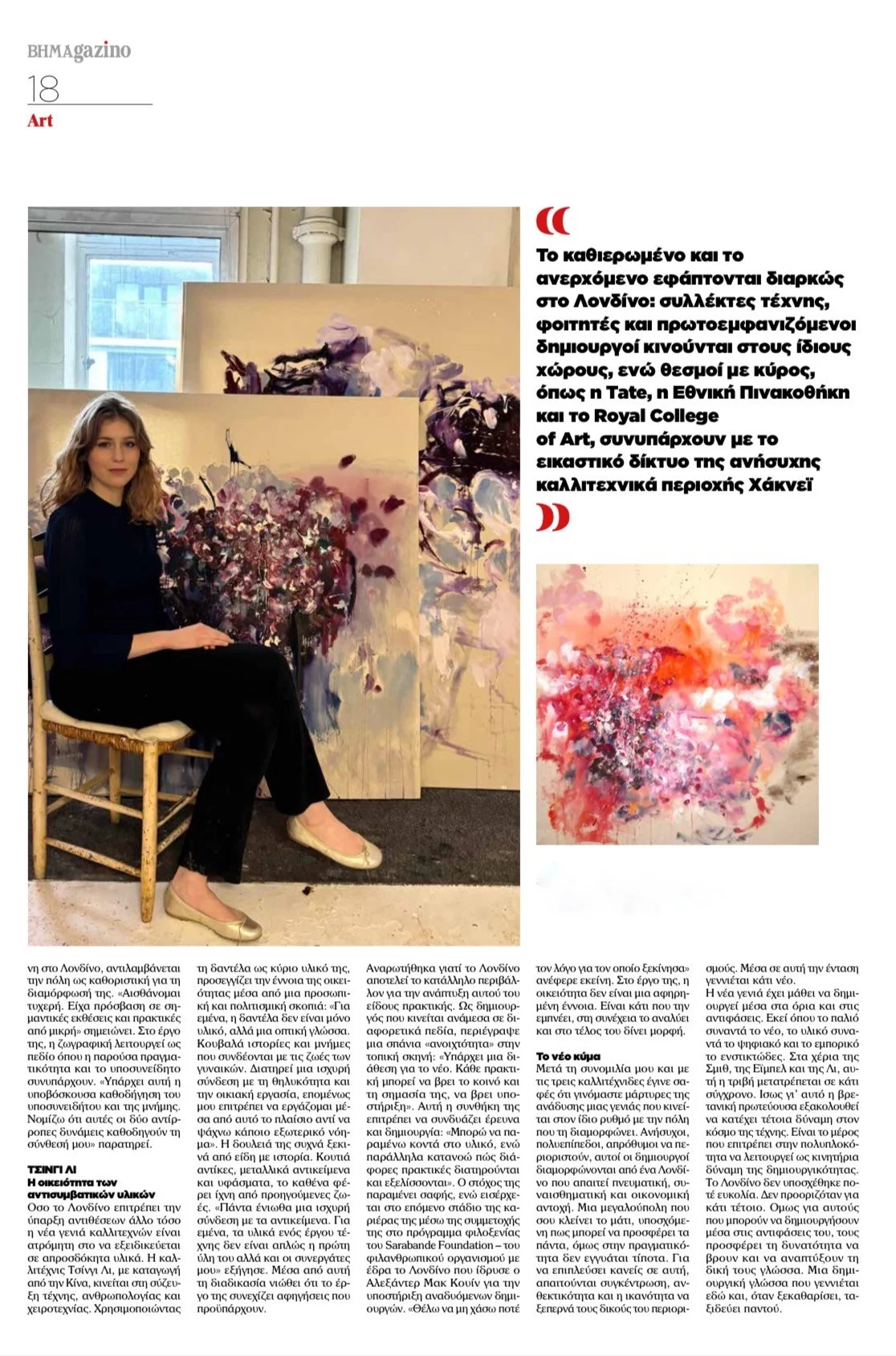
Within this new generation, painter Elizabeth Abel approaches her practice with a sensitivity that feels deeply personal. Working in London, a city shaped by both its history and constant renewal, her work draws as much from memory as from the present moment. I asked her about her working process, which prioritises urgency. “I begin working straight onto raw canvas. There is a sense of urgency, particularly during the beginning phases. I use paint straight from the tube,” she explained. Rather than starting a piece with a fixed idea, the young artist described how her paintings unfold through fragments of feeling: “I am unearthing. A feeling, a memory, a place… something ancient. Traces of where people have been. Bodies moving, passing each other… folded, suffocating, embracing,” she told me. Figures emerge and dissolve in the same movement. “Sometimes this can create an object, a figure. Sometimes I am left with a colour, a line. An absence. A presence.” There is a strong physicality to her process, where gesture and repetition build and destabilise the composition. “Marks wrestle and clash with one another, as soft colour washes over the surface, preserving the serenity,” she said. This tension continues in her approach to form. “I am always trying to find a tension between abstraction and figuration… the compositions refuse to commit fully to the figurative. They exist in ambiguity.” Having grown up in London, she sees the city as formative. “I feel very privileged,” she noted, “I have been exposed to lots of brilliant and inspiring exhibitions. I am consumed by the present expression of painting, but there is also this underlying guidance of the subconscious and memory. I think these two opposing forces abstract my composition.”
Jingyi Li - Unconventional Material whisper intimacy
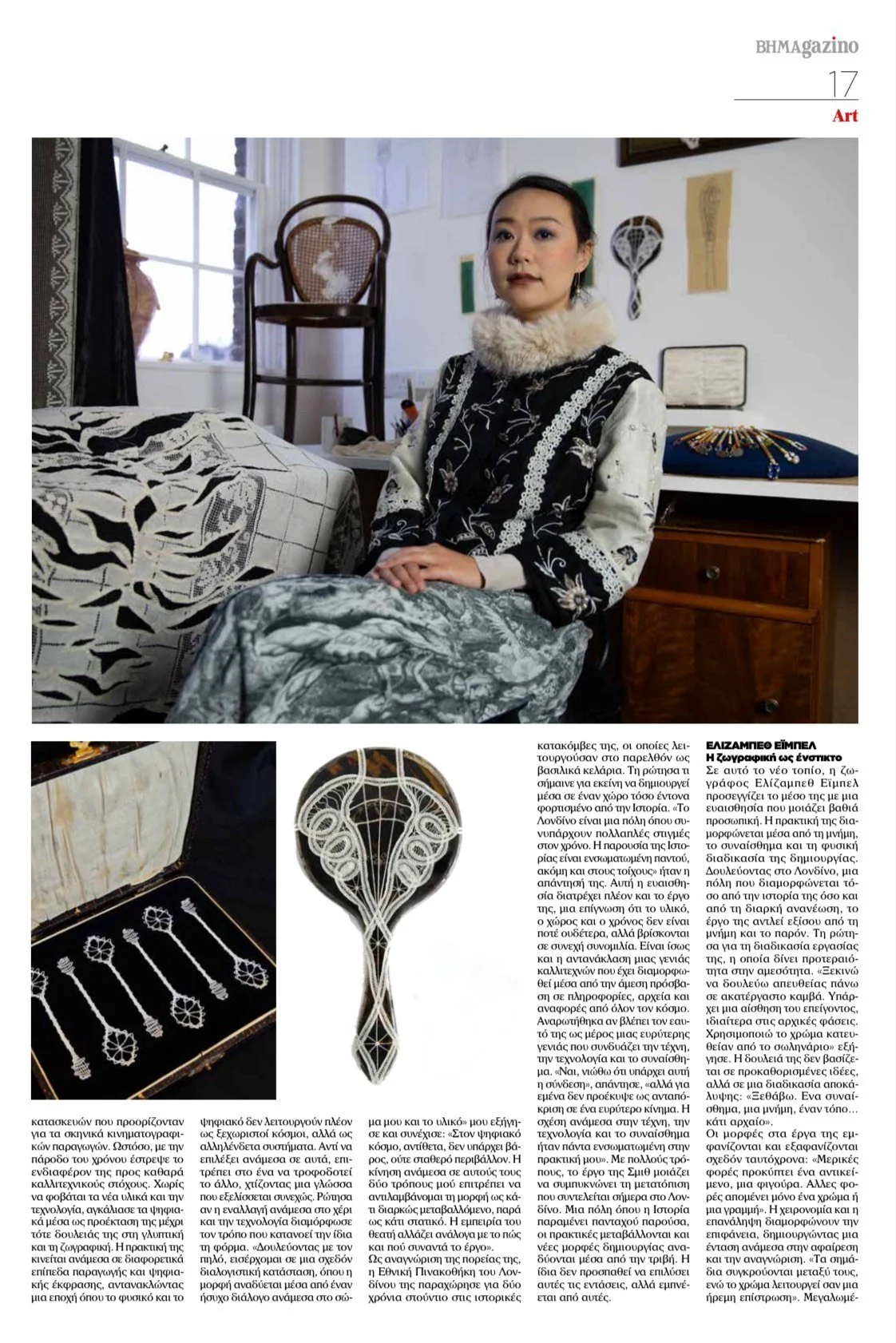
While London allows contradictions to coexist, the new generation of artists is equally unafraid of specialising in unexpected materials. Chinese-born artist Jingyi Li is building a name for herself between craft, anthropology and contemporary art, working through a medium that carries both delicacy and weight. Using lace as her primary material, she explains that it holds both personal and cultural significance. “For me, lace is not only a material but a visual form. It carries histories, family memories, and forms of knowledge that are often closely tied to women’s lives,” she told me. “Lace already holds a strong connection to femininity and domestic labour, so it allows me to work from within that context rather than adding meaning from the outside.” Her work often begins with objects that already carry a past. Antique boxes, cutlery and textiles each hold traces of previous lives. “I have always felt a strong connection to objects… they have taught me to think of materials as partners rather than raw matter,” she explained. “Working with them feels like continuing something that began long before me.”
I wondered why London feels like the right place for this kind of work to develop. As someone working across disciplines, she described a rare openness within the local scene. “London offers a certain possibility… each practice can carry its own importance, rather than being judged against a fixed hierarchy.” That environment has allowed her to pursue a research-led practice alongside making. “Through my work, I am able to stay close to the material itself, while also understanding how these practices are sustained and shared.” As she enters the next stage of her career through her residency at the Sarabande Foundation, the London-based charity founded by Alexander McQueen to support emerging creatives, her focus remains clear. “I hope to remain an artist who does not lose sight of why I began… I want to continue treating art as a way to understand myself and to express something honestly.” In her work, intimacy is carefully observed and made visible, finding its place within a city that continues to hold space for such narratives.
After speaking with all three, it became clear that we are witnessing the emergence of a generation moving at the same pace as the city itself. Restless, layered, unwilling to settle, these artists are shaped by a London that demands stamina, both intellectual and emotional. It is a city that offers everything, yet guarantees nothing. To stay in it requires focus, resilience and the ability to move beyond your own limitations. In the hands of Smith, Adel and Li, that friction becomes something modern. This is a generation that has learned to work within intersections: craft and digital, old and new, commercial and instinctive. Perhaps that is why the British capital still holds such power in defining the art world, it is the place that allows complexity as an engine for creativity. London has never promised ease, and it was never meant to. But for those who can exist within its contradictions, it continues to offer the possibility to build a language that is entirely their own. And when that language is clear enough, the rest of the world listens.