
George Trochopoulos, the Alchemist of Knitwear
This article was written by Demi Karanikolaou for Vimagazino / To Vima Greece - print & digital here
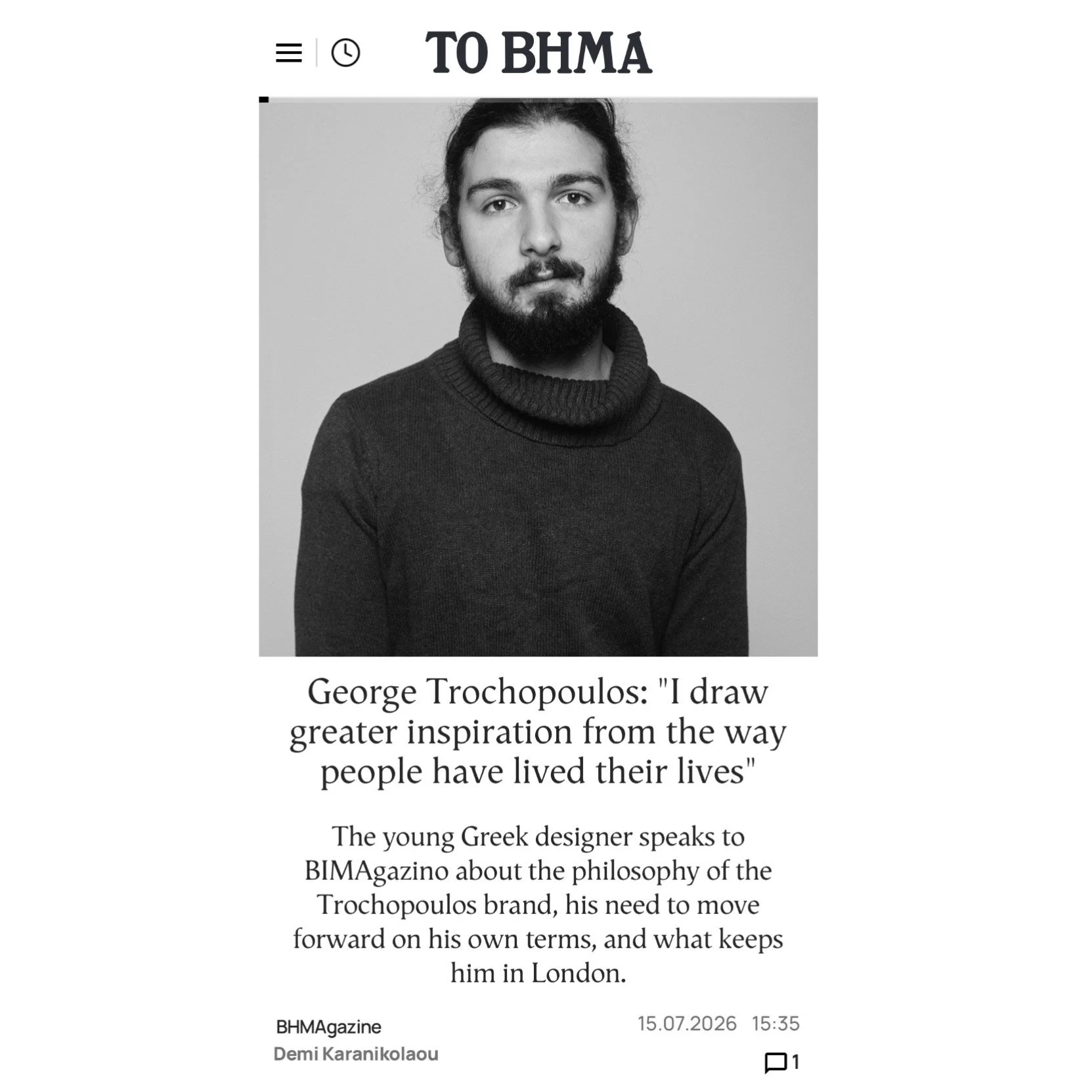
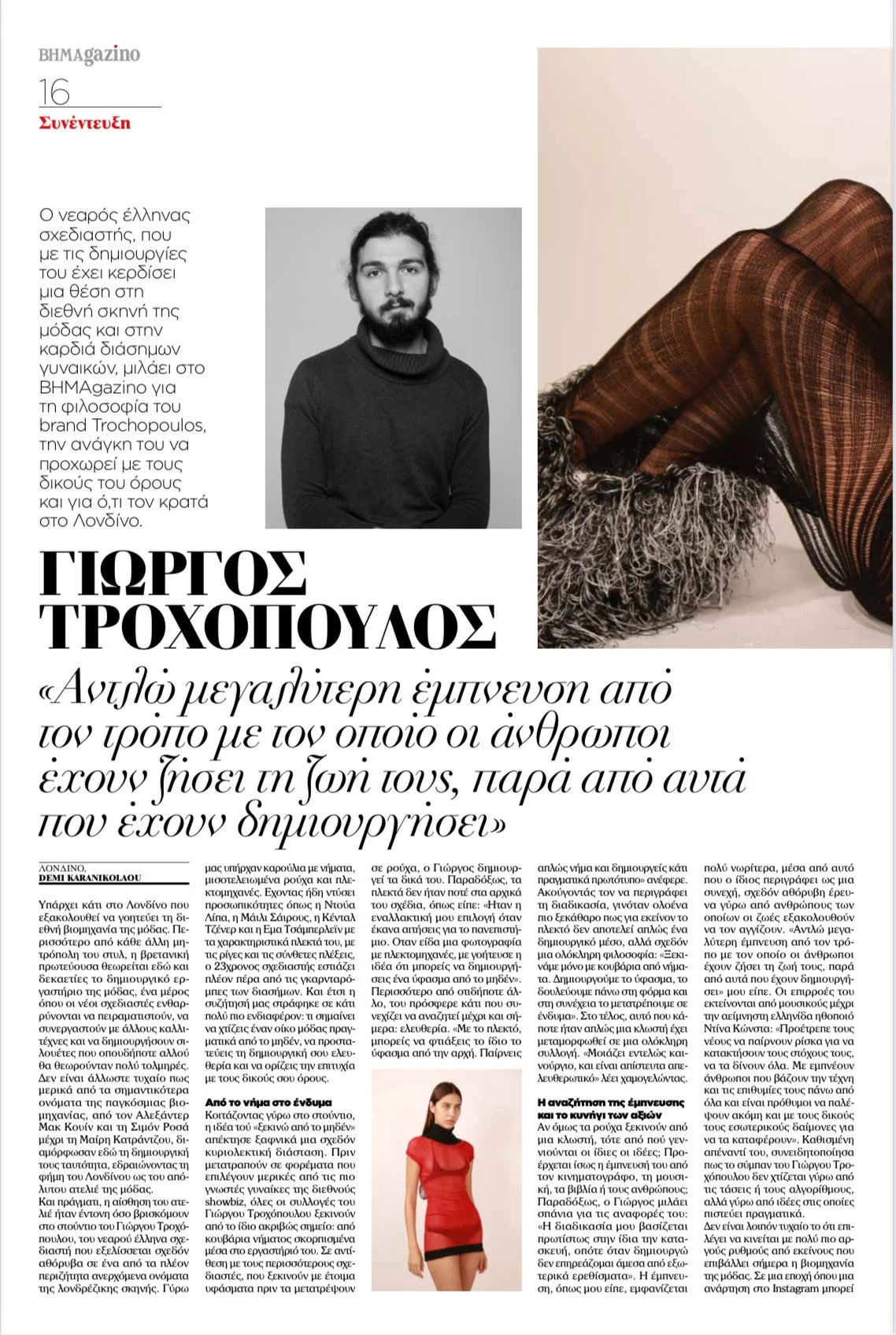
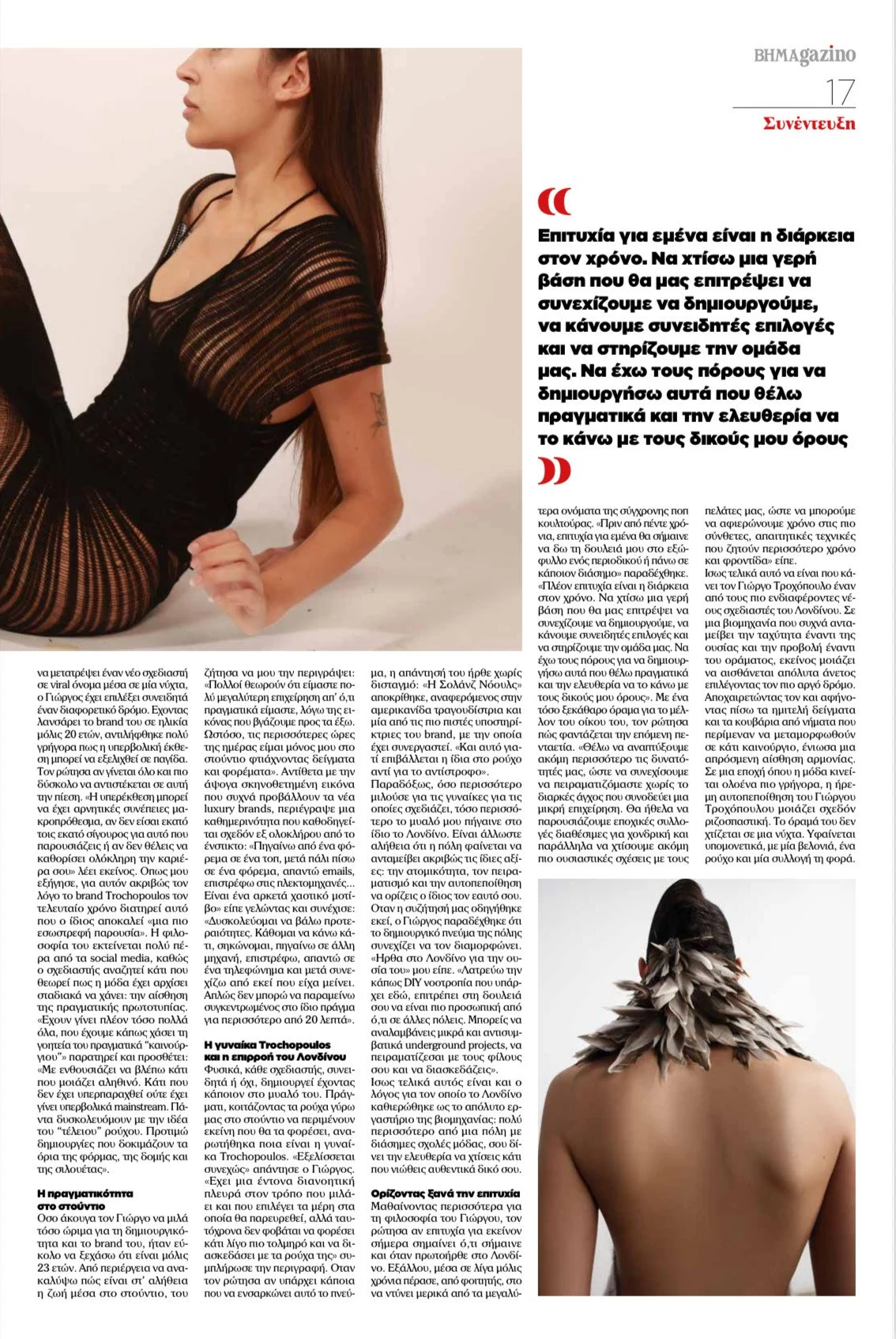
There is something about London that continues to captivate the fashion industry. More than any other fashion capital, the British city has long been regarded as its creative laboratory - a place where young designers are encouraged to experiment fearlessly, collide with artists from every discipline and create silhouettes that might be considered too provocative anywhere else. It is no coincidence that some of fashion’s most influential names, from Alexander McQueen and Simone Rocha to Mary Katrantzou, all helped shape their creative identities here, reinforcing London’s reputation as the industry’s ultimate workshop. And it certainly felt like a workshop as I sat inside the studio of George Trochopoulos, the young Greek designer who has quietly become one of London’s most sought-after emerging talents - bolts of yarn, half-finished garments and knitting machines surrounded us in every direction. Having dressed the likes of Dua Lipa, Miley Cyrus, Kendall Jenner and Emma Chamberlain in his now-signature striped and drop-stitch knitwear, the 24-year-old designer is already looking beyond celebrity wardrobes. Instead, our conversation turned to something far more interesting: what it really means to build a fashion house from scratch, protect creative freedom and define success on your own terms.
Looking around the studio, that idea of “starting from scratch” suddenly felt surprisingly literal. Before becoming sculptural dresses worn by celebrities, every George Trochopoulos collection begins in exactly the same place: balls of yarn scattered across the studio. Unlike most designers, who start with existing fabrics before transforming them into garments, George first creates the textile itself. Ironically, knitwear was never part of the original plan. “It was my backup option for university,” he laughed. “When I was applying to university, I saw a picture of the knitting machines and was just intrigued by the idea of creating fabric from scratch.” More than anything, it offered something he continues to chase today: freedom. “With knitwear, you get to create the fabric itself. You take just yarn and turn it into a textile from scratch, you are making something original.” Listening to him describe the process, it seemed that knitwear was more like a philosophy than a medium for him. “We start with nothing but balls of yarn,” he explained. “We create a fabric, drape it and turn it into a garment.” By the end, what had once existed only as thread has become an entire collection. “It feels entirely new,” he smiled. “Very freeing.”
If the garments themselves begin with yarn, I found myself wondering where the ideas behind them begin. Does inspiration arrive through cinema, music, books or people? Surprisingly, George rarely speaks about references in the conventional fashion sense. “It’s a very craft-led process, so there isn’t necessarily direct interference from outside sources when I’m physically creating,” he explained. Instead, inspiration arrives much earlier, through what he describes as “lingering research” into the lives of creative people whose stories continue to resonate with him. His inspirations range from musicians to the late Greek actress Dina Konsta. “I’m taking a lot of inspiration from the way people have lived their lives rather than the things they’ve created,” he told me. Recalling an old interview with Konsta, he paused for a moment. “She was urging younger people to take risks in order to attain what they want, to go all in,” he said. “It’s inspiring to see people who put their art and desires first and battle their internal demons to do so.” Sitting across from him, I realised that the Trochopoulos universe is driven less by trends or algorithms than by ideas he genuinely believes are worth pursuing.
Indeed, his focus on values is no accident. In an industry increasingly obsessed with virality, where a single Instagram post can propel a young designer to overnight success, George has deliberately chosen a different pace. Having launched his label at just twenty years old, he admits he quickly realised that visibility can become a trap if it arrives before a designer fully understands what they want to say. I asked him whether resisting that pressure had become increasingly difficult. “Overexposure can have negative long-term effects if you aren’t one hundred per cent sure about what you’re presenting, or if you don’t want it to define your entire career.” It is precisely for that reason, he explained, that the house has consciously maintained what he describes as “a more insular presence” over the past year. His reasoning, however, extends far beyond social media, with George ultimately searching for something he believes fashion has gradually lost: genuine newness. “Since so much has been done before, we’ve somewhat lost the novelty of true ‘newness’,” he reflected, adding, “I find it exciting to see something that feels real - something that hasn’t been overly produced or too mainstreamed. I’ve always struggled with the idea of ‘perfect’ clothing. I prefer things that push the boundaries of structure, shape and silhouette.” It quickly became clear that George isn’t searching for perfection, but for originality.
While listening to George speak so thoughtfully about creativity, it was easy to forget how young he is. Reality, however, tends to be far quieter than appearances suggest. Curious to discover what life inside his studio really looked like, I asked him to describe it. “People often assume that we are a bigger business based on our outward presence,” he admitted. “But at the end of the day, most of the time it’s just me in the studio making dresses and samples.” Far from the polished image people often associate with young luxury brands, he described a working day driven almost entirely by instinct. “I bounce from dress, to top, to dress, to answering emails, back to the machine. It’s a very manic process,” he laughed. “I struggle with prioritising, so I’d sit down, do one thing, stand up, go to another machine, finish that, take a call midway through and do the whole thing again.” Then, almost as an afterthought, came perhaps the most honest sentence of our conversation. “They’d just realise that I cannot sit still with one thing for more than twenty minutes.”
Of course, every designer, whether consciously or not, creates with someone in mind. Looking around the studio, where garments were waiting for their wearer, I found myself wondering who exactly the “Trochopoulos woman” really was. “She is constantly evolving,” George replied with a smile. “She has a very intellectual foundation in the way she speaks and curates events, but at the same time, she isn’t afraid to wear something a little more daring and have fun with clothing. She perfectly showcases that intersection between sexiness, fun and intellectuality that I hope to bring to the clothes we make.” When I asked whether there was someone who embodied that spirit, his answer came without hesitation. “Solange,” he replied, referring to one of the house’s most loyal supporters. “It is because she takes over the clothing rather than letting the clothing take over her.” Curiously, the more George spoke about the women he designs for, the more I found myself thinking about London. It is also true that the city seems to reward exactly the same qualities: individuality, experimentation and the confidence to define yourself on your own terms. When our conversation pointed there, George admitted that the city’s creative spirit continues to shape him. “I came to London because of its essence,” he reflected. “I love the DIY aspect of it; it allows the work to feel a bit more personal than in other cities. You get to do scrappy underground projects and have fun.” Perhaps that is what has made London the industry’s ultimate workshop for generations: not simply its fashion schools or fashion weeks, but the freedom to build something that feels unapologetically your own.
As I learned more about George’s philosophy, I questioned him on whether success still meant the same thing to him today as it did when he first arrived in London. After all, in just a few short years, he has gone from university student to dressing some of the biggest names in contemporary culture. “Five years ago, success would have meant seeing my work on the cover of magazines or on celebrities,” he admitted. “Now, success to me looks much more like longevity. It’s about building a foundation that allows us to create more work, be intentional and sustain a team. Having the resources to create what I want to create and the freedom to do it on my own terms.” With such a clear vision for his business, I asked him how he hopes the brand will evolve over the next five years. “I want to grow our capabilities so we can keep experimenting without the constant anxiety of running a small business. I’d love to offer seasonal collections available for wholesale, while also building established relationships with clients where we can really lean into the complex, craft-heavy techniques that take more time and effort,” he said. Perhaps that is precisely what makes George Trochopoulos one of London’s most compelling young designers. In an industry that often rewards speed over substance and visibility over vision, he seems remarkably comfortable taking the longer route. As I said goodbye and stepped out of the studio, leaving behind the industrial knitting machines, half-finished garments and cones of yarn waiting to become something else, I was struck by an unexpected sense of calm. In a fashion landscape increasingly driven by immediacy, George’s quiet confidence feels almost radical. His vision isn’t built overnight. It is patiently woven, one stitch, one garment and one collection at a time.