This article was written by Demi Karanikolaou for WIRED. You can find it here.
“Some exercise is necessary after a full day of trying to match people up,” said the woman next to me to our instructor just before we were about to begin our reformer Pilates class. Intrigued, I asked her to explain what she meant. As luck would have it, I happened to be sharing a class with a professional matchmaker, someone I had never encountered in real life before, even though the profession had certainly come up vaguely in recent conversations. Only a few days earlier, my friend Kate, a 30-year-old model who has absolutely no shortage of male attention, had told me she was seriously considering hiring one after we watched Materialists, the 2025 film about a professional matchmaker attempting to make sense of love in a world where romantic compatibility can start to resemble a particularly complicated spreadsheet. Dating apps, she complained, had begun to feel less like dating and more like “an endless scrolling game”. Kate was hardly the only friend complaining. Dating technology has made finding people remarkably easy. So why did dating itself seem to be getting so difficult, when most of us can theoretically meet hundreds of single people without getting off the sofa? Somewhere between planks and trying not to fall off the reformer, my mind started wandering.
The Illusion of Abundance
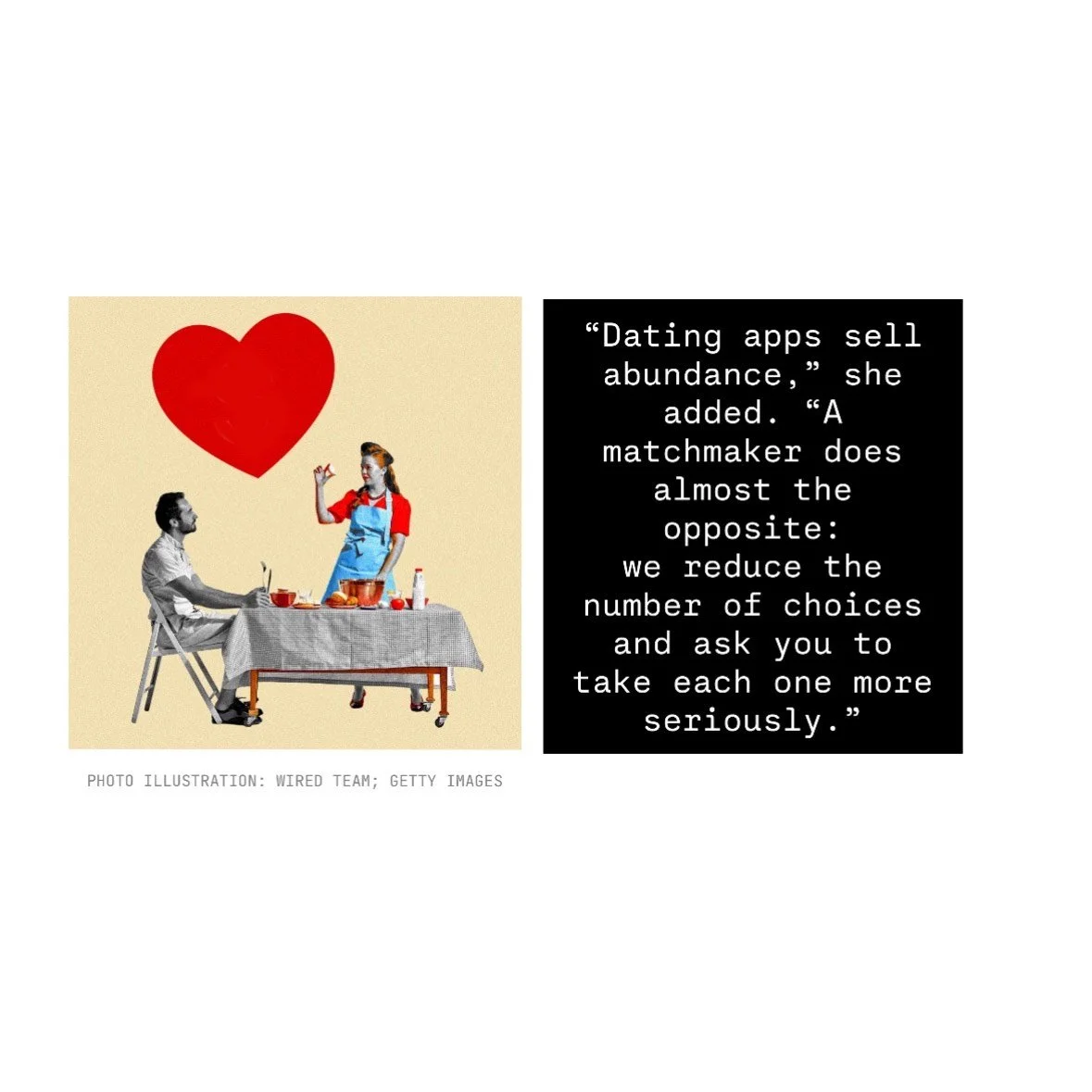
After the class, I asked the matchmaker, who asked to stay anonymous, if she had a few minutes to talk, starting with the age demographic of her clients. Was matchmaking even relevant to people in their 20s and 30s? “I have clients in every age bracket,” she replied. “The over-60s are certainly the easiest to match, but my fastest-growing demographic is definitely people in their 30s to 50s. I also have clients in their 20s.” “Can’t a 30-year-old just go on an app?” I wondered. Apparently, they can, but that is not really the problem. “Younger clients rarely come to me because they cannot get dates. They come because they are exhausted by having to screen hundreds of people themselves,” she told me. The problem, then, was not necessarily a lack of choice, but perhaps too much of it. Dating apps have made access to potential partners almost endless, but that also means endless profiles, conversations and decisions about whether someone is worth pursuing. “Dating apps sell abundance,” she added. “A matchmaker does almost the opposite: we reduce the number of choices and ask you to take each one more seriously.”
The next day, my friend Ingrid showed me her Hinge profile, which seemed to offer a perfect example of what I had been hearing. At 40, she had eight active conversations, but had met none of the men behind them. “I have all these matches and technically all these conversations, but none of them actually go anywhere. What is the point of matching with someone in the first place?” she wondered. There is some research suggesting that abundance itself may change the way we choose. In a series of studies on online dating, psychologists Tila Pronk and Jaap Denissen found that people became increasingly likely to reject potential partners as they were presented with more options, describing it as a “rejection mind-set”, while other studies have similarly found that perceiving more romantic options was associated with greater choice overload. Perhaps the problem is not simply having too few good choices, but knowing there is always another one waiting.
Permanently Postponed
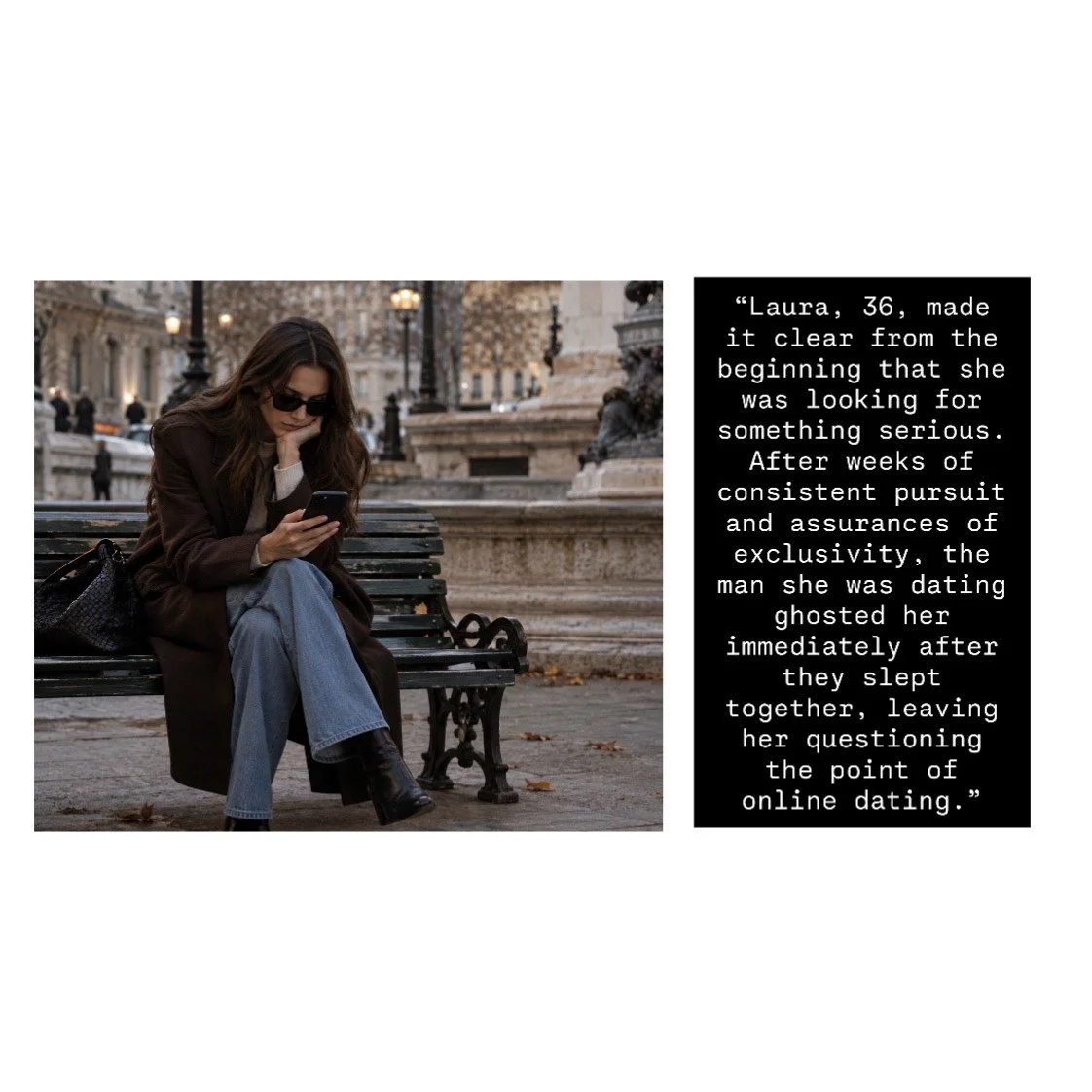
My 31 yo friend Nikki’s story, however, offered perhaps the most heartbreaking example of what that constant sense of false possibility can do. She had spent almost two months talking to a 37-year-old man she met online, even though he lived in Switzerland. Through regular video calls, daily messages and normal conversations about life, not just sexting, the two of them felt like they were actually getting to know each other. When he finally visited her, the chemistry was palpable. They spent hours talking about their worldview, felt comfortable with one another and eventually had great sex. “I had that feeling where you just know someone is about to become your next boyfriend,” Nikki told me. “He felt special and we made sense together.” Before he left, Nikki told him directly that she liked him and wanted to see him again. He said he felt the same. Then, almost as soon as he left the country, he became distant. Eventually, he told her that while he thought she was great, he liked being single and having “so many options through the apps”. After all, he had only been single for a year and was enjoying it. Nikki was hardly alone. Laura, 36, had deliberately started telling matches early on that she was not interested in hookups. One man assured her he felt the same, told her he did not want her seeing other people and pursued her consistently for weeks. “He ghosted me immediately after we slept together,” she told me. “I honestly don’t know what the point of online dating is anymore.” “The biggest change is not that people no longer want relationships,” the matchmaker had told me. “Many do. They simply behave in ways that keep relationships permanently postponed.”
Are they consistent?
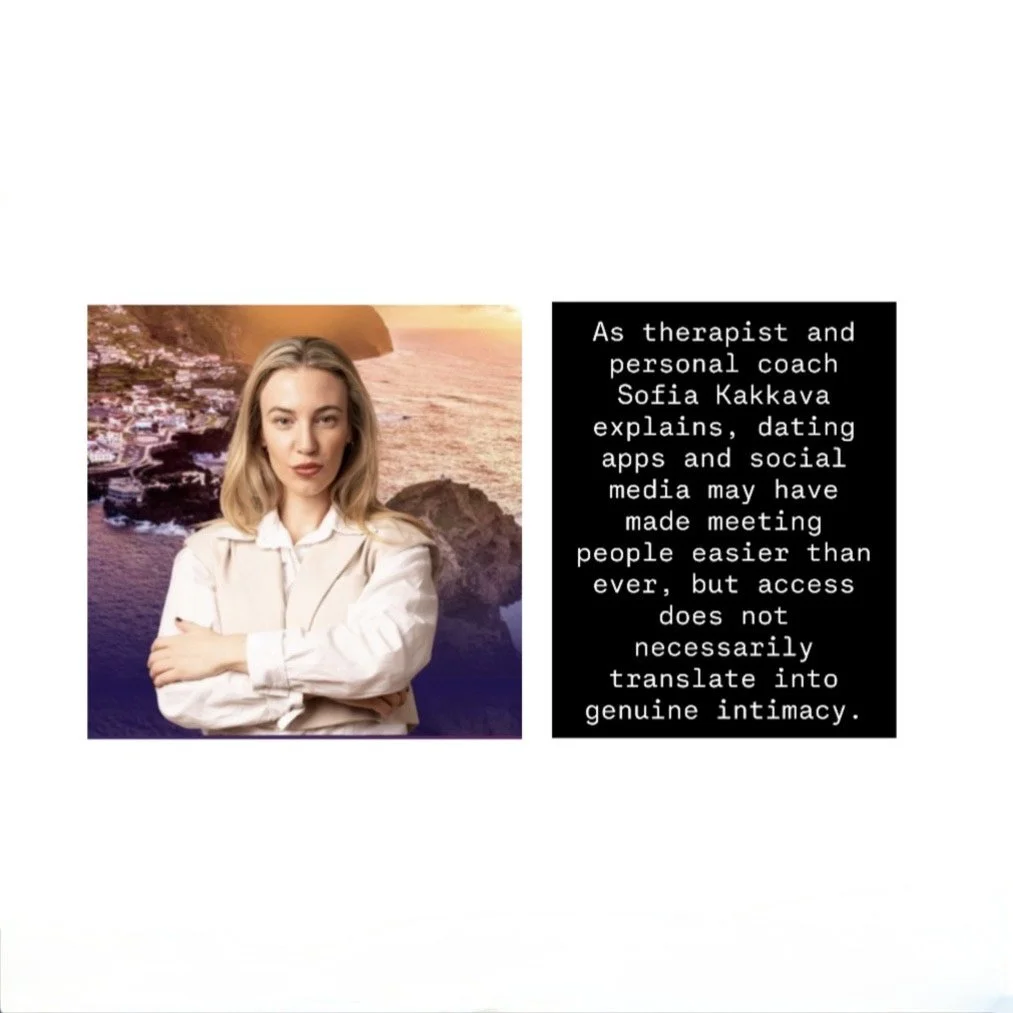
Confused and overwhelmed, I turned to my friend Sofia Kakkava, a therapist and personal coach. How did she explain this behaviour from a professional point of view? “Dating apps and social media have given us more ways than ever to meet people, but access to someone is not the same as intimacy with them,” she told me. “A profile can create an impression, but real connection develops through curiosity, conversation and shared experiences.” For Kakkava, what happens after that first spark matters even more. “Consistency matters much more than a great first impression. A strong first conversation can create excitement, but over time you understand who someone is by whether they keep their plans, respect your boundaries and continue to show genuine interest. Attraction is important, but you also have to follow through.”
I immediately wondered whether that idea of “following through”, and simply behaving with a little more consideration, might have something to do with the nature of a real-life introduction between two pre-vetted people. After all, this was dating with intention, which is exactly what the matchmaker replied when I asked her what was fundamentally different about meeting someone through her.“The younger clients are not necessarily more traditional. They still want autonomy. What they are looking for is curation,” she explained. There is also, inevitably, a little more at stake. Someone has chosen to be there, paid for the service, made time to talk about what they actually want and agreed to meet another person in real life. “What apps remove is friction. But some friction is useful,” she told me. “When another human being has introduced you, you are less likely to dismiss someone after one slightly awkward message.” If all you wanted was another evening of scrolling, or simply sex, there are already considerably easier ways to find both online.
Is this the real paradox of modern dating? Hardly anyone would seriously want to return to a world in which romantic choices were dictated by family, convention or necessity. Having more freedom, more sexual autonomy and more ways to meet people is unquestionably a good thing. Yet, somewhere along the way, choice seems to have created its own kind of paralysis. And while there are undeniably people who genuinely enjoy an endless, commitment-free dating life, there are also plenty who would quite happily try a relationship, whether it lasts a few months or several years, if they could stop wondering whether someone marginally better was one swipe away. I couldn’t help but wonder whether this was why something as old-fashioned as matchmaking suddenly feels relevant again, as our increasingly burnt-out dating culture seems willing to put a little human judgment back into the process. Maybe the next innovation in dating will not be finding us more people, but persuading us to take one of them seriously.