Curated Intellectualism: The new labels on the radar of tastemakers
This article was written by Demi Karanikolaou for Harper’s Bazaar Greece. You can find it here.
They say one of fashion’s greatest strengths lies in the fact that many different aesthetics can coexist within the same moment. It allows people to express individuality, to signal belonging, and to locate themselves within a wider cultural mood. Yet fashion still tends to move forward through quieter shifts - the kind shaped not by mass consensus, but by the women and tastemakers whose instincts begin influencing the room before anyone else has noticed.
And indeed, the most telling changes in style rarely announce themselves loudly. While overt signalling of wealth and pretentious fashion has weakened a lot of familiar household names, a new mood is emerging across the global fashion set - where the clearest signal of status is often the one you have to look twice to recognise. If the last few years were defined by the flattening language of “quiet luxury,” this moment feels closer to a kind of curated intellectualism. The mood is sharper, more distinctive, and more deeply rooted in the arts, in historical reference, and in a refined simplicity that is less about anonymity and more about point of view. The labels gaining real traction now are not minimal for minimalism’s sake. Some are sculptural, some sensual, some archival, some almost severe - but all of them speak to a new kind of fashion authority: discreet, precise, and quietly ahead of the curve. From the bags appearing on Leandra Medine to the shoes newly worn by Tracee Ellis Ross, these are the names circulating with real credibility among the style set now.
Savette is perhaps the clearest example of how modern luxury has shifted from overt recognition to insider recognition. Founded by Amy Zurek, whose résumé includes design roles at both The Row and Khaite, the brand carries a pedigree of refined minimalism that feels at once archival and modern. The secret seems to lie in that tension: its accessories feel classic, polished, and unfussy, without ever tipping into overdesign. Savette’s signature Symmetry hardware, seen across its bags and belts, has already become a kind of secret handshake among editors and those in the know.
The brand has come to embody a form of anti-logo sophistication - the sort of luxury that is recognised most instantly by the right eyes. Each piece is handmade in a third-generation family-owned atelier outside Florence, reinforcing a “future-vintage” sensibility that resists trends in favour of permanence. For Spring/Summer 2026, the focus shifts to the Anello family. Named after its loop closure, the Anello tote combines the slouch of a bucket bag with the structural integrity of traditional Italian saddlery. A favourite among minimalist-chic tastemakers, Savette has already been worn by names such as Leandra Medine and Sophie Turner.
Charlotte Chesnais, meanwhile, marks her tenth anniversary this year, continuing to prove that jewellery can function as an architectural extension of the body rather than a mere accessory. Since founding her eponymous house in 2015, after working under Nicolas Ghesquière at Balenciaga, Chesnais has built one of the most distinctive jewellery universes of the past decade. She approaches metal like a sculptor, shaping prototypes by hand in clay rather than on a screen.
Her work exists in the space between fine jewellery and contemporary art, defined by “floating” lines that circle the wrist or ear in one singular, fluid motion. At a moment when so much jewellery feels either overly referential or overly eager for social-media visibility, Chesnais offers something rarer: a visual language that is instantly recognisable yet still intellectually alive. Her decade-long evolution, along with collaborations with houses such as Rabanne and Loro Piana, only reinforces that authority. The Round Trip and Biseau lines remain central to her vocabulary, capturing the instinctive, avant-garde spirit that defines the house. It is, unmistakably, jewellery for the woman who sees adornment as a kind of wearable gallery.
Headquartered in Huis de Vicq, a 17th-century monument in Amsterdam, Róhe has quietly emerged as a favourite among women drawn to wearable pieces with intellectual precision. Founded by Marieke Meulendijks and Maickel Weyers, who come from a background in textiles, the brand has built a world defined by what it calls a “dialogue of quiet confidence.” Its elevated minimalism has found particular resonance with contemporary tastemakers, with figures such as Athena Calderone and Leia Sfez already counted among its admirers.
Much of that appeal lies in the brand’s ability to make tailoring feel both architectural and deeply wearable. The much-loved Róhe Frame blazers, with their structured shoulders and rich Italian fabrics, have become especially emblematic of that balance. For SS26, the collection continues this language through an exploration of volume and air, offering silhouettes that feel at once constructed and soft. It is the kind of brand that naturally becomes a creative director’s uniform - precise, restrained, and quietly authoritative.
Then there is JUDE, the fast-rising footwear and accessories label crafted in Portugal and favoured by tastemakers for its modern minimalist aesthetic, sharpened by sculptural and slightly subversive details. Established in 2024 by Jurgita Dileviciute and Denitsa Bumbarova between Sydney and Porto, the brand has already achieved what many labels take years to master: a distinct and sensual identity. Its designers lean into what they describe as “subversive sensuality” - a form of minimalism that is unafraid to feel slightly off-centre, and therefore all the more compelling.
The shoes are defined by what the brand calls “hidden pleasures” - details known first and foremost to the woman wearing them, from the feel of the leather against the skin to the unexpected curve of a heel. They feel modern, but never sterile; feminine, but never obvious. The imminent expansion into bags feels like a natural progression, because JUDE already seems to understand the importance of accessories as aesthetic objects. It is no surprise, then, that figures such as Nicole Kidman and Chloë Sevigny are often spotted in the brand's Date and Fame styles.
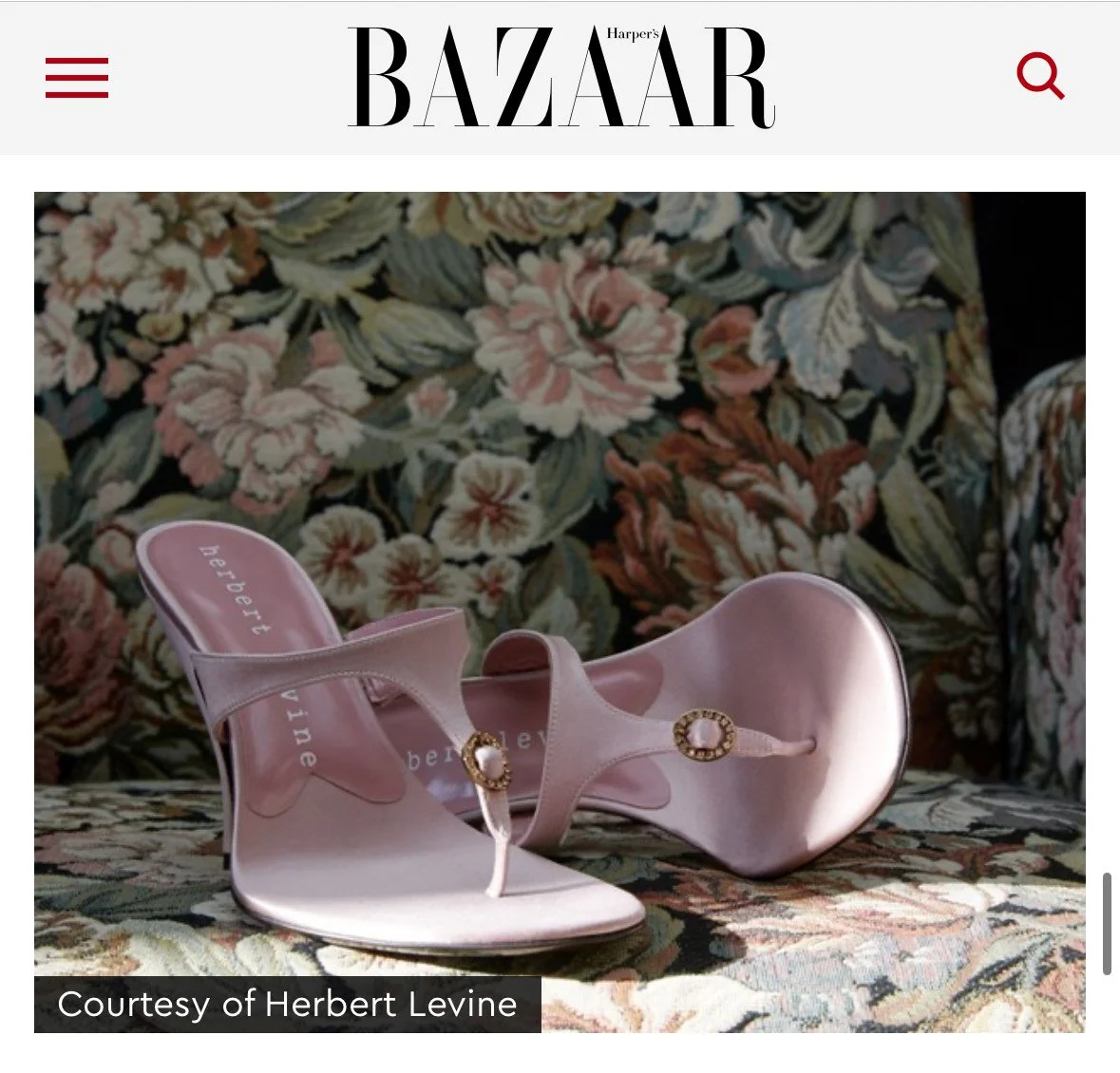
Perhaps the most exciting relaunch of the moment, Herbert Levine is the 1948 American heritage house reimagined for 2026. Founded in New York by Beth and Herbert Levine - and once the shoemaker of choice for women such as Jackie Kennedy and Marilyn Monroe - the house carries an extraordinary fashion history, long associated with wit, glamour, and experimentation. That legacy has now been reanimated under the creative direction of Trevor Houston, who brings to Herbert Levine a sharp neo-noir edge.
The Spring/Summer 2026 collection, framed around the metaphor “Life Is A Movie”, draws on the moody world of Blade Runner, as well as on the visual language of shadow, reflection, and cinematic suspense. There are luminous satins, soft suedes, sheer mesh, sculpted heels, and high-voltage colour, all of which make the shoes feel both elegant and faintly dangerous. It is not difficult to see why the relaunch feels so current, particularly with women such as Tracee Ellis Ross and Emilia Clarke already wearing the label. After years of flattening sameness in accessories, the combination of the brand’s rich heritage and its distinctly modern, rebellious spirit feels especially compelling. Herbert Levine’s history - including Beth Levine’s cult status in American footwear design - gives the revival real depth, but what makes it matter now is that it does not rely on nostalgia alone.
Taken together, these labels point to a broader shift in fashion’s centre of gravity: away from the obvious and toward cultural fluency and a sharp eye for design. Perhaps that is what tastemakers are responding to most right now - not the comfort of the familiar name, but the pleasure of recognising something a little earlier, and a little more privately. They speak to the appeal of a woman who dresses with curiosity, conviction, and a point of view that does not need to be made explicit to be felt.