
Maison Estelle Estelle Manor: The discreet charm of London's new elite
This article was written by Demi Karanikolaou for Vimagazino / To Vima Greece - print & digital here
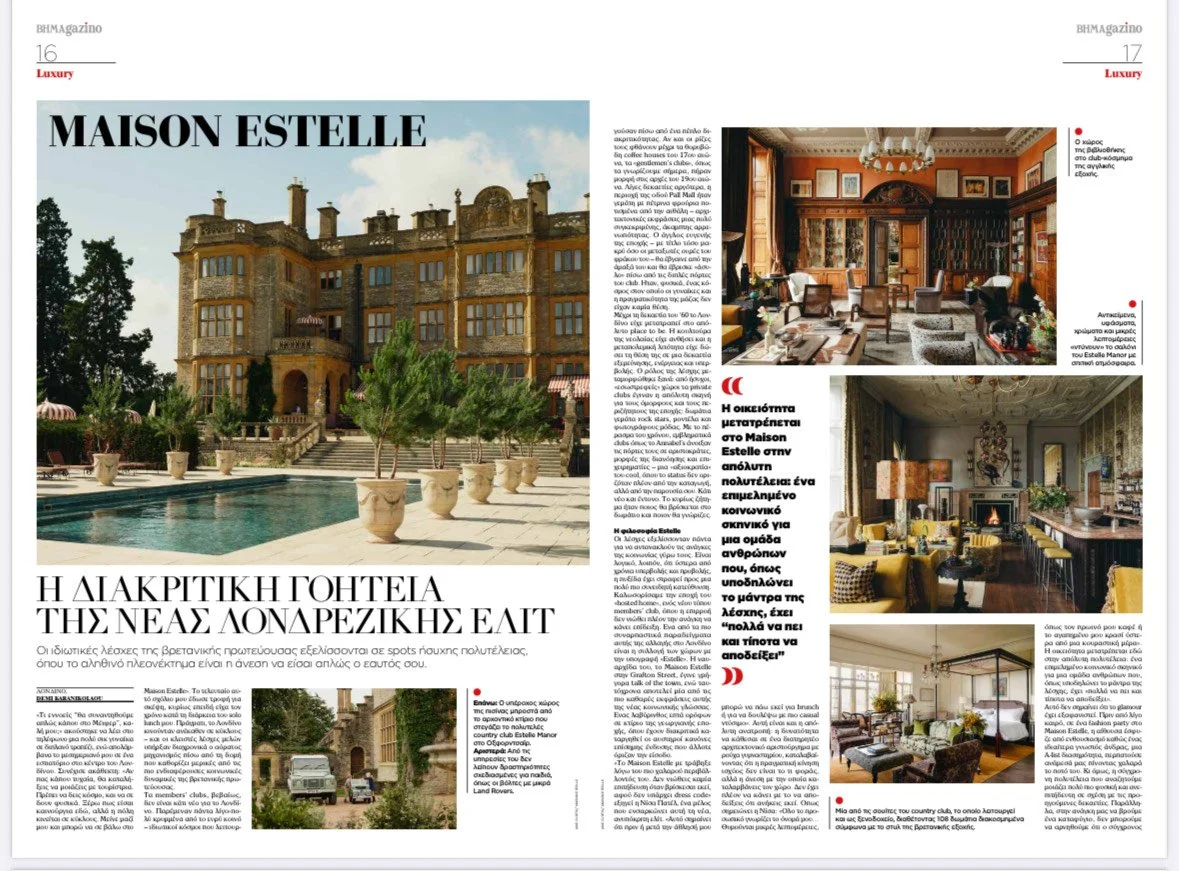
“What do you mean we’ll just meet in Mayfair, darling?” I overheard an overly chic woman say on the phone at the table next to mine while having lunch at a downtown restaurant in London. She continued, “Go out to a random place and you’ll just end up looking like a tourist. You’ve simply got to be seen. Look, I know you’re new around here, but the city moves in circles. Stick with me, I can get you into Maison Estelle.” That last comment stayed with me, especially since I was enjoying a solo lunch and allowing myself more time to daydream than usual. London has, indeed, always moved in circles, and selective establishments have long been the unseen engine behind the social structure that shapes some of the UK capital’s most interesting dynamics.
Members’ clubs are nothing new to London, of course. They have always remained, more or less, hidden from the general public - private universes operating behind a veil of discretion. While their roots trace back to the rowdy coffee houses of the 1600s, the “gentlemen’s club” as we recognise it today took shape in the early 19th century. By the mid-1800s, Pall Mall was lined with soot-stained stone fortresses, architectural expressions of a very specific, rigid masculinity. Back then, a gentleman of English nobility, with a title as long as his silk coattails, would step out of his carriage and disappear behind double doors that promised sanctuary - a world where women were strictly forbidden and the “common” outside was quietly erased. By the 1960s, London had become the place to be. Youth culture flourished, and post-war austerity gave way to a decade of exploration, energy and excess. The role of the club shifted once again, from quiet, insular spaces to a stage for the beautiful - rooms filled with rock stars, models and fashion photographers. As time moved on, prominent clubs like Annabel’s opened their doors to aristocrats, cultural icons and businessmen alike - a meritocracy of cool, where status shifted from lineage to presence. It was loud, it was sweaty, and it was all about who was looking at you.
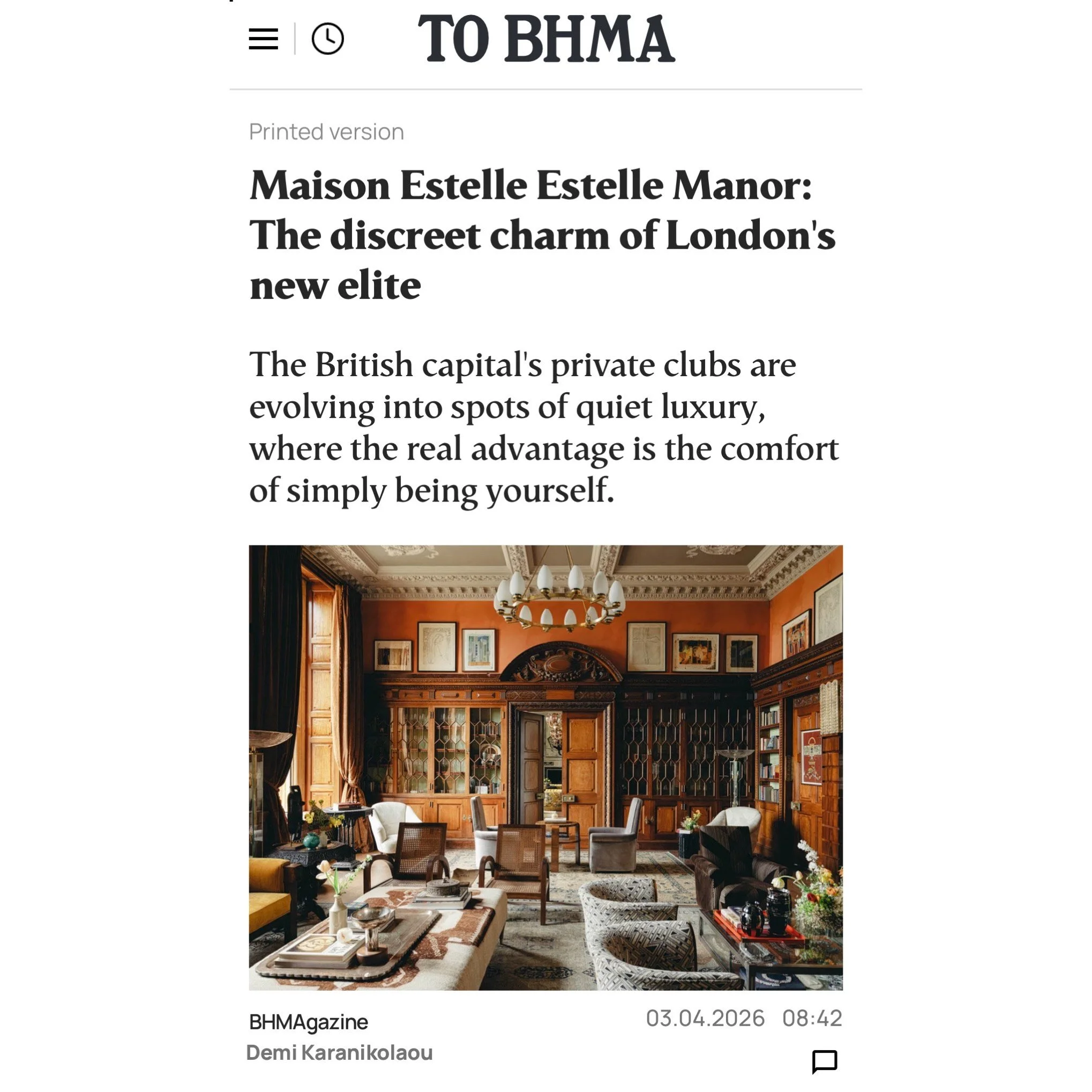
Over time, clubs have always evolved to reflect the needs of the society around them. It makes sense, then, that after years of excess and spectacle, the pendulum has swung in a far more considered direction. Enter the era of the “hosted home” - a new kind of club where influence no longer feels the need to perform. One of the most compelling examples of this shift in London is the collection of Estelle-branded spaces. Its flagship, Maison Estelle on Grafton Street, has quickly become the talk of the town while simultaneously offering one of the clearest expressions of this new social language. A seven-floor Georgian labyrinth, it has quietly dismantled the rigid “suit and tie” codes that once defined entry. “I was drawn to Maison due to its more relaxed environment... It does not feel pretentious when you are there, with no dress code,” says Nisha Patel, a member who embodies this new, unbothered elite. “This means before or after a workout I can go there for brunch or do work in more casual attire.” This is the ultimate subversion: the ability to sit in a Grade I-listed masterpiece in gym gear, understanding that the real power move is not the outfit, but the ease with which you inhabit the space. It is no longer about proving you belong. As Nisha notes, “The staff all know my name... from the hostess to the waitresses. They all remember small details like my coffee order in the morning, or my favourite wine after a long day at work.” Familiarity, here, has become the ultimate luxury - a curated social scene for a tribe that, as the club’s own mantra suggests, has “plenty to say and nothing to prove.”
That does not mean glamour has disappeared. A while ago, at a fashion party in Maison Estelle, the room was buzzing with excitement as a very prominent A-list celebrity walked the halls among us, casually sipping a drink. Yet the modern luxury we now crave seems far more innate and unpretentious than that of previous decades. However, in our need to find a safe haven, there is also no denying that the modern Londoner is a restless creature. We crave the city’s friction, the vibe of the art galleries, the ever-changing environments. As Nisha points out, the beauty of Maison Estelle is that “each room and floor has different energy,” allowing for a seamless shift from a high-velocity workday to a curated social scene. Having said that, even for the most dedicated urbanite, the city eventually demands an escape.
Sharan Pasricha, the founder of Ennismore, the hospitality group behind Estelle, must have understood that instinctively when he chose to extend the signature atmosphere of Maison Estelle into the English countryside, offering his crowd the chance to leave Grafton Street behind and retreat into the Oxfordshire landscape. Set within the grounds of the former Eynsham Hall, a Grade II-listed manor near North Leigh in Oxfordshire, the history of the estate alone is compelling. The original house dates back to the 1770s, when it served as a country residence and venue for hunting parties. Later, during the Second World War, it became a maternity hospital and rest centre before eventually being transformed into a police training college - until its complete contemporary reinvention. In its current form, Estelle Manor is an ultra-luxurious hotel and country club that merges the cultivated energy of its Grafton Street counterpart with the serenity of the countryside - a 3,000-acre masterclass in the art of the exhale. Arriving through an oak-lined driveway that cuts across centuries of pasture, the Grade II-listed house does not feel like a traditional hotel, but rather a “hosted home” that happens to have 108 bedrooms and a master sommelier presiding over a 5,000-bottle cellar. It is here that the group’s “unstuffy” philosophy seems to breathe most naturally. The recently extended terrace becomes, in Nisha’s words, “perfect for long summer evenings,” complete with board games, cards, and the rare comfort of a dog-friendly policy - details that strip away the final traces of hotel stiffness. “It is my favourite sister property, in the countryside,” she says.
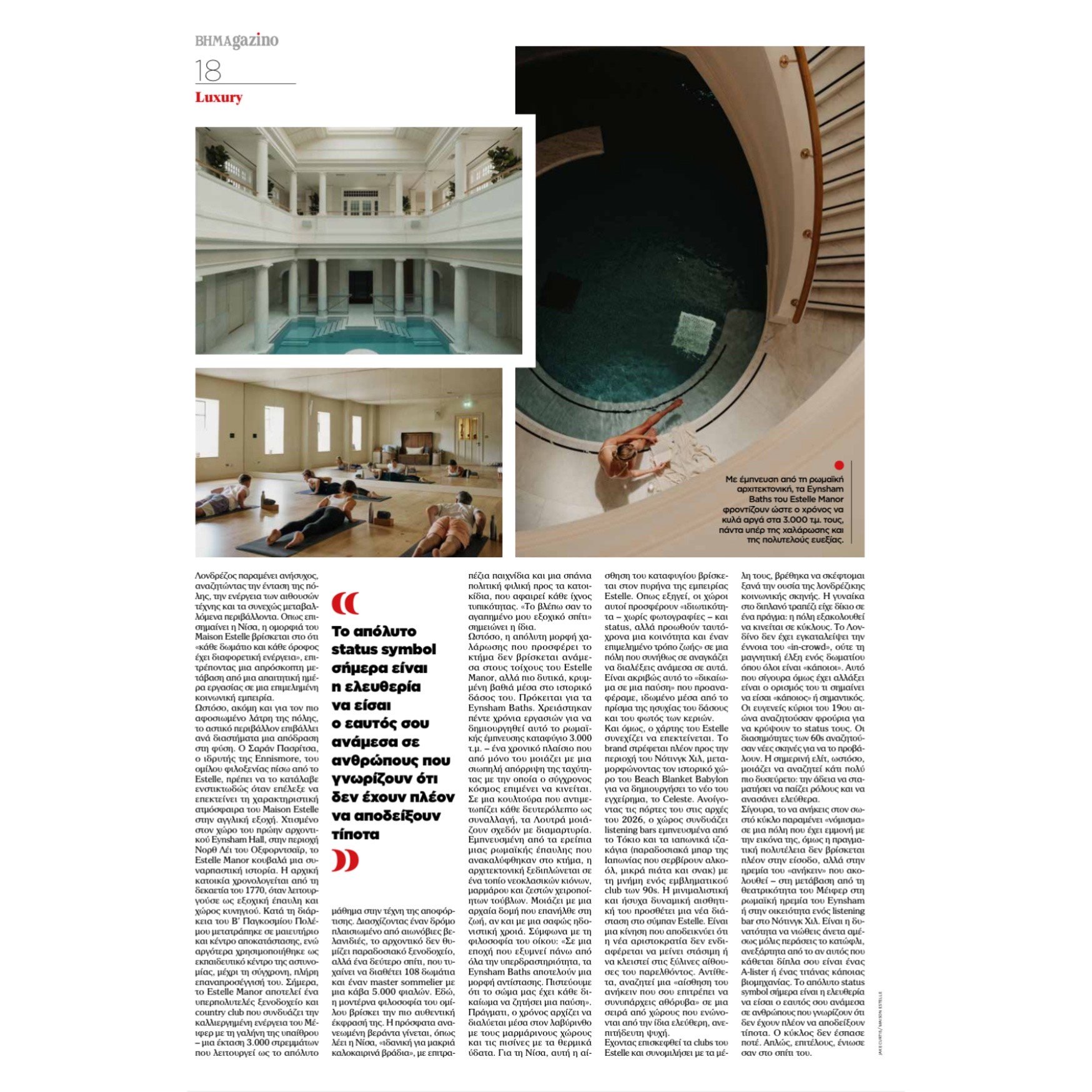
However, the purest form of relaxation the estate offers is not found within the walls of the Manor itself, but further west, hidden deep within its storied woodland: the Eynsham Baths. It took five years to create this 3,000-square-metre Roman-inspired sanctuary - a timeframe that, in itself, feels like a quiet rejection of the speed at which the modern world insists on moving. In a culture that treats every second as a transaction, the Baths feel almost like a protest. Inspired by the ruins of a Roman villa discovered on the estate, the architecture unfolds as a landscape of neoclassical columns, pilasters, and hand-shaped bricks. It feels like an ancient structure brought back to life, though with a distinctly hedonistic edge. As the house philosophy states, “In this time that celebrates busyness above all else, Eynsham Baths is a subversion. We believe it is well within our body’s right to request a short pause.” Within its labyrinth of thermal pools and carved marble spaces, time begins to dissolve: each guest becomes the master of their own ritual, moving through a journey that feels both physical and introspective. For Nisha, this sense of sanctuary lies at the very core of the Estelle experience. These spaces, she explains, offer “privacy, with no photographs allowed, status, community, and a curated lifestyle” in a city that so often demands you sacrifice one for the other. It is, ultimately, that same “right to request a short pause,” set against a backdrop of flickering candlelight and quiet forest views.
And yet, the Estelle map continues to expand. The brand is now turning its attention to Notting Hill, taking over the former site of the legendary Beach Blanket Babylon to create Celeste. Opened in early 2026, the space layers Tokyo-inspired listening bars and Japanese izakayas over the ghost of a 1990s party institution. Its minimalist, quietly confident design adds a new dimension to the Estelle portfolio. It is a move that proves this new aristocracy has little interest in remaining static or retreating into mahogany-lined rooms, but instead seeks a “sense of belonging that settles in quietly” across a constellation of spaces united by the same free-spirited, unstuffy soul.
Having visited Estelle’s properties myself and spoken with its members, I found myself thinking again about the very essence of London’s social scene. The woman at the restaurant was right about one thing: the city still moves in circles. London has not abandoned its appetite for the in-crowd, or the magnetic pull of a room where everyone is someone. But the definition of that “someone” has undergone a radical, quiet recalibration. The gentlemen of the 1880s sought fortresses in which to conceal their status; the socialites of the 1960s sought stages on which to display it. Today’s elite, however, seem to be searching for something far more elusive: permission to stop performing.
In the end, while being seen and entering the right room remains the currency of a city obsessed with its own reflection, the true modern luxury is not the entry itself, but the ease of belonging and being that follows - the shift from the high-stakes theatre of Mayfair to the ancient Roman stillness of the Eynsham woodland, or the Tokyo-inspired intimacy of a Notting Hill listening bar. It is about entering a space where you feel at ease the moment you cross the threshold, regardless of whether the person beside you is an A-lister or a titan of industry. The ultimate status symbol has become the comfort of being entirely yourself among a tribe of people who have nothing to prove, but are quietly, impressively aware that they no longer have to. The circle has not broken; it has simply, finally, made itself at home.